Material World is a weekly roundup of innovations and ideas within the materials sector, covering what’s changing in how fashion is made, scaled or engineered from emerging biomaterials and alternative leathers to sustainable substitutes and future-proof fibers.
Alegensis Labs

Materials science start-up Algenesis Labs has achieved International Organization for Standardization 14001:2015 certification for its Environmental Management System. The internationally recognized standard, according to the EPA, provides a framework to help organizations fulfill environmental obligations and minimize operational impacts.
Related Stories
“By certifying our environmental management systems, we are proving that our commitment to the planet starts within our own walls — ensuring that our growth is managed responsibly and sustainably,” said Stephen Mayfield, chief executive officer and cofounder of Algenesis Labs. The Soleic technology producer’s ISO 14001 certification demonstrates a robust framework for managing environmental responsibilities, including sustainable innovation, material sourcing, responsible waste management and pollution reduction.
Cofounded by a team of scientists, including Michael Bukart, and funded by the Department of Energy to work on biofuels, the San Diego-based company brings algae-based polymers out of the lab and into production.
Nick Sandland, chief business officer at Algenesis Labs, said the certification represents a commitment to partners and customers.
“As we continue to scale our business globally, having ISO-certified systems and procedures in place ensures that Algenesis remains a trusted leader in the sustainable materials market — allowing us to meet the stringent compliance requirements of our global partners across various sectors while future-proofing our operations against a rapidly changing regulatory landscape,” he said.
The certification complements the company’s existing “suite of sustainability credentials,” including REACH compliance and USDA BioPreferred certifications.
The Lycra Company
The Lycra Company has launched Lycra Antistatic, a next-generation fiber engineered with proprietary additives directly integrated into its structure. It was developed to meet growing demand for workwear and personal protective equipment apparel that combines stretch with antistatic performance, the spandex and apparel fiber maker said.
Lycra Antistatic fiber is a drop-in elastane solution for knit fabrics, intended to provide antistatic functionality without changing processing methods. While the Wilmington, Del.-headquartered company filed for Chapter 11 bankruptcy on March 17, Lycra had previously announced plans to attend Techtextil, held this Tuesday through Friday in Frankfurt, Germany.
“Professional workwear and protective apparel must perform reliably every day, in demanding conditions,” said Marc Souto, The Lycra Company’s technical sales manager for southwestern Europe. “By combining antistatic functionality with the comfort, fit and freedom of movement provided by Lycra fiber, we help enable garments that workers are more willing to wear day after day.”
The Lenzing Group
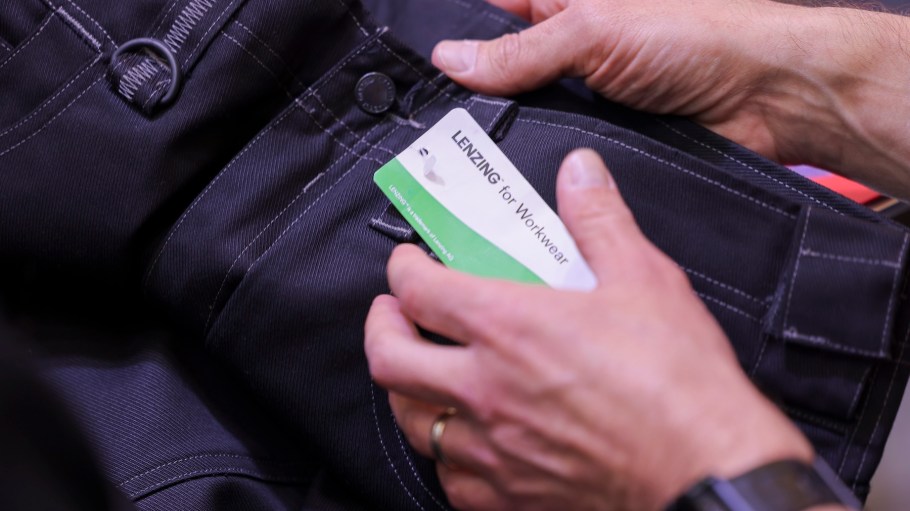
The Lenzing Group presented its latest flame-resistant, or FR, cellulosic fibers under “Wear With Nothing to Hold You Back” at the China International Occupational Safety & Health Goods Expo, or CIOSH, Shanghai.
Lenzing Solutions for Protective Wear combines Lenzing FR and Tencel Lyocell fibers to deliver integrated cellulosic systems for protective wear — intended to enable inherent, hybrid and FR-finished fabric solutions.
“For too long, the protective wear industry has relied on a one-size-fits-all fiber approach,” said Alexander Gstettner, global commercial director of FR fibers at Lenzing. “With PFAS regulations accelerating and workers operating in increasingly demanding thermal environments, we see a clear need for a more structured one.”
Independent testing demonstrated that protective clothing made with Lenzing FR fibers delivered “measurably lower heat stress and supports longer, sustained physical performance compared with conventional FR alternatives,” according to the physiological performance study.
Lenzing’s protective wear business is experiencing its largest expansion since the company debuted inherently FR cellulosic fibers in 1977. The launch coincides with the projected PPE market reaching $130 billion by 2033, according to the Indian market research firm, Fortune Business Insights.
Plus, CIOSH brings together more than 90 percent of the Chinese industry partners for FR alternatives, according to Kevin Sun, the commercial manager of Lenzing’s FR China team.
“We took this opportunity to engage in many productive exchanges with our partners, enhancing confidence and trust under the complex geopolitical situation,” Sun said. “At this event, we debuted our refreshed brand image in China for the first time. Customers generally commented that our new design is clear and elegant, creating a strong visual impact, while the new slogan conveys a strong sense of security.”
Circulose
Circulose has announced an agreement with China Textile Academy Green Fibre, or CTA.
Produced through a solvent-based spinning process, lyocell fibers are valued for their strength and softness. Plus, the closed-loop system makes it an environmentally favorable fiber production method; what Circulose said becomes even more so “when produced from recycled raw material instead of virgin wood.”
CTA and Circulose will offer lyocell fibers in both standard and non-fibrillating grades, produced from Circulose pulp.
Supply will be limited in 2026, with plans to scale capacity for 2027. Selected brands will have commercial volumes in 2026, while others can develop products for access in 2027. CTA will purchase a set volume of Circulose pulp from Circulose, supporting investment and scaling efforts to reduce costs and advance the adoption of circular textile fibers.
“Lyocell is a more sensitive process than viscose, making the use of recycled pulp more challenging,” said Jonatan Janmark, CEO of Circulose. “CTA’s ability to produce lyocell from Circulose is a strong testament to their technical capabilities, as well as the performance of our pulp. We are very pleased to work with CTA to bring this opportunity to our brand partners and are excited by what it means for the broader adoption of circular materials.”
CTA is part of China General Technology Group, a leading research and industrial platform in the region. Based in Xinxiang City of Henan Province, the lyocell fiber producer operates commercial-scale lyocell production facilities and has developed proprietary technologies to advance its fiber variants.
It’s a familiar firm for the Altor-owned company. In March 2023, Renewcell partnered with the CTA — signing a letter of intent outlining an upcoming offtake agreement between the parties.
Techtextil & Texprocess
Techtextil and Texprocess 2026 featured 1,700 exhibitors from 54 countries, showcasing innovations in the textile industry, with a particular focus on performance apparel.
Techtextil featured 1,500 exhibitors from 52 countries, including the Textile Chemicals and Dyes segment and Nature Performance-labeled products. Texprocess featured 200 exhibitors from 28 countries, showcasing new textile processing technologies; its Start-up Stars area connected newcomers with industry partners.
“A good idea that remains in the laboratory changes nothing. A technology that does not scale solves no problem,” said Detlef Braun, a member of the executive board of Messe Frankfurt. “The real lever is the ability to translate innovations into market-ready solutions — from fiber to application, from prototype to product. That is precisely what Techtextil and Texprocess stand for.”
Highlighting the industry’s growing needs, demand for highly functional textile solutions is increasing across sectors, driven by rising investment in security, defense and disaster response. To that end, three examples of innovative protective clothing were presented: a Molotov Cocktail Protective Suit, a UV Protection Jacket and a multi-norm PPE fabric.
“Only through precise, state-of-the-art processing technologies — tailored to the respective fields of application — do innovative materials become high-performance, standards-compliant and production-ready apparel solutions,” said Elgar Straub, managing director of textile care, fabric and leather technologies of the VDMA, a European trade group for machinery and manufacturing equipment.