Circulose is restarting its recycling plant.
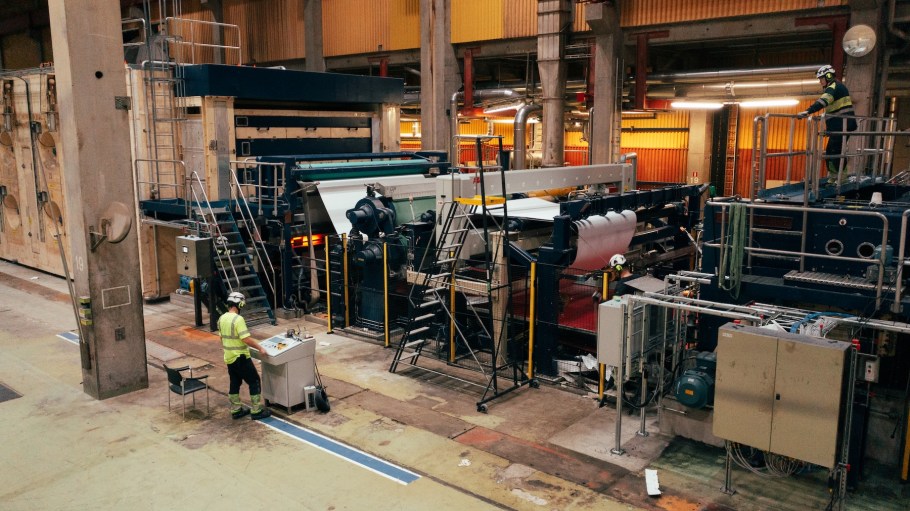
The textile recycler is executing a phased return to commercial-scale production nearly two years after pausing operations at its industrial-scale facility in Ortviken, Sweden. The plant is slated to resume production of its 100 percent recycled cotton textile pulp in the fourth quarter of 2026.
“The preparations are in full swing and new pulp is expected to roll out of the factory by the end of the year—ensuring there is no gap in supply,” said Jonatan Janmark, the Swedish sustain-tech company’s chief executive officer.
Related Stories
Rescued from bankruptcy by Swedish private equity firm Altor in June 2024, the rechristened Circulose—the textile recycler formerly known as Renewcell—churns out new material made from pre- and post-consumer fabrics with high cellulosic content, from tree-based fibers to cotton. In February 2024—the period prior to its bankruptcy—the company paused operations at the Ortviken facility, citing the need to align the production restart with confirmed demand.
“Restarting Ortviken is a major milestone for Circulose and for scaling next-generation materials,” Janmark said. “The fashion industry needs solutions that work at industrial scale and integrate seamlessly into existing supply chains. Circulose is designed to do exactly that.”
The heart of Circulose’s operations is the Ortviken plant, recognized as the world’s first commercial-scale chemical textile-to-textile recycling facility. The plant produces Circulose—a dissolving pulp made from 100 percent discarded cotton textiles—designed to integrate into existing textile supply chains and move circular solutions beyond the pilot phase into sustained industrial production.
To ensure a continuous supply during the transition, Circulose said current orders are being fulfilled using existing inventory produced by Renewcell before the bankruptcy.
“Our plan was to align the production restart with confirmed demand,” Janmark said, adding that the company signed strategic partnerships with fiber producers Tangshan Sanyou, Aditya Birla and Jilin Chemical Fiber. “With commitments from 11 brands, we are now moving forward with confidence,” he continued.
To that end, Circulose has long leveraged the power of proximity through long-standing relationships with Chinese manufacturing powerhouses.
Tangshan Sanyou remains the world’s largest user of Circulose pulp, reportedly accounting for over 40 percent of China’s total viscose exports. The Chinese man-made cellulosic fiber manufacturer was the first commercial producer of Circulose-based fibers—and the first to commit to sourcing significant volumes from the textile-to-textile recycler, former CEO Patrik Lundström said in March 2023.
As a key collaborator since Renewcell’s early days, the Hebei Province-based manufacturer aims to be the first to commercialize fibers containing 100 percent Circulose content. While their partnership dates back to 2019, the companies signed a five-year deal for 175,000 metric tons in 2020, which was increased to 200,000 metric tons in August 2023.
Last April, Tangshan Sanyou said Circulose, backed by Altor and new management, will “bridge the gap between brands and suppliers,” pioneering what it described as a new circular era.
“We have unwavering confidence in the market potential of Circulose and its new strategic direction, and we are excited about our future collaboration,” EVP Zhang Dongbin said at the time.
In September 2025, Circulose entered into a strategic partnership with Jilin Chemical Fiber (JLC) to scale circular viscose filament yarn production. Under the agreement, JLC will exclusively market and sell Jirecell—a viscose filament yarn made from 70 percent FSC-certified wood and 30 percent recycled cotton Circulose pulp—globally from 2026 to 2028, alongside a commitment to purchase annually increasing volumes of Circulose pulp to fulfill its expansion plans.
In response to the news, Nicole Rycroft, founder and executive director of the environmental nonprofit Canopy, highlighted the future- and forest-forward gains to be made for brands and fiber producers avoiding timber inputs.
“As conventional wood sources are increasingly regulated and compromised by climate disruptions, scaling up production of next-gen alternatives is essential for the fashion sector to secure a more resilient supply,” Rycroft said. “Congratulations to the Circulose and Altor teams—along with the brand and producer partners who have stepped forward to anchor their reopening—[for] charting the course for circularity in textiles.”