Material World is a weekly roundup of innovations and ideas within the materials sector, covering what’s changing in how fashion is made, scaled or engineered from emerging biomaterials and alternative leathers to sustainable substitutes and future-proof fibers.
The Lycra Company

The Lycra Company has dropped Coolmax CloakFX.
Related Stories
While the Wilmington, Delaware-headquartered company filed Chapter 11 bankruptcy March 17, Lycra previously shared plans to debut the new material innovation during Performance Days in Munich, held March 18-19.
Designed to help garments appear drier, the Coolmax Cloak technology “diffuses light at the fiber level using optical masking that reduces the visual appearance of moisture,” Lycra said, “helping to make sweat marks less noticeable.” And because that tech is “built into the durable fiber, its benefits last beyond wear and wash, per the producer.
“Visible sweat on apparel is the leading pain point for consumers, often forcing them to compromise,” said Tara Maurer-Mackay, The Lycra Company’s product category director, branded specialty products. “Consumers want one fabric that does it all. Coolmax CloakFX fiber helps garments look drier while keeping them cool and dry.”
Ciclo Technology
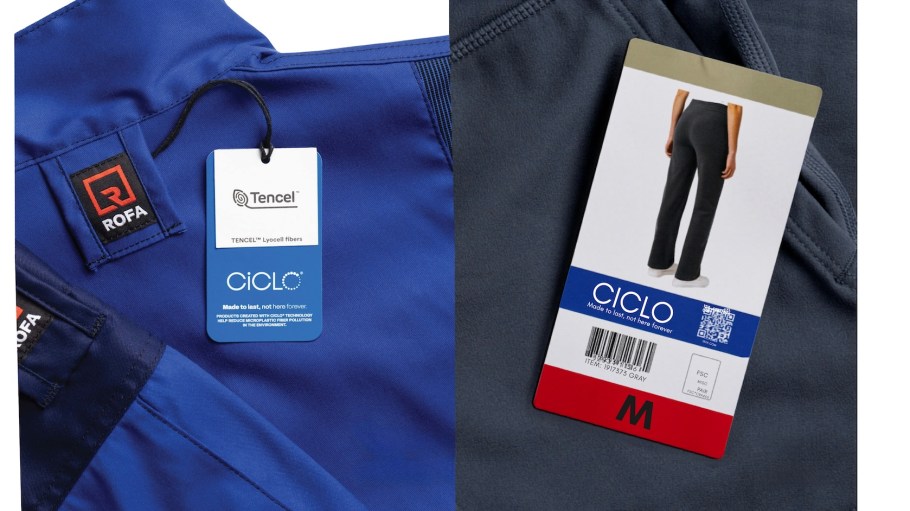
Intrinsic Advanced Materials (IAM) is pushing to broaden adoption of its Ciclo technology additive, a biodegradable ingredient embedded into polyester and nylon fibers, as apparel brands look for ways to curb the long-term persistence of microplastic shedding.
“We are seeing a real shift with brands,” said Andrea Ferris, CEO and co-inventor of Ciclo. “Producer responsibility and circularity are increasingly understood as cohesive strategies that bring more responsible materials and products to market from inception—extending beyond closed-loop recycling alone.”
As Ciclo is added during the fiber production process, IAM said third-party laboratory studies show that Ciclo-enabled fibers can biodegrade in under four years when exposed to seawater, soil or wastewater sludge—leaving behind only naturally occurring elements, according to the Gastonia, North Carolina-based company.
In Europe, Fruit of the Loom incorporated Ciclo polyester into its Iconic Premium and Iconic 250 Sweats collections, including sweatshirts, hoodies and jog pants, designed with durability and comfort in mind for everyday wear.
“With these new sweat collections, we wanted to add value and stand out; Ciclo helped us do that,” said Christian Lanvermann, senior marketing manager for Fruit of the Loom Europe. “It’s a practical way to bring ingredient innovation into everyday apparel while continuing to deliver comfort and durability—and helping address concerns about microplastic fibers.”
In the United States, Black Diamond Equipment introduced Ciclo technology through its Rift Fleece collection, as designed for comfort and outdoor performance. Additional market adoptions, according to IAM, include athleisure apparel at Costco and Walmart, under the Mondetta brand, across North America.
“Ciclo delivers a proven, scaled and affordable solution for the entire existing textile supply chain,” said Cheryl Smyre, vice president of IAM. “Helping brands move beyond intention into speedy adoption is unlocking the power of collaboration and partnership.”
Smyre said responsible material innovation is “at a new level” and that IAM is committed to supporting brand partners as they roll out durable, more sustainable products across market segments.
“We are experiencing an industry urgency to solve the environmental impact of unavoidable microplastic shedding from synthetic textiles,” she continued. “Let’s do better together, for people and planet.”
Thermore
Thermore said its latest “free fiber” insulation—aka featuring no fiberglass or chemical binders—can turn textile waste into warmth.
The thermal insulation developer and producer’s Ecodown Fibers T2T offering was designed for use; it can be blown into baffles, placed inside panels—or applied by hand, Thermore said, noting that its structure was engineered to minimize clumping and remain stable over time.
The Bluesign, Oeko-Tex Standard 100, and GRS-certified insulation features high loft and softness. Ecodown Fibers T2T is made from 100 percent recycled polyester; a “clever blend” of 80 percent post-industrial textile waste and 20 percent post-consumer PET bottles—a combination the Milan-based producer said enables textile-to-textile recovery.
“The theme of circularity and textile-to-textile has long been the subject of study by our team,” said Patrizio Siniscalchi, managing director of Thermore and self-reported coordinator for the company’s research group. “Just as we pioneered the use of recycled fibers from PET bottles over 40 years ago, in recent years we have worked on the revaluation of textile waste.”
Lilysilk
Lilysilk, a silk apparel brand with Gwyneth Paltrow’s stamp of approval, announced the launch of its SilkContour Collection—what the China-based company is calling “no squeeze, just ease.”
The patent-pending, triple-layer fabric comprises 42 percent recycled nylon, 36 percent silk and 22 percent Lycra. Lilysilk said SilkContour’s double-faced knit construction places the nylon outward, for structure, while the silk goes against the skin for comfort; the Lycra, meanwhile, serves as the supportive mid-layer. The trademarked fabric is engineered on precision circular knitting machines for a “uniquely consistent, dense and smooth double-faced hand,” the company continued.
“We spent a long time asking whether comfort could also feel refined,” said David Wang, CEO of Lilysilk. “With SilkContour, we wanted to create something that follows the body’s natural lines without pinching or squeezing. It’s not about reinventing shapewear, but about creating something that simply feels good to wear.”
DSC
Performance foam manufacturer DSC just released new data that puts its Dreamcell Velo in the running to replace the industry-standard poured polyurethane (PU) insole as a fan favorite. Introduced last August, the company formerly known as Dahsheng Chemical dropped Dreamcell Velo, a formulation 60 percent lighter than traditional poured PU. Now, DSC said its offering has emerged as a “clear leader in the performance category” for a poured PU insole, per the technical data.
“Never before was poured PU a solution in the performance conversation—but now, Dreamcell Velo defines it for the elite athlete,” said Mei-Fen Wei, chief operating officer of DSC. “Dreamcell Velo is industry-changing. It not only delivers a premium lightweight experience with newfound speed-focused advantages, but our direct-pour process creates almost zero material waste.”
IFF
International Flavors & Fragrances (IFF) is strengthening regional production and innovation to support the continued growth of its Health & Biosciences (H&B) business in Latin America, one of the New York-based company’s fastest-growing markets.
The effort includes converting the Arroyito site in Argentina into IFF’s first full fermentation‑based enzyme production hub in the region and opening a household care application laboratory at IFF’s Innovation Center in Brazil.
“This is about turning science into impact where it matters most,” said Letícia Gonçalves, president of IFF H&B. “By bringing world‑class fermentation and application capabilities to Latin America, we are accelerating innovation for our customers and translating that into better food, more effective cleaning solutions, and everyday products that improve quality of life for millions of consumers across the region.”