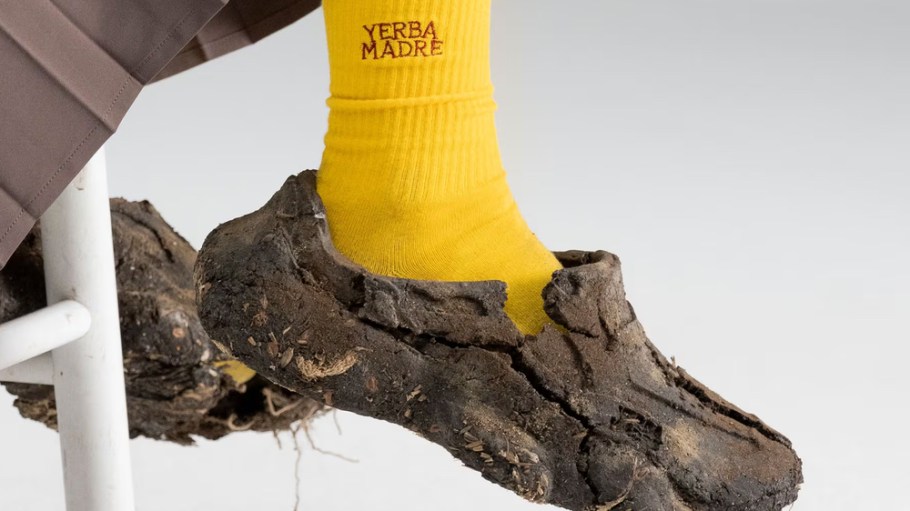
A week ago, Yerba Madre, the organic drink brand formerly known as Guayaki, presented with a sly flourish a pair of Dirt shoes that resembled little more than cracked, molded pieces of muck masquerading as textured clogs.
This was no accident. Designed with New York creative studio Basura, the soil-clad kicks were engineered to break apart as they were worn, scattering wildflower seeds with every step as they returned to the ground from whence they came. “Fully natural and biodegradable” was how Yerba Madre described the footwear, down to the Acacia gum that prevented it from disintegrating the second a foot was inserted. Make no mistake, however, these were shoes that were made to be unmade.
Related Stories
“We got questions like, ‘Why do this?’” said Emily Kortlang, chief marketing officer at Yerba Madre. “It made people scratch their heads. To me, that’s a good thing—because in a way, it mirrors our regeneration message. You have to stop, get curious, dig in. Otherwise, it’s misunderstood. The shoes might seem silly or unnecessary on the surface, but they’re serious in what they represent to Mother Earth and the work we’re doing with the communities who steward it.”
While the Dirt shoes are an evident gimmick, a growing number of footwear brands are using descriptors such as “biodegradable” and “compostable” as serious selling points for their wares. The idea is to create something more durable and lasting than a metaphoric marketing moment. That includes making shoes that won’t fall apart after a few wears, which is a common concern—and misconception.
What these companies are designing for, instead, is a “worst-case scenario,” said Vicki von Holzhausen, founder of von Holzhausen, an L.A.-headquartered material innovation firm that makes a high-performance—and biodegradable—plastic alternative known as Liquidplant using sugar, castor and linseed oils and “some little special ingredients.” If, at the end of a long and adventure-filled life, the shoes wind up in the landfill—as is the case with hundreds of millions of high and low-tops every year, many within the first 12 months of their use—they’ll become feasts for microbes, taking a matter of months or, at most, a few years, to disappear versus potentially never.
The latter scenario is what Will Verona, a footwear design veteran, wanted to avoid when he founded Purified in London using plastic-free, next-gen materials from the likes of Bananatex (made using Abacá banana plants) and Natural Fiber Welding (made using rubber, agricultural byproducts and plant oils) in 2020. He can still recall, in his mind’s eye, the towering “garbage mountain” that eclipsed his field of vision every time he visited suppliers in the Sri Lankan capital of Colombo. This was everything wrong about fast fashion, literally writ large. In 2017, the Meethotamulla dump collapsed on the surrounding houses, killing 32 people.

“I couldn’t help but feel like part of that system, because there’s just no consideration in footwear,” he said. “That’s why we basically started making entirely natural shoes. Because you’re taking from nature. You’re keeping the processes as clean as possible, so at end of life, they can break down over time and safely go back into the soil.”
But shoes are complicated contraptions, made to both protect and perform. A single one can contain as many as 60 components made from wholly disparate materials, including leather, metal, cotton canvas, polyester and closed-cell foam, painstakingly pieced together in as many as 300 steps. “Biodegradifying” an entire sneaker has to take into account not only uppers, insoles, midsoles and outsoles but also more fiddly bits such as heel counters, heel tabs, heel wedges, toe caps, tongues, vamps, eye stays, eyelets, laces, collar linings, glues and stitching.
It’s why von Holzhausen’s 3D-printed Ripple shoe, unveiled last month, is being framed as a “case study” that showcases the versatility of Liquidplant—“the top is a little more flexible and the lower part is squisher,” von Holzhausen said—rather than something you can run out and buy, even though it could conceivably be scaled through injection molding or the supercritical foaming process that Crocs employs.
And it’s also why David Solk, co-founder of the so-called “biocircular” sneaker brand Solk, which he soft-launched at the Global Fashion Summit in Copenhagen in June, thinks that even big guns like Adidas (see: Biosteel) and Puma (see: Re:Suede) haven’t made much headway into biodegradable or compostable footwear outside of “tiny capsules” with limited commercial runs. Solk, he thinks, is the first to crack the code with a chrome-free leather sneaker, dubbed the Fade 101.
This was a tall order, since leather that’s traditionally tanned is very much designed to resist biodegradation, as millenia-old shoes that have been unearthed by archaeologists can attest. Solk also wanted the shoe to compost, which, despite the interchangeability of the term, carries different implications. Any item is technically “biodegradable” given the fullness of time, which can be anywhere from a month to 100 years, he explained. “There are no clear rules around how long it takes, what it leaves behind, or whether it’s actually safe in the end,” Solk said.
“Compostable,” on the other hand, is more specific. The term refers to materials that break down in composting environments, meant to recycle organic matter. The result is something useful: water, nutrients, biomass. More importantly, all this happens without leaving any toxic residue behind. Eventually, however, the company found a tannery in Germany with the help of Darryl Cassingham, a consultant who also operates under the name “Dr. Leather.” As it turned out, it wasn’t so much an issue of doing away with tanning than tanning differently, Solk said.
From that point on, it was a matter of designing out elements. It got rid of the harsh synthetic cements in favor of water-based ones, bolstered with extra stitching using Tencel thread. There are no metal eyelets; the holes are reinforced, again, using Tencel thread. For the aglets—the plastic tips at the end of its Tencel laces—Solk ended up going the DIY route with its own agleting machine, which it feeds pellets of bioplastic into. The sole comprises latex—not vulcanized but “pure poured” rubber. It helps that the company is an offshoot of Shoefabrik, a full-service footwear manufacturer that Solk’s wife owns with a factory in Ho Chi Minh City in Vietnam.
End-of-life management is similarly a family affair. Solk’s in-laws own a 30-hectare farm in Germany, where they have purchased and situated a “really vicious” grinder, painted pink.
“This is where we grind the product,” he said. “So if you want to send your shoes back, we’ll send you a special compostable bag for you to put your shoes in and they come straight back to us. We’ll collect until we’ve got a critical mass, and then my wife’s brother, Uncle Norbert, our chief composting officer, will start grinding.”
The ground-up material is mixed with organic matter—Solk’s weapons of choice are horse manure from the farm next door and coffee grounds from the local Starbucks—and then laid on the fields. Solk intends to test the compost religiously; more often, in fact, than what the German government would require industrial compost facilities. As a further precaution, the takeback bag will have boxes that consumers can check if they’ve applied, say, a durable water repellent treatment on the shoe that might have hinkier ingredients.
Verona, who doesn’t have a grinder, says that “compostable,” as a marketable term, is subject to more regulatory scrutiny if you’re not literally making your own compost. Most home and industrial composting standards require that a product nearly completely degrade within 90 to 180 days. So far, no certification takes into account the unique demands of clothing or footwear. In describing Purified’s shoes, he has to limit himself to saying they promote soil health when they “return to the earth,” lest he run afoul of greenwashing rules. (He can, however, say that they’re worn by “princes and eco-dads.” Prince William donned a pair of the Hevea style at the Earthshot Prize Awards in Cape Town, South Africa, in 2024. It was a pleasant, profile-boosting surprise.)
“I understand why they do that,” he said. “It’s to do with composters or farmers who need a compost to be processed quickly, so they’re not going to take something that will take longer to break down. But these standards aren’t consistent with nature. You know, tree roots don’t break down in 90 days. Seeds don’t break down in 90 days.”
But Purified has run tests that exposed its shoes to soil conditions for 90 days, finding that this resulted in “exceptionally low levels” of toxic chemicals. Tomato and barley plants that were introduced to this soil, Verona said, grew “better” than with regular compost.
“We’ve also trialed things with a U.K. company that basically grows a textile from wheatgrass,” he added. “We sent them our souls to try and grow the wheatgrass on, and we found it reacted really positively. So we’re kind of experimenting whether they could use our soles as a growth mechanism for future textiles, which would basically be a complete closure of the circularity loop.”
Making it to that stage wasn’t easy, however. Latex is naturally dense, which also makes it heavy. What he would have normally done in his previous career to lighten the shoe is core out the inside and replace it with a synthetic foam.
“Obviously, because we’re trying to be fully natural, we couldn’t do that,” Verona said. “And at the time, there were no entirely natural foams that would be commercial to use. There was latex foam, but it was really expensive.”
Purified ultimatey decided to take advantage of latex’s high energy return and design a “comfort system” around it to cosset the foot even more. But this involved much trial and error to get right, particularly since latex is a difficult material to extract from a mold. Make it too thick, and stitching wouldn’t penetrate. Render it too thin and it would crack. And just because a material looks like animal leather, it doesn’t mean it behaves the same way.
“We had to work out what is the optimum backer on the textile? What are the tension settings of stitching?” Verona said. “We had to figure out how to last it, how it reacts to heat and moisture, things like that. It all took a long time to really get into the nitty gritty of things.”
Similar to von Holzhausen’s Ripple, San Diego’s Algenesis Labs uses its Blueview range as a proof of concept for its Soleic compound, a proprietary polyurethane foam derived from plant-based feedstocks. Unlike Ripple, however, the boat shoe-like Blueview Pacific—dubbed by Algenesis Labs as the world’s first fully biodegradable shoe—is available for purchase. Soleic makes up the insole, cupsole and outsole. The rest of it consists of a knit upper made from hemp, cotton and lyocell yarns.
“Every part of it is fully biodegradable,” said Sandra Watts, director of marketing at Algenesis Labs. “You can take it, put it in your home composter, sprinkle it in your garden after a year and then eat the vegetables. There are no lingering microplastics.”
While the footwear doesn’t meet California labeling requirements for compostability—the threshold is a tighter 60 days—because the Blueview Pacific needs at least seven months and up to two years to fully degrade, it’s “better than sticking around for hundreds of years,” she said. Legislators, Watts added, to have a tiered system that accounts for non-food or packaging items.
Even so, Blueview is a side hustle rather than an attempt to take the market by storm. Algenesis Labs is also receiving an increasing number of inquiries about Soleic. Despite the threat of more tariffs putting many footwear purveyors in survival rather than innovation mode, smaller companies could swoop in and grab market share because “the trend is definitely going towards biobased and fully biodegradable shoes,” Watts said.
Not everything needs to be compostable, either, said von Holzhausen, whose company will be releasing data about how many days its Liquidplant material takes to degrade in landfill conditions in the coming months. It’s the “reality” of people throwing away their shoes that she wants to tackle.
“A lot of times, neighborhoods don’t have the pickup for industrial composting,” she said. “So we didn’t think that that was as much of a relevant problem to solve. Biodegradation, for us, happens in a landfill, which is the normal scenario for the plastics that we’re looking to replace. Compostability…maybe that’s more important for a commodity-based plastic, not a performance-based plastic.”
Determining how much biodegradable-slash-compostable shoes will cost can be an exercise in and of itself. Purified didn’t want to price itself into a niche, which means that margins are fairly slim, even with a more streamlined production process that takes place in Portugal. Its styles start at $148, though a sale that is currently underway puts the Hevea that the Prince of Wales donned at a more affordable $103.
When Solk launches in September, the Fade 101 will run around $250, with future leather-free options poised to come in lower and future economies of scale suppressing prices even more later on. The Blueview Pacific, which is made in Vietnam, is a relative steal at $80, or between 10 and 30 percent more than a conventionally made counterpart, Watts estimated. It comes in seven colors, including vintage black and aquamarine denim blue.
Von Holzhausen said that what makes Liquidplant so special is that it’s “within the scope” of the cost of a petroleum equivalent while providing the same performance level.
“We’re in line with some of the high-performance polyurethanes that are used for casting in the shoe industry,” she said. “So it’s really not some exotic polymer that nobody can afford. We really want this to be a mass-adopted material, and that was part of the formula. Like, we changed our formula in order to tune it for cost.”
Questions might yet abound about the wisdom of allowing resource-intensive materials to simply vanish into the ether, even if they might end up making up a tasty pasta sauce. “Recycle,” after all, is the third of the three “R”s. Circularity also remains a North Star that is heavily tied with the broader industry’s decarbonization ambitions, no matter how plagued with hurdles that require transformative changes to reverse logistics systems and sorting and processing infrastructure.
But shoes, again, are complex, even more so than clothes that might only have a few buttons or trims to contend with. Designing for recyclability, Solk said, requires focusing on material separation or mono-material construction, both of which are already big design challenges. When it comes to sneakers, it “gets even trickier,” he added. “To recycle all the different components properly, they’d need to be taken apart first.”
Soleic is recyclable, though von Holzhausen would prefer that a brand partner takes the lead with a takeback program. Blueview could also take back its shoes for recycling, though it “hasn’t gotten that far yet,” Watts admitted. Natural Fiber Welding, which supplies many of Purified’s materials, does have a process in place to recycle industrial offcuts, so it’s about “having the right logistics in place,” Verona said.
“At the end of the day, if something’s going into the soil and breaking down, we have to consider that we’ve put a lot of processes in there already,” he said. “So yes, it’s ‘better’ waste than the alternative of doing harm to the environment, but it’s still waste. If we can recycle it and provide further uses, that’s got to be a level above.”
In the end, Solk decided to double down on “biocircularity.” Instead of designing something that needs to be disassembled to be recycled, the company asked itself how it could create a shoe that could break down safely, as is. The concept, Solk said, combines “everything we were looking to create: a beautiful, comfortable shoe that’s safe at the end of its life and can be processed in one piece.”
“I’ve probably put tens of millions of pairs of shoes into this world through Shoefabrik, including for big fashion companies, and my daughter, who was 12 or 13 at the time, was questioning that,” he said. “That was a little bit of the spark for that.”