Innovation is increasingly the textile industry’s go-to answer to a messier operating environment—economic uncertainty, geopolitical volatility and tighter investment conditions that leave little room for business-as-usual bets. That reality was underscored at Heimtextil 2026 in Frankfurt, Germany, this week.
But how can innovation thrive amid upheaval? According to the parent trade organization Messe Frankfurt, Techtextil and Texprocess 2026 will provide the answers.
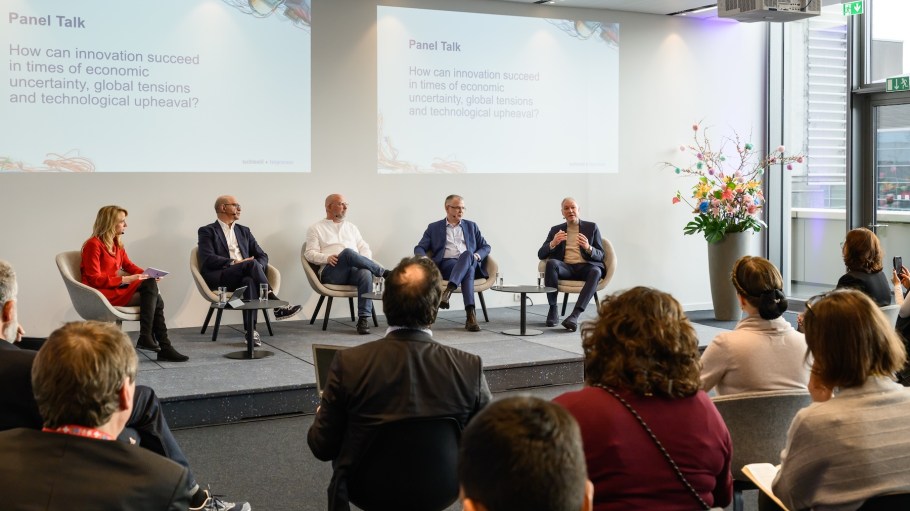
During a panel hosted by sustainability moderator Merle Becker, industry heavyweights explored how the sector’s transformation—from artificial intelligence (AI) and automation to sustainable materials and digital development processes—is becoming a strategic resource.
Related Stories
In a nutshell? Innovation was framed as less than a nice-to-have and more as the mechanism that’s keeping transformation on track when capital and confidence are constrained.
“Especially in times of restrained investment, it becomes clear just how crucial innovative strength is,” said Olaf Schmidt, Messe Frankfurt’s vice president of textiles and textile technologies. “Techtextil and Texprocess are the places where ideas are not only presented but further developed into market-ready solutions; the Innovation Awards make this innovative strength tangible—giving new technologies visibility, credibility and often the decisive impetus needed to turn research into concrete industrial applications and partnerships.”
The VDMA, a European trade group for machinery and manufacturing equipment, emphasized how companies can remain competitive despite global challenges.
“Today, innovation serves both as a lever for efficiency and a driver of growth,” said Elgar Straub, the VDMA’s managing director of textile care, fabric and leather technologies. “Digitalization, automation and AI enable companies to conserve resources, produce flexibly and reposition themselves more effectively and competitively.”
The extent to which digital processes are already transforming development and production was illustrated by insights from industry practice. From virtual prototyping to real-time supply chain monitoring, these digital tools can optimize efficiency while enabling greater manufacturing customization and flexibility.
“Three-dimensional design, virtual prototyping and AI drastically shorten development cycles and reduce material use,” said Walter Wählt, senior director of advanced creations, apparel pattern and digital creation, at Adidas. “Yet despite all the technological momentum, people remain decisive—creativity, experience and judgment cannot be automated.”
That momentum is distilled in the Techtextil and Texprocess Innovation Awards, which serve as a concentrated showcase of the ideas and technologies pushing the industry forward. By highlighting practical, scalable solutions—rather than theoretical concepts—the awards spotlight the tools and approaches most likely to drive the textile sector’s next phase of change, per the panelists.
The vital role that research and advanced materials play in making sustainability viable was also underlined.
“Sustainability, particularly when applied to high-performance materials and products, only becomes economically viable through a virtuous tandem of research and innovation. Recycling technologies, circular solutions or entirely new materials are meaningless if they remain confined to the lab,” said António Braz Costa, general manager of Portugal’s Technological Centre for Textiles and Clothing (CITEVE) organization and chairman of the Techtextil Innovation Award. “What matters is their translation into real industrial processes.”
The awards knit these shifts into a sharper snapshot of where the industry is headed. They show technical textiles, nonwovens and textile processing as moving forward with AI, next-gen materials and cleaner production—signaling that innovation is no longer optional but a competitive edge. The winning projects also capture what both trade fairs are trying to do: connect research, technology and real-world application so promising ideas become market-ready solutions to global problems, according to Braz Costa.
“Trade fairs such as Techtextil and Texprocess—and the Innovation Awards themselves—are critical in bridging research and the market,” he said.
Techtextil and Texprocess 2026 will take place from April 21-24, with the winners of the Techtextil and Texprocess Innovation Awards announced the week prior.