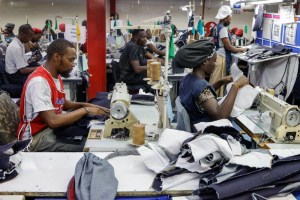
Like it or not, artificial intelligence (AI) is rapidly transforming the textile industry, from creation and production to pricing and communication.
This year’s edition of the international trade fair Heimtextil, held annually in Frankfurt, Germany, will explore these transformations and how the textile sector can successfully implement AI—without stripping value from creators (or consumers).
“In a dynamic market environment, the global textile industry relies on Heimtextil. While AI is transforming markets, Heimtextil shows how companies can benefit from this technology,” said Detlef Braun, managing director and member of the executive board of Messe Frankfurt. “As a strategic partner, it highlights business opportunities and future prospects—laying the foundation for potential growth.”
Related Stories
Since 1949, Messe Frankfurt has been an “established partner” for some 250 guest events a year at its Frankfurt headquarters, which has been certified under the Eco Management and Audit Scheme (EMAS) since 2023. The holistic Heimtextil program, held Jan. 13-16, offers both finished home textile products and raw materials and fabrics for manufacturing home goods. The fair regularly draws a global crowd of exhibitors and buyers; grouped under the umbrella of the Texpertise Network, Messe Frankfurt’s international events attract some 23,000 exhibitors and 500,000 trade visitors annually.
“We’ve had some rusty times, I must say,” Braun said. “In 2025, we faced a major complexity of challenges and, honestly, in my professional career—which now spans over 40 years—I have never, ever experienced such complexities.”
As the largest international trade show for home and contract textiles, Heimtextil has been a partner of the UN Fashion and Lifestyle Network—and the UN Office for Partnerships to highlight the Sustainable Development Goals at Messe Frankfurt’s global textile events—since 2019.
“We truly believe that Heimtextil is the place where people connect across industries, across markets, across countries to exchange, to learn and definitely to move forward,” said Ivonne Seifert, Messe Frankfurt’s director of marketing communications for textiles and textile technologies. This year’s program, she continued, is focused on one main topic: How can we stay future-ready? How can we do business in an ever-changing world?
“One of the key drivers—politics aside—is artificial intelligence; everyone is talking about it and, at Heimtextil, AI is becoming very visible, very technical—you’re going to see it in the processing and the practical applications of the industry as well,” Seifert continued. “At the same time, Heimtextil stands firmly for what defines textiles: for innovation, for high-quality materials, for craft and definitely for human creativity.”
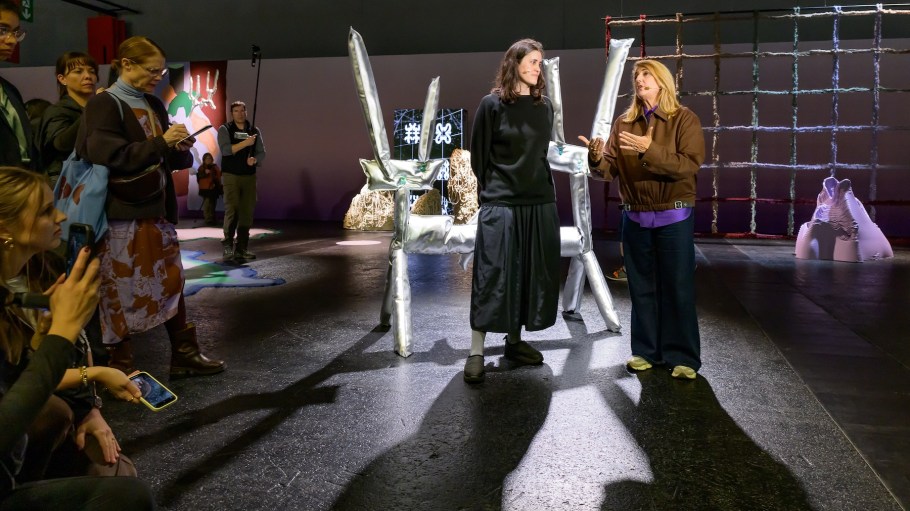
The 2026 edition kicked off with Patricia Urquiola’s “Among-All” installation: the celebrated architect, industrial designer and art director’s design exploration of what happens when humans themselves become part of AI-based creation.
Combining futuristic textile elements with sustainable materials and AI technologies, the next phase in an ongoing exploration of textile thinking examined “how textiles can function as transformative and intelligent materials and actively involves visitors in the spatial staging,” the trade organization prefaced.
“‘Among-All’ is the second chapter of our research on textiles, developed through objects, processes and spatial experimentation,” Urquiola said. “This new landscape listens and responds, inviting visitors to gently activate the space through their presence.”
Heron AM, a large-format robotic additive manufacturing (LFAM) platform by Caracol AM, was used to produce a 3D-printed portal made from Econyl chips by Aquafil to “welcome visitors into a future-facing design world.” A large LED wall with motion sensors detects movement. It uses AI to “morph visitors into hybrid beings.” In contrast, a hybrid sculpture introduced a material contrast with the synthetic fibers to highlight the project’s circular approach. It’s made with Ohoskin, the Italian company’s flagship fiber and the first patented material made from orange and cactus by-products.
“Rather than a container, the exhibition takes the form of a temporary ecosystem,” Urquiola said. “Bringing together installations made from regenerated nylon, textile waste and biobased materials.”