Sustainable trims have gained momentum in recent years as brands and suppliers begin to confront one of fashion’s more functional blind spots: the small components (and the data attached to them) that keep garments together—and determine whether a garment can be recycled or recovered.
As regulatory pressure intensifies and supply chains grow more complex, a fragmented landscape of traceability tools has made it increasingly difficult for brands to manage product-level transparency.
Related Stories
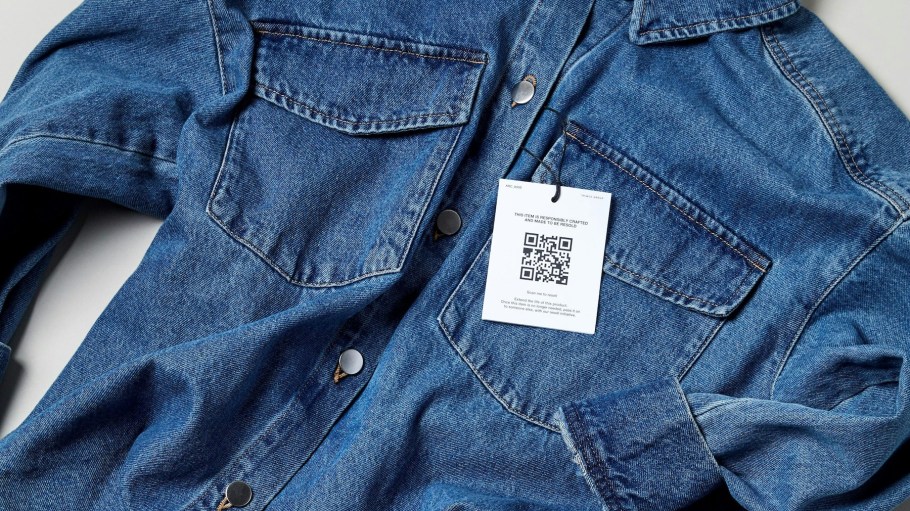
Against that backdrop, Trimco Group has partnered with Retraced to deliver an integrated transparency solution linking upstream supplier data directly to on-product labeling.
The collaboration connects the Software-as-a-Service (SaaS) company’s supply chain intelligence platform—which enables brands to map suppliers, manage sourcing data and validate claims—with Trimco’s labeling, packaging and RFID infrastructure. The result: verified supply chain data embedded into physical products via QR codes, allowing access to structured information for consumers, retailers and regulators.
“Transparency only creates value when it is accessible, structured, and connected to the physical product,” said Camilla Mjelde, sustainability and compliance director at Trimco Group.
The partnership reflects a broader industry shift toward consolidating traceability systems and preparing for regulatory frameworks such as the Ecodesign for Sustainable Products Regulation (ESPR), which will require more robust product-level data.
If that’s the digital backbone, manufacturers are now racing to fix the physical side of the equation.

While industry attention has historically centered on fabrics, trims—ranging from fibers and elastics to zippers and labels—can account for more than 40 percent of a garment’s bill of materials. Despite this significant share, trims remain among the least-addressed barriers to circularity.
Harnest, a vertically integrated manufacturer in Bangladesh, strives to bridge the gap with its Responsible Trims Collection. The platform brings recycled, next-generation and biodegradable trims into existing supply chains at cost parity with conventional options, partnering with material innovators including OceanSafe, Ambercycle, BlockTexx, Indorama Ventures and Jiaren to connect innovation and scalable production.
“Trims are one of the most overlooked constraints in circular fashion,” said Assef Shaikh, CEO of Harnest. “Brands may focus on the main fabric, but the threads, elastics and labels within a garment also influence whether it can be more effectively recovered, recycled or redesigned for lower-impact outcomes.
The collection’s first material is OceanSafe’s naNea. The synthetic polymer alternative to polyester can biodegrade in marine environments without leaving a trail of microplastics, according to the company. NaNea can also be recycled with PET—offering timelines and pricing structures similar to traditional trims.
With these materials embedded in its vertically integrated manufacturing platform in Dhaka, Harnest aims to move circular trims beyond pilot-stage experimentation into industrial-scale production.
At the same time, legacy component suppliers are scaling their own sustainability transitions.
YKK Corporation said its Natulon zipper series—made with recycled materials—has surpassed 50 percent of its global zipper sales, reaching 56 percent by the end of fiscal 2025. The milestone denotes a sharp increase from 3 percent in 2019, prior to the Japanese fastening manufacturer’s accelerated push under its Sustainability Vision 2050.
Natulon products use recycled materials without compromising performance and can generate roughly 20 percent fewer greenhouse gas emissions during production versus conventional alternatives. According to lifecycle assessment (LCA) data, a standard Natulon coil zipper can generate roughly 19.6 percent fewer greenhouse gas emissions during production compared to conventional alternatives.
“As a true sustainable partner that goes beyond being a manufacturer of parts, we will continue working alongside our customers to help build a circular economy,” said Yasuhiro Sato, vice president of product strategy at YKK. “Going forward, we will aim to create a circular society for apparel by further increasing the share of Natulon series zippers in global sales, as well as developing zippers that can be easily recycled along with the garments themselves.”
Such developments represent a move toward making circularity a standard practice rather than a pilot-stage experiment.