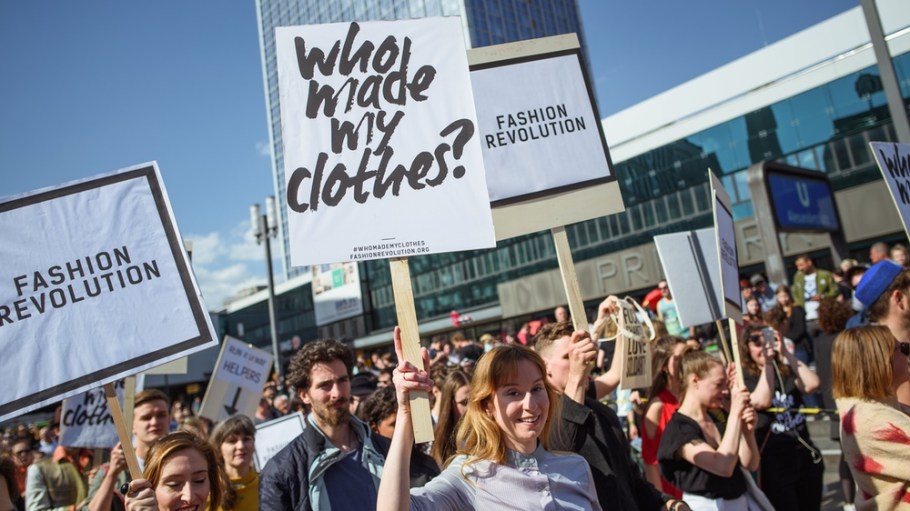
Nearly 12 years after Fashion Revolution ignited a global movement with a single yet explosive question, “Who Made My Clothes?,” the activism group is facing a reckoning of its own.
Founded in 2014 by British designers Orsola de Castro and Carry Somers to commemorate the more than 1,130 garment workers who died in the Rana Plaza building collapse in Bangladesh the previous year—and to rail against the forces behind it—Fashion Revolution is shutting down its London headquarters in favor of decentralized governance among its global affiliates.
Related Stories
The organization has sought to downplay the news, sharing it on LinkedIn on Thursday rather than issuing a formal press release or splashy social media post to avoid detracting from Fashion Revolution Week. The annual event, which evolved from Fashion Revolution Day into a longer period for grassroots organizing, policymaker engagement and awareness-raising, begins April 24, the anniversary of the disaster. Focusing on the theme of “collective action,” the “seven days of action,” including Mend in Public Day on April 25, will take place in more than 80 geographies worldwide.
Now groups in countries like Australia, Brazil, Kenya, Spain and the United States will gain greater autonomy as the nerve center known as Fashion Revolution CIC—the acronym stands for Community Interest Company, a U.K. designation for social enterprises—prepares to dissolve.
De Castro, who with Somers stepped away from her directorial role in 2022, said she always envisioned Fashion Revolution to be run as a decentralized organization, and that was one of the reasons she left.
“I very much believed that Fashion Revolution should not be run by a U.K.-based team, but that it should really focus on the global teams; that was always my pride and that was always my vision,” she told Sourcing Journal. “So, the fact that the CIC is closing, I think, is indicative of a very natural progression of Fashion Revolution, which ought to be decentralized and ought to be run by the people who know what needs to happen in their own countries. As far as I’m concerned, this is great news. I look forward to the new beginning rather than the old closure.”
Still, the move comes amid increased fragility in the fashion activism movement as economic shifts and global headwinds threaten to roll back hard-won labor and environmental gains from the past decade.
It was only in February that Remake, the San Francisco watchdog behind the #PayUp and #NoNewClothes campaigns, shuttered after failing to secure sufficient, sustainable funding—a consequence it blamed on the “growing pushback against the corporate accountability measures we fought so hard to establish.” The Clean Clothes Campaign, the garment industry’s largest consortium of trade unions and civil society groups, too, laid off at least 15 staffers in its Amsterdam and Belgium offices last year after the Dutch government declined to renew financing that accounted for 40 percent of its budget.
Once a 400-person-strong organization, the Solidarity Center—the largest U.S.-based international workers’ rights organization—axed more than half of its employees, downsized or closed one-third of its 30-plus field offices and prematurely ended programs after Elon Musk’s so-called Department of Government Efficiency gutted U.S. Agency for International Development, State Department and Labor Department funding in the name of fraud elimination.
Money woes also appear to have driven Fashion Revolution’s decision.
“Despite the appetite we have witnessed for industry change across public supporters, collaborators, partners and funders, after careful consideration of the current funding and operating context, the CIC has decided to wind down its operations,” it wrote on LinkedIn. At the same time, it added, its mission—the need for a “clean, safe, fair, transparent and accountable” fashion industry—has “never been stronger.”
Fashion Revolution also leaves behind a rich legacy. Beyond a dozen Fashion Revolution Weeks, the organization spearheaded a European Citizens’ Initiative demanding living wage legislation at EU level for garment workers worldwide, collecting over 240,000 signatures from the bloc’s citizens in 12 months.
It published an annual Fashion Transparency Index ranking 250 of the world’s largest fashion brands on their disclosures regarding social and environmental policies, supply chain traceability and impact, finding that just over half—52 percent—disclose their first-tier suppliers. (“Transparency is a first step; it is not radical, but it is necessary,” it has said.)
Most recently, the nonprofit turned its sights on the climate crisis with “What Fuels Fashion?”—a pair of reports of 200 global giants revealing an industry still heavily reliant on fossil fuels. This strategic shift stemmed as much from necessity as conviction, a Vogue Business story published Thursday suggested: There was more funding available for environmental research. Still, it didn’t seem to have been enough.
But the movement persists, Fashion Revolution said, even if it will look a little different.
“Fashion Revolution’s next phase will be carried forward through the strength of its Global Network, with stronger local leadership and continued global coordination,” it said. “We hope this next phase strengthens collective commitment to transforming the fashion industry and enables the movement’s work to continue with renewed focus and shared ownership.”
For de Castro, the work continues because it has to. With the 13th anniversary of Rana Plaza looming, she knows what she’ll be doing.
“As always, on the day of the Rana Plaza anniversary, I will be thinking about the people who perished and the ones that were maimed in that disaster and in every other industrial disaster that has happened because of our greed and because of our lack of transparency,” she said. “And this is not mission accomplished at all. However, it is at least mission evidenced. We know that not enough has changed, but we also know that we are escalating toward bigger problems.”