If fashion’s labor movement feels diminished of late, it’s through no fault of its own.
Blame Hurricane DOGE’s landfall a year ago. By the time Elon Musk’s so-called Department of Government Efficiency was done wiping out foreign aid budgets that undergirded programs rooting out child and forced labor and otherwise promoting decent working conditions worldwide, once-vital initiatives that served as the industry’s conscience had been greatly depleted.
“None of this needed to happen,” said Shawna Bader-Blau, executive director of the Solidarity Center, a Washington, D.C.-based nonprofit whose work in 70 countries is running at less than half of its original strength because of the effective dissolution of the U.S. Agency for International Development, or USAID, and the cancelation of grants from the Labor Department’s Bureau of International Labor Affairs, better known as ILAB.
Related Stories
“In so many countries, wealth and political power are concentrated in the hands of the few,” she said. “Working-class people organize unions and engage in collective action to hold corporate and political power to account and expand democracy for average citizens. The programs that were terminated helped them do that.”
But it’s not only the United States that is pulling back. European countries like the United Kingdom, the Netherlands and Sweden are also reducing their largesse to prioritize domestic interests, including increased military spending. This has created knock-on effects that have been similarly devastating.
Take the Clean Clothes Campaign, the garment sector’s largest consortium of trade groups and civil society organizations. After the Dutch government declined to re-up financing that made up at least 40 percent of its budget, it let go of half of the roughly 30 staffers at its international offices in Amsterdam and Brussels at the close of the year.
This means the watchdog group will have to streamline some of its advocacy work, which has included calling attention to wage theft, urging greater accountability from brands for workplace accidents and demanding the release of activists jailed for organizing for better conditions.
“You will see a much more fractured, divergent set of actions and campaigns and responses, which is to nobody’s benefit,” said Ineke Zeldenrust, international coordinator of the Clean Clothes Campaign.
Zeldenrust doesn’t expect the organization to move away from its “core” purpose: the struggle for decent wages. But climate change is also becoming an unignorable concern in garment-producing regions as extreme weather exacerbates heat stress in factories and fuels humanitarian crises such as flooding and drought. There are also issues with automation that could lead to job loss and tech surveillance “being sold” as workers’ voice tools that “we’re only beginning to understand,” she said.
“I was also just reading about plastic-recycling workers in Turkey, and it’s horrendous because it’s completely invisible work,” Zeldenrust said. “And I know that the same is happening in textile recycling. Those are the kind of things that I think, as a network, we are uniquely placed to map and expose. So we’re looking for new types of funders, including individual donations and small funds, to build that.”
A ‘weakened ecosystem of worker power’
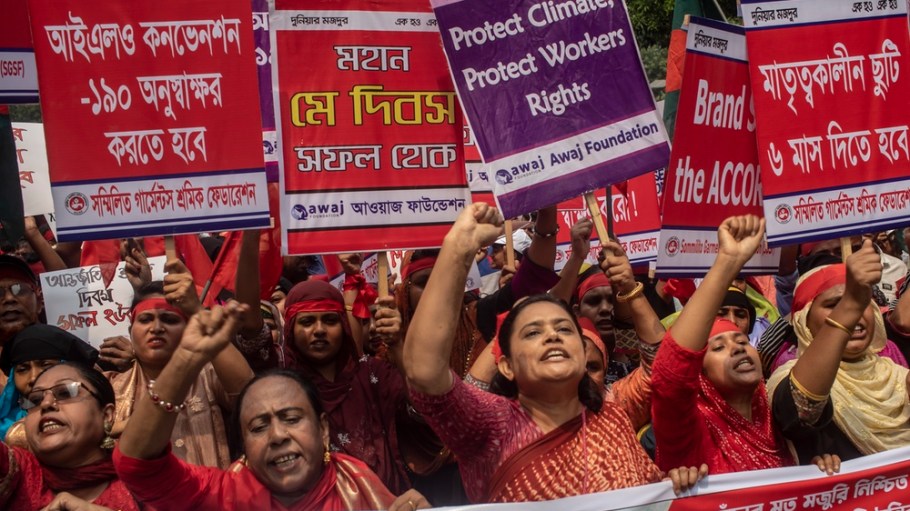
If nothing else, 2026 will be a “stress test” year for the industry, said Kalpona Akter, executive director of the Bangladesh Center for Worker Solidarity. The grassroots group had to lay off seven employees after losing downstream funding from the Solidarity Center, but it’s still trying to keep all eight of its offices in and outside of Dhaka open because otherwise “workers will have nowhere else to go.”
“The risk is not only fewer programs,” she said of the cost-cutting. “The risk is a weakened ecosystem of worker power. Without independent resources, unions and labor groups are pushed toward short-term, brand-controlled or consultancy-style projects that rarely challenge the core business model.”
Geopolitical turbulence, logistics disruptions and changing trade alliances will filter down to the factory floor in the form of longer hours, tighter production targets, unstable employment and an ever-shrinking space for workers to organize, she said. The question isn’t whether the industry will survive the volatility because “it always does,” Akter said, but whether workers will be protected from “becoming its shock absorbers.”
Bangladesh, whose “Liberation Day” tariff rate was negotiated down from a hefty 37 percent to 20 percent in August, is set for another inflection point: elections on Feb. 12, the first since its authoritarian leader, Sheikh Hasina, was ousted from power in 2024. It’s a moment in history that is as fraught with peril as it is opportunity. The next government, Akter said, will inherit an industry that “generates billions in exports while millions of workers still struggle to survive on minimum wages far behind living costs.”
Even countries that escaped the worst of the Trump administration’s “reciprocal” tariffs and can bank on preferential access to alternative markets like the European Union will struggle, said Khalid Mahmood, director of the Labour Education Foundation, a workers’ rights group in Pakistan.
“These advantages are not translating into better lives for workers,” he said. “Instead, the dominant business model still leans on low wages, excessive working hours, weak enforcement and restricted worker voice.”
In many large factories, workers are treated like “extensions of machines,” Mahmood said. With inflation continuing to squeeze margins, this is unlikely to change. Meanwhile, the dearth of funds from USAID, ILAB, and others means fewer resources for independent training, legal aid, worker-centered monitoring, and organizing support—which, in turn, reduces capacity to document violations, bargain collectively or champion equitable wages and workplace safety.
“When financial pressures on suppliers rise, labor abuses rise with them,” agreed Scott Nova, executive director of the Worker Rights Consortium in Washington, D.C. “The tariffs drive pressure, and though there is legal uncertainty, the high tariffs are likely, in some form, to be a factor in 2026. But it is apparel brands that negotiate prices with suppliers, not the U.S. government, and brands have been squeezing suppliers for decades.”
As such, tariffs exacerbate a deeper problem, he added: Brands’ pricing practices perpetuate labor abuse, rendering their own labor rights promises meaningless.
“It is money that matters, not words,” Nova said. “Unless brands reform their pricing practices, labor rights abuses at their supplier factories will worsen in 2026.”
It’s short-term sourcing decisions that exclude suppliers and workers from the process that “quickly translate” into factory closures, layoffs and pressure on wages and safety, said Annabel Meurs, executive director of the Fair Wear Foundation, a multi-stakeholder organization in Amsterdam whose brand members include Acne Studios, S.Oliver and Nudie Jeans.
“The companies that are coping best are those that approach sourcing decisions collaboratively and proactively through embedding responsible purchasing practices and meaningful worker engagement into their core operations,” she said. “These are early-warning systems in practice: when workers and suppliers are part of the conversation, risks are identified and harm can be prevented rather than repaired.”
When workers’ capacity to negotiate for better wages and employment conditions deteriorates, so too do the risks increase for “everyone in the supply chain,” Meurs said. It also increases the responsibility of businesses to ensure workers “still have access to representation, remedy and safe channels to raise concerns.”
“At Fair Wear, we saw that brands that had invested in due diligence and supplier relationships were better able to navigate disruption, for example, during changing tariffs in 2025, earthquakes, political unrest and the pandemic,” she said. “The lesson for 2026 is clear: when companies invest in worker engagement and risk-based due diligence, they build resilience even when external funding declines.
‘Like relying on magic‘
Even so, with the White House’s tariffs “causing havoc” in terms of job losses for garment workers in countries where the figure is high—India and its until-recently 50 percent burden being one—Sarosh Kuruvilla, professor of industrial relations and Asian studies at Cornell University, expects “no real change” in the rights of garment workers for the foreseeable future because “fewer garment workers will have jobs.”
And even if the funding cuts didn’t directly impact particular groups of garment workers, they may have affected programs that were “tangentially related” through the weakening of the Solidarity Center and others, he added. This would erode standards and conditions in countries like Cambodia, Lesotho, Eswatini or Ethiopia.
Another disquieting trend: changes to the EU’s corporate sustainability due diligence directive that have left all but the largest companies off the hook for social and environmental abuses across their value chains.
“It has been quite terribly weakened in that we will not see any pressure on European companies to improve human rights in their supply chains,” Kuruvilla said. “All in all, not a very good scenario for workers’ rights in global supply chains.”
Bader-Blau, whose organization teamed with Global March Against Child Labour and the American Institutes for Research in April to sue the Labor Department for what they described as the “unlawful termination” of the ILAB grants, has continued to question the actions of the past year.
In one country, she said, a local government official told women unionists that they no longer needed to negotiate workplace safety issues with them because “the Solidarity Center lost its grant here, so no one is backing you anymore.”
This isn’t “America first,” Bader-Blau said. When garment or other manufacturing workers in Honduras or Bangladesh are forced into unsafe, underpaid jobs with no meaningful rights, it drives a “race to the bottom” that undercuts wages, standards and job security for everyone, including American workers, who now have to compete on a far less even playing field.”
“Unions are often one of the few democratic institutions workers have, a way to exercise free association, speak collectively, and hold power accountable,” she said. “When those rights are weakened, you are leaving workers to rely on the voluntary goodwill of companies and governments to ensure labor standards are good and salaries rise toward a real living wage, which is like relying on magic.”
Mahmood sees some bright spots, such as the Pakistan Accord’s health and safety program, which is currently developing a heat stress protocol. But even that will remain limited if workers are too afraid to report harassment and abuse and if factory committees are formed without independent worker representation, he said.
“Unless brands and suppliers stop substituting unions with management-controlled participation structures and instead commit to freedom of association, collective bargaining and living wages, the pattern in 2026 will look very similar to what workers have already endured: continued exploitation on wages, hours, overtime, voice and dignity—alongside compliance theater that reassures buyers and consumers but fails the people who actually make the garments,” he said.
Christie Miedema served as the Clean Clothes Campaign’s campaign and outreach coordinator until December, when she was let go. She said she’s worried that without sufficient scrutiny, brands—the organization’s biggest adversaries—will no longer feel the need to write “lofty statements,” even if they don’t match up with their actions. Her big fear is that “they stop pretending that they care about the lives of the workers whose underpaid labor their profit is built on.”
Following the dilution of the CSDDD, Miedema said she can understand if “brands think they’re winning,” even though some business organizations, such as Cascale—the multi-stakeholder organization formerly known as the Sustainable Apparel Coalition—have criticized the laxer standards for potentially allowing unscrupulous companies to gain an advantage. Trade groups, including the American Apparel & Footwear Association, have likewise touted the importance of USAID and ILAB for protecting high-road commerce.
Still, she maintains hope that the spirit of international solidarity—the same one that has inspired the labor movement for more than a century—can continue to bring about change. Anything else would mean giving up, which isn’t an option for her.
“There’s been a global shift in priorities,” Miedema said. “But I think that workers around the world will always eventually find ways of resisting.”