On a sunny September afternoon in Manhattan, a couple of days before the start of Climate Week NYC, a Sourcing Journal reporter went hunting for a mound of textile waste.
This was trickier than she thought. The Flatiron Building turned out to be a bust, with nary an article of discarded clothing in sight, no matter how much she paced around in front of Shake Shack at Madison Square Park. The Empire State Building likewise refused to cooperate, though she was finally able to, with some effort, drag a cone of castoffs on a smartphone camera screen and lay it on top of Herald Towers on the next block.
Related Stories
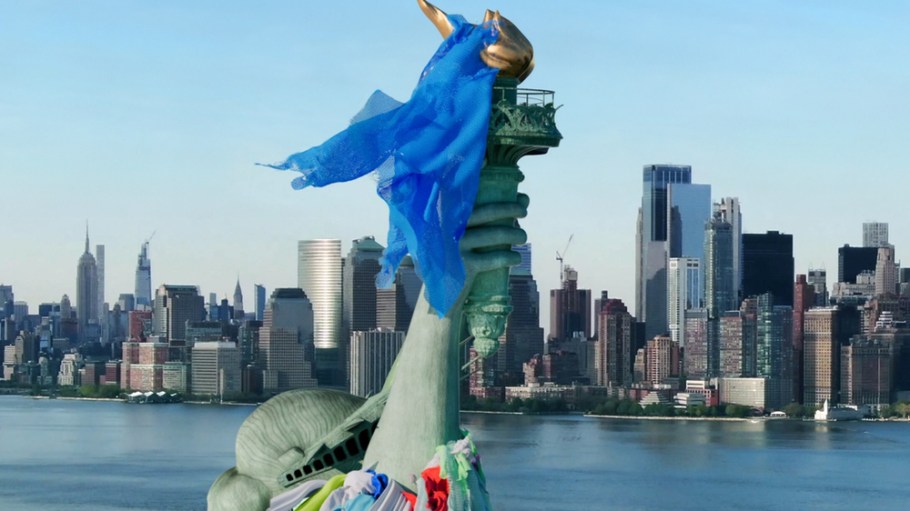
Mission semi-accomplished. The point of Reju’s augmented reality “experience” was to allow anyone with a cellular—and the ability to pinpoint the somewhat fiddly activation spot—to superimpose the amount of textile waste the world generates in a second, minute, hour or day on an iconic New York City landmark, making it click in the user’s mind the scale of the fashion industry’s impact.
“We’re constantly asking ourselves: how do we make the invisible visible?” said Patrik Frisk, who helms the Paris-based textile-to-textile recycling firm. “Textile waste is one of the biggest problems of our time, yet most people never see it. We wanted to bring that reality to Climate Week, when the world is paying attention to climate solutions and so New York City made sense. It’s also where culture, fashion and innovation meet. By projecting the scale of textile waste against landmarks like the Empire State and the Flatiron Buildings, we’re making an abstract problem impossible to ignore.”
Reju isn’t the first company that has sought to wake New Yorkers up to a problem that’s literally mounting, if somewhat out of sight, thousands of miles away. A little over a year ago, during New York Fashion Week, The Or Foundation in Ghana sent a “fashion zombie” to prowl fashion shows and stalk the Brooklyn Bridge and Times Square, confronting people head-on with the consequences of overconsumption. Over in Europe this past March, the Stop Fast Fashion Coalition, which comprises organizations like Fashion Revolution France and Zero Waste France, dumped several tons of textile waste behind the French Senate building to demand that lawmakers include in their agenda a 2024 bill aimed at curbing the rampant overproduction of clothing.
Still, one question remains: Do stunts like these work?
“Yes, I think people need to be able to visualize it to be able to understand the issue,” said Clémence Faure, the environmental justice nonprofit’s EU engagement and “Speak Volumes” campaign lead. “But then again, I think they also need some context behind it, because otherwise it’s very easy to misunderstand the situation or not have enough information to be able to act on it. It’s a first way of interacting with consumers, for sure, but then education is important.”
Concerns about oversimplifying what is a very tangible and growing problem are why The Or Foundation started “Speak Volumes,” an initiative that calls on fashion purveyors to publicly declare their production volumes.
“Otherwise it’s hard to realize that every purchase has an incredibly big impact on the environment, whether it’s in the resource extraction phase or the production side of things, or even the collection and sorting and preparation for reuse, and then the final life of the garments that is happening in places like Ghana,” Faure said. “So it’s very important that people understand all these steps, and it’s important for brands, too, because they don’t always know all about them.”
Of the unprecedented 1,000 events on Climate Week NYC’s calendar, however, textile pollution was a blip on the agenda. The nonprofit recycling center Fabscrap organized a textile sorting event at its warehouse, followed by a happy hour. Oxfam America, the poverty-alleviating charity, moderated a Secondhand September discussion that explored the “real ripple effects of secondhand fashion.” Remake, a fashion advocacy group, hosted a Wear Your Values Weekend at Parsons The New School that included a panel on reselling, remaking and recycling. And “action-oriented” nonprofit Accelerating Circularity, together with business and technology consultancy Accenture, held a roundtable on the vertiginous 61st floor of One Manhattan West about a recent report on how to unlock textile-to-textile recycling in the United States.
“New York Climate Week was the perfect time to launch the ‘Rags to Revenue’ report,” said Karla Magruder, founder and president of Accelerating Circularity. “While we had a great turnout from companies in the industry, from collectors and sorters to mainstream brands, the textile industry still has a lot of work to do to transition to circular textile-to-textile systems. That’s why we launched the report. It’s designed to help the industry understand what still needs to be done.”

But so, too, do consumers, even though awareness is spreading across young generations. While Secondhand September has taken off in the United Kingdom, it’s still in its nascent stages across the pond, said Katrina Caspelich, chief marketing officer at Remake. And even though many people are “already living the spirit of it through clothing swaps, thrifting or pausing new purchases, but without calling it that,” skipping new clothing purchases during peak back-to-school shopping season is a “big shift.”
Even so, Caspelich would like to see textile pollution take up as much space metaphorically as it does physically. Every year, 92 million metric tons of textile waste are produced globally, yet less than 1 percent goes on to become new clothing. The majority is landfilled, incinerated or shipped to poorer countries like Chile, Ghana and Kenya that lack the infrastructure to cope with what they can’t resell—something that is becoming an increasingly significant amount with the rise and continued acceleration of fast fashion. Reju’s virtual piles of unwearables are veritable mountain ranges elsewhere.
“Textile waste is one of the fashion industry’s biggest blind spots, and it rarely takes center stage at New York Fashion Week or Climate Week,” Caspelich said. “The conversations often focus on innovation and future solutions, which are important, but we can’t ignore the mountains of clothing waste piling up right now. Until waste is acknowledged alongside climate impacts and labor rights, we’re only telling half the story.”
As Obroni Wawu October, which was inspired by Secondhand September, kicks off in the Ghanaian capital of Accra—“obroni wawu” is Akan for “dead white men’s clothes”—The Or Foundation is enlisting consumers in its pursuit of production numbers. The expanded campaign, dubbed “Show Love, Speak Volumes,” is rolling out in three phases. The first is encouraging people, with the help of the Kantamanto community, to show their garments love through repair and renewal. The second is to show love to Kantamanto and those like it by writing letters to secondhand markets, charity shops and other places involved in the challenging work of recirculating garments.
“And then the last phase of the campaign is going to be show love to your backyard,” she said. “The idea is to connect the dots for the public that now know the positive and negative effects of the secondhand trade and connect them to what is happening around them. Because obviously, when we show what is happening in Accra, if you’ve never been to Ghana, it can be hard to relate to. But you can connect it to what you know, like volunteering at your charity shop or organizing a swap event with your friends.”
For Frisk, the AR experience is a reminder that change is possible, and that everyone, from brands to consumers, has a role to play. It’s also why Reju is building a circular textile system to transform the textile industry through “collaboration at scale.”
“Bringing the issue to life in a way that’s immersive and shareable helps bridge that disconnect,” he said. “But the point isn’t to make people feel guilty. It’s to empower them. If consumers see the impact, they can also see their part in demanding better materials, supporting circular solutions and making choices that keep textiles out of landfills. Awareness is the first step to change.”
That said, the key is “what happens after the stunt,” Caspelich said. Creative activations, particularly ones that shock or disquiet, can make the problem of textile waste visible in a city where overconsumption is often glamorized.
“Do we connect the dots for consumers about overproduction, about how our waste ends up in places like Accra or the Atacama Desert? Do we give them ways to take action, whether that’s taking Remake’s No New Clothes challenge, buying less, swapping or holding brands accountable?” she said. “ At Remake, we see these moments as powerful entry points, but they have to be paired with education and advocacy if we really want to shift behavior and the industry.”