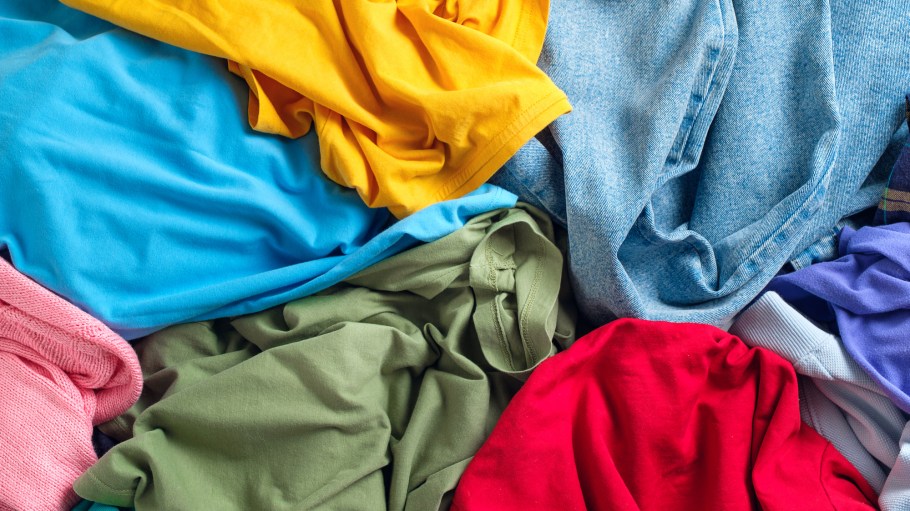
While textile-to-textile recycling using post-industrial waste has grown in recent years, the process of converting post-consumer garments into new fibers hasn’t quite gotten off the ground in the same way. Part of the reason for that is the lack of large-scale collecting and sorting infrastructure to provide post-consumer feedstock for recycling.
That problem took center stage at the recent Textiles Recycling Expo, held last week in Charlotte, N.C. Stakeholders from Goodwill, textile recycling nonprofit Fabscrap, reverse logistics platform SuperCircle and the Ellen MacArthur Foundation gathered during the event to discuss the challenges of post-consumer textile collection and sorting.
Related Stories
Over the past few years, the Ellen MacArthur Foundation has focused on supporting business models that promote textile circularity at scale. Director of network and industry in North America for the foundation Haley Lieberman said that along with addressing materials and design and creating circular business models for fashion that include repair and resale, infrastructure has been one of the most important aspects of their work to scale circularity.
“Infrastructure—the collection, sorting and recycling systems—don’t exist yet at the scale we need,” she said. “All of these aspects are deeply interconnected, and progress on all three is required to drive meaningful systemic change.”
The overwhelming scale of post-consumer textile waste makes the prospect of collecting and sorting feel like an impossible task. According to the United Nations Environment Program, 92 million metric tons of textile waste is produced globally each year. Fast fashion and haul culture have exacerbated this problem, and while secondary marketplaces such as Goodwill process and resell a portion of those consumer castoffs, their role is limited by market demand, quality and existing infrastructure for processing pieces unsuitable for thrift sales.
“There’s a mismatch between the textiles we receive and the downstream vendors and use of those textiles,” said Barbara Maida-Stolle, president and CEO, Goodwill Industries of Northwest North Carolina. “We can sort well using technology, but the biggest struggle is having downstream vendors take and handle the amount of textiles that come into the system. Our Goodwill alone (which spans 52 stores) has 17 million pounds annually of textiles that we don’t sell. You can imagine across 3,400 stores in the United States, that becomes a very large number.”
One of the biggest challenges has been the lack of universal standards for collecting and sorting, which are often dependent on the discretion of the sorter with regard to criteria such as fabric makeup or the presence of dyes or prints.
“There’s no single pre-processing standard for textiles and for certain fibers,” said Stuart Ahlum, co-founder and COO SuperCircle. “So, say we have multiple cotton recyclers—one might take 100 percent white cotton cut to a certain flag size, and we have another with a 15 percent capacity for contamination with no prints, but only needs a center cut.”
Ahlum said the often-wide range of needs from recyclers makes it difficult collectors and sorters to efficiently process clothing by hand, much less incorporating an automated machinery process. He said SuperCircle has been able to do that with shoes through the circular footwear brand he founded called Thousand Fell, which accepts post-consumer shoes, converting rubber and other materials from donated shoes into furniture batting, insulation and padding. But for textiles, the process remains difficult to perfect.
“The biggest catalysts for making this work are building sustainable business and commercial models for this ecosystem, and then having brands involved in the loop,” Ahlum said. He explained that SuperCircle works with brands to process their post-consumer trade-ins, as well as items from excess inventory, damages, damaged returns, factory defects and the like. He said that keeping brands involved has helped simplify the process.
Another issue that can hamper the sorting process is a lack of clear labeling indicating the fiber makeup of a garment. If a label is missing or too faded from washing to be read, it can be difficult for sorters to determine if it’s 100 percent cotton or a blend. To solve that problem, Hans Chan, co-founder of Matoha, introduced the company’s textile identification system at the expo.
Matoha’s scanners use AI technology to identify the fabric makeup of a garment, with the capacity to detect 10 materials and 13 blends. Chan said the tool can be used by hand sorters to streamline their work, and it has the potential to be incorporated into sorting processes on a larger scale to reduce the cost and time investment.
“Instead of replacing the sorter, we’re trying to make them better and more efficient,” he said. “Waste sorting has to make economic sense—these people are businesses.”
Maida-Stolle said transparency with consumers also has been a key component for Goodwill, and they’ve tried to educate people about where their donations go if they’re not bought in the thrift store. Goodwill of Northwest North Carolina has partnered with the Textile Innovation Engine to process some unsold textiles into socks, which she said has been a win for their effort to improve circularity for post-consumer textiles.
“We’re doing more telling the story of where their product goes—we owe that to them,” she said. “Partnerships that Goodwills are developing with brands and other recyclers have been a bright spot for us.”
Ultimately, the panel agreed that while some progress has been made to solve the collecting and sorting problem, a larger, more concerted effort across the fashion industry will be necessary to make textile-to-textile recycling for post-consumer garments a reality at scale.
“I don’t think there’s one single entity that can do this work—we have to work together,” Maida-Stolle said. “Collecting and sorting is very costly, so being able to have a shared responsibility and cost with an infrastructure that balances that is quite important. That’s really the way to unlock success in being able to keep product out of the landfill.”