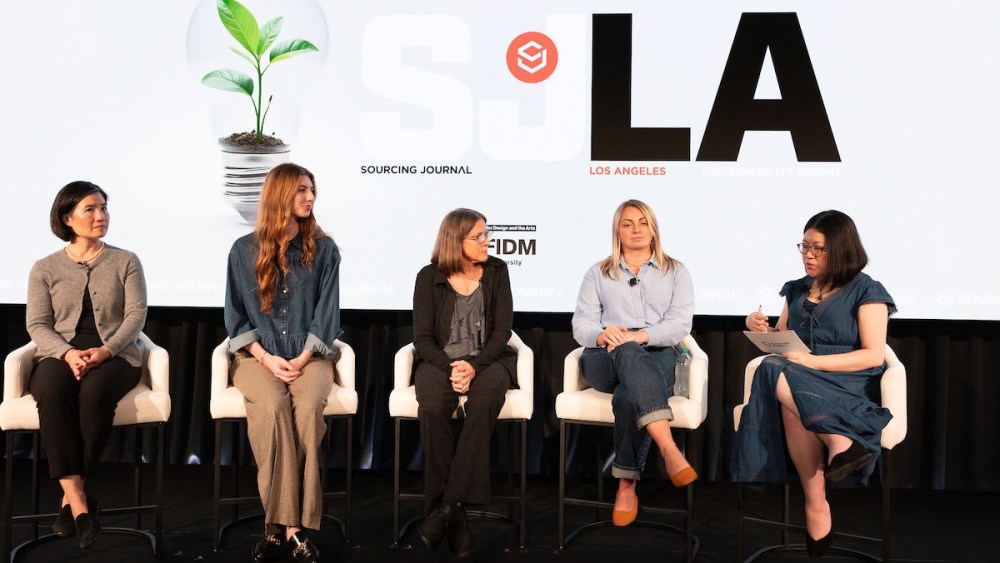
The Footwear Collective (TFC) was born in 2023, launched under the auspices of climate advocacy nonprofit EarthDNA, with backing by boldface names such as Brooks Running, Crocs, Ecco, New Balance, Reformation, On, Target and Vibram among its inaugural funding partners. The idea? To put “all the industry together to start thinking collectively about the solutions that we need in order to make shoes sustainable and circular.”
That said, the fashion industry has no shortage of trade groups, Sourcing Journal’s climate labor and editor, Jasmin Malik Chua, pointed out during the SJLA Sustainability Summit. What, exactly, made this collective so crucial?
You May Also Like
Related Stories

“You’re right—there’s a lot of amazing organizations in the space already and so many of those were honored to be able to call our partners today,” responded Morgan Ginn, program manager at the Footwear Collective. “The gap that we saw in the space was an organization that was able to bring footwear specific brands together to be able to catalyze collective action. Our organization actually spawned out of research that was done at MIT—to evaluate the state of footwear circularity today, to look at the opportunities and the challenges—and one of the biggest opportunities was for brands to work together.”
Steve Madden said joining the initiative was rooted in the fact that it emphasized this scientific research-based approach.
For the Almost Famous owner, onboarding helps to “not only to build the base of knowledge that we have as brands, but also to precisely identify the gaps in the action needed to drive impact,” said Madeleine Danzberger, sustainability and social impact specialist of Steve Madden. “It’s really rooted in how much can we learn—learn from each other—and then have TFC be the facilitator to fill those gaps and find the best solution for everybody that’s involved.”
To that end, the collective launched the Footwear Futures Project in Los Angeles in October to “reimagine what happens to shoes at the end of their life,” per EarthDNA. The month-long initiative invited consumers to donate their shoes (regardless of brand or condition) to participating Goodwill SoCal locations, with 50 collection sites across the country taking part as well.
“We collected 30,000 pounds of footwear,” Ginn said. “That’s 80 pallets of footwear that are at the end of their life—there’s no other use for them—and are going into our material recovery trials.”
Shoes that are still in good nick will be resold through the charitable retailer’s existing network, with whatever is unsellable set to be delivered to the project for sorting, reuse and recycling.
“In about a week, we received between five and 7,000 pounds,” said Margaret Frericks, director of foundations and sustainability at Goodwill SoCal. “People bring us a lot of stuff; getting 30,000 pounds was not that difficult—but in shoes, it’s all over the place.”
Homeboy Threads will collect the data on those 30,000 pounds of footwear to “better understand the shoes that are coming through,” per Ginn. Comprising sorters and graders of pre- and post-consumer and post-industrial textiles, the Los Angeles local organization is the certified social enterprise of Homeboy Industries: the world’s largest re-entry and rehabilitation program for formerly gang-involved and previously incarcerated individuals.
“When we think about the circular economy—the job skill, the job training, the job pathways that are created, not only is it supporting an economy for those populations, but those same skills are also used to solve challenges within their own communities—providing double the impact,” said Linda Corrado, business development manager at Homeboy Threads. “We’re committed to including those populations that have historically been left out of the linear economy.”