“I’m trying to continue, but I don’t know how long I can.”
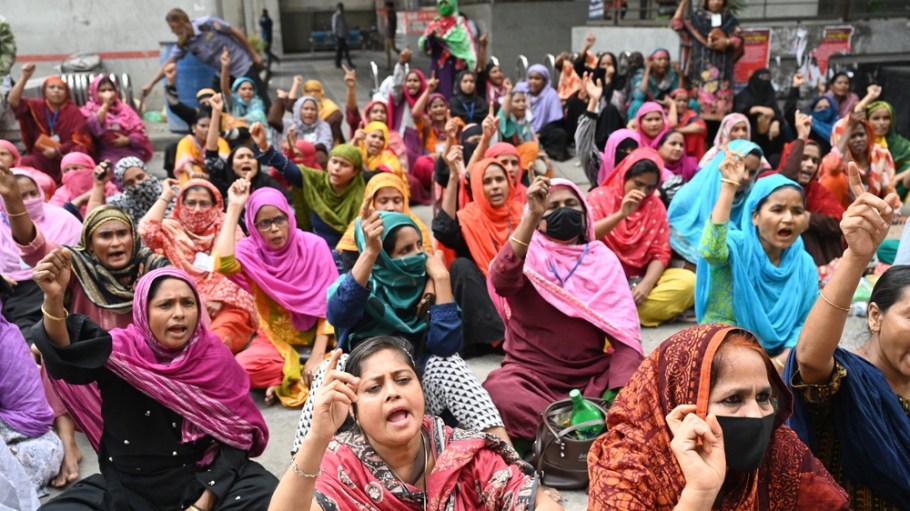
That’s Nazma Akter, founder and executive director of Awaj Foundation, a grassroots organization that relies on funding from the U.S. government—the now taboo “foreign aid”—to support 600,000 garment workers across Bangladesh. The nonprofit not only teaches workers about their rights and how to negotiate for better working conditions, but it also tackles issues such as reproductive health, domestic violence and children’s education. During the Covid-19 pandemic, it helped with vaccine registration.
Related Stories
It was seemingly overnight when Awaj Foundation lost 25-30 percent of its funding, resulting in the termination of 30 of its 150 employees and the closure of four of its Dhaka and Chittagong offices. The timing is terrible: Bangladesh is at a critical juncture where worker discontent about jobs and wages continues to run high. Now that the billionaire Elon Musk, as head of the so-called Department of Government Efficiency, has set about feeding the U.S. Agency for International Development “into the wood chipper,” crumbling its workforce of 14,000 to fewer than 300 unless lawsuits or legislation offer a last-minute reprieve, the organization’s very existence is in peril.
“I don’t know what to do,” Akter said.
She’s far from alone in that sentiment. Other advocacy groups in South and Southeast Asia, Central America and the Middle East that rely on USAID funding but spoke on the condition of anonymity because they feared retaliation or were under gag orders, are in the process of terminating contracts with community organizers, winding down services that negotiate prescription drug prices and provide legal advice for workers, or stepping away from discussions involving “one-in-a-lifetime” potential labor reform in countries on the precipice of change. This is despite the fact that the legality of DOGE’s actions is murky at best because it has put on hold spending that was greenlit by Congress through the annual appropriations process.
While USAID often works—or worked—in tandem with programming by the Department of Labor and the Department of State, its role as the nation’s leading provider of global humanitarian relief has given it a bigger remit with lifting standards in the garment industry. The agency is better known for investing in schemes that stoke worker empowerment or job creation, but it also actively undergirds organizations, often through larger intermediary nonprofits, that forge long-term community, provide access to mutual aid and legal assistance, resolve disputes and grievances, and safeguard against trafficking, gender-based violence and forced labor.
USAID saw the bigger picture, too. In the aftermath of the 2013 collapse of Rana Plaza, which killed more than 1,130 garment workers and injured thousands more in Bangladesh, it contributed $22 million to help suppliers finance safety improvements. As a whole, Bangladesh, the world’s second-largest exporter of garments after China, is South Asia’s largest recipient of U.S. aid to the tune of some $490 million in 2023, the most recent year with complete data available.
“They may not survive this,” one staff member at an international nonprofit, which also depends on USAID funding and has had to make difficult decisions, said of groups like Awaj Foundation, some of which are now literally struggling to keep the lights on. “And it takes a long time to build these kinds of networks, which can be destroyed in an instant. It’s really troubling.”
President Donald Trump has called, in his signature all-caps verbiage, for the closure of USAID, saying that the agency runs counter to his “America First” agenda. What this will result in instead, say insiders, is the collapse of an already tenuous ecosystem that has been buttressing American interests and American prosperity by promoting decent work and strengthening democratic norms.
“I think people think of foreign aid as charity, and what they don’t understand is what an important role it plays in terms of American self-interest,” said Thea Mei Lee, who served as deputy undersecretary for international affairs at the Department of Labor during the Biden administration. “It’s good for us to live in a safe world where there is not rampant disease. It is good for us to live in a stable world where people are not egregiously abused and so poor that they cause upheaval. It’s good for us to live in a democratic world because that’s a more secure and reasonable place to live in.”
For chronically underpaid garment workers with little social protections to speak of, help at the grassroots level provides a critical safety net that has buffered many from starvation and destitution. Such groups are also frequently the ones that hold badly behaving corporations accountable for their involvement or complicity in labor rights violations. Many say that removing these failsafes will make it easier for unscrupulous employers to exploit workers and further cheapen their labor, putting American workers at a competitive disadvantage—the complete opposite of what Trump is supposedly trying to accomplish.
Larger institutions aren’t immune from the fallout, either. The United Nations’ International Labour Organization, for instance, counted the United States as its second-largest voluntary funding contributor after the Netherlands in 2024 and will have to grapple with the broader aid freeze. The future of its Better Work program, a pillar of the garment industry that helps factories in more than a dozen countries boost their compliance with core labor standards—and receives infusions from the Department of Labor, another target of Musk’s federal downsizing blitz—could also hang in the balance as budgets are slashed and employees furloughed.
Neither is it clear what will happen to the work of the Solidarity Center, which derives the bulk of its funding from the U.S. government and is implementing USAID’s Workers Empowerment and Participation activity to improve conditions in Bangladesh’s garment and shrimp and fish processing sectors, and Reimagining Industry to Support Equality, which brings together the four largest women’s empowerment programs in the apparel industry—Gap Inc.’s Personal Advancement & Career Enhancement, BSR’s HERproject, CARE and the aforementioned Better Work—to train and educate hundreds of thousands of workers from Guatemala to Vietnam alongside on-the-ground partners that are likely buoyed by grants from USAID.
This has produced an uncommon moment of consensus between civil society and industry, which are both raising alarm: Not being able to reduce the business risks of sourcing from countries with more fragile or elastic rules of law doesn’t just hurt vulnerable garment workers, they say, but it also threatens U.S. companies through economic and security disruptions. The domino effect goes both ways.
”We are witnessing one of the worst and most costly foreign policy blunders in U.S. history,” Samantha Power, USAID’s administrator under President Joe Biden, wrote in a recent New York Times op-ed. “USAID has become America’s superpower in a world defined by threats that cross borders and amid growing strategic competition.”
‘People don’t realize’
The American Apparel & Footwear Association is urging the Trump administration to work with Congress and other stakeholders to ensure that USAID remains “fully funded and fully staffed.” In a statement it released last week, it named USAID’s Workers Empowerment and Participation activity, its Prevention and Response to Gender-Based Violence initiative and its Africa Trade and Investment project as “just a few” of the programs that have been harmed by DOGE’s slash and burn but must remain “vital, robust and operational” for the sake of America’s economic, diplomatic, foreign policy and humanitarian objectives.
“People don’t realize—and regrettably, they’ll quickly realize—how much foreign assistance matters to help a country through a natural disaster, help promote democratic institutions…just help educate people so that they can become productive citizens and possibly, in turn, buy U.S-made products and be a good partner to the United States,” said Nate Herman, senior vice president of policy at the trade group, whose roster includes household names such as Adidas, Gap Inc., J.Crew Group and H&M Group. “Instability can lead to a lot of issues with far-reaching implications because we decide to not help people who are desperately in need.”
Secretary of State Marco Rubio disputed on Monday claims that the United States is walking away from foreign aid entirely. It’s just foreign aid that’s “dumb, that’s stupid, that wastes American taxpayer money,” that has to go. Speaking in an interview on SiriusXM’s “The David Webb Show,” he said that the State Department is reviewing American foreign aid commitments to allow the government to determine if the programming fits the lens of Trump’s foreign policy and national security interests.
“Are people going to starve to death? Are we going to have a famine? Is it going to destabilize a country in a way that would be negative to our national interest and open the door for radical jihadists or others to take advantage?” said Rubio, who was named acting administrator for USAID in a move earlier this month that suggests that the once-independent agency could be subsumed into his. “We’re going to continue to do those.”
But who decides this, one NGO employee wondered. And with USAID staffers all but recalled from their foreign postings and placed on indefinite administrative leave, who is around to conduct reviews?
Gregory Meeks, a Democratic representative from New York and a ranking member of the House Foreign Affairs Committee, criticized Rubio on Wednesday, writing a letter to say that the secretary’s actions and remarks are a “sharp departure” from his “strong history of praise and support of USAID,” which included entreating the Biden administration last year to prioritize USAID’s funding as a key tool to “counter the Chinese Communist Party’s expanding global influence.”
“If the Chinese government is going to be offering, through the Belt and Road Initiative and other areas, piles of cash for infrastructure for other kinds of development aid without strings attached, then it’s important that the United States also be able to say, ‘We can also be strong partners and friends and allies to you,’” Lee said. “And ours does come with democracy and human rights conditionalities, but I think governments in the long term realize that they don’t want China to throw a bunch of money and then bring in workers that work in squalid conditions to complete a port project. They don’t want to get called out for egregious worker rights conditions or even forced labor conditions within their geographic boundaries.”
Still, the United States isn’t an isolated example of what may be construed as a “woke” or “DEI”—meaning diversity, equity and inclusion—backlash. As Europe continues inching toward the far right, non-governmental organizations in the region, too, are feeling silenced and squeezed of funding. The European Parliament’s Committee on Budgetary Control, which is responsible for dispensing the European Union’s budget, is led by the center-right European People’s Party. In January, Monika Hohlmeier, one of its leading members, said she would push to end EU grants to groups that spend money on advocacy, particularly as part of the LIFE program set up by the European Commission to back environmental and climate action.
“We’re seeing global trends of reduced governmental funding and opposition to NGOs,” said Anna Gedda, CEO at H&M Foundation, a philanthropic organization privately funded by the Persson family, founders and majority owners of H&M Group. “Therefore, it’s important that philanthropic organizations are bold, flexible and proactive in their funding.”
Philanthropic organizations have traditionally filled funding gaps left by governments, though whether their largesse can bridge the yawning breaches left behind by the United States is a major question. In fiscal year 2023, USAID managed more than $40 billion in combined appropriations, broken down into wide-ranging sectors such as governance, humanitarian, health and education. Gedda, however, is optimistic.
“We use our philanthropic resources to fund early-stage innovations, breakthrough research, and impactful collaborations that address the textile industry’s most critical challenges,” she said. “We are risk tolerant, can provide flexible funding, be fast-moving, and focus on long-term public benefit. We collaborate with actors that have the power to scale transformative solutions whether it’s industry leaders, investors or civil society. This is how we amplify the impact of our donations.”
Lee is more circumspect. There is a deep connection between democracy, workers’ rights and human rights, she said. To put it another way, workers cannot form independent democratic organizations if there isn’t a broader pushback against the repression of free speech and support for democracy. And as democratic spaces worldwide continue to shrink, so will the rights of the millions who keep the world clothed and shod. It’s them who will have to pay the price, but the implications of that—increased forced labor, lower wages, the sheer surfeit of human misery—don’t bear thinking about.
“I think there are very long-term consequences,” she said. “And I’m afraid we don’t know yet what they will be.”