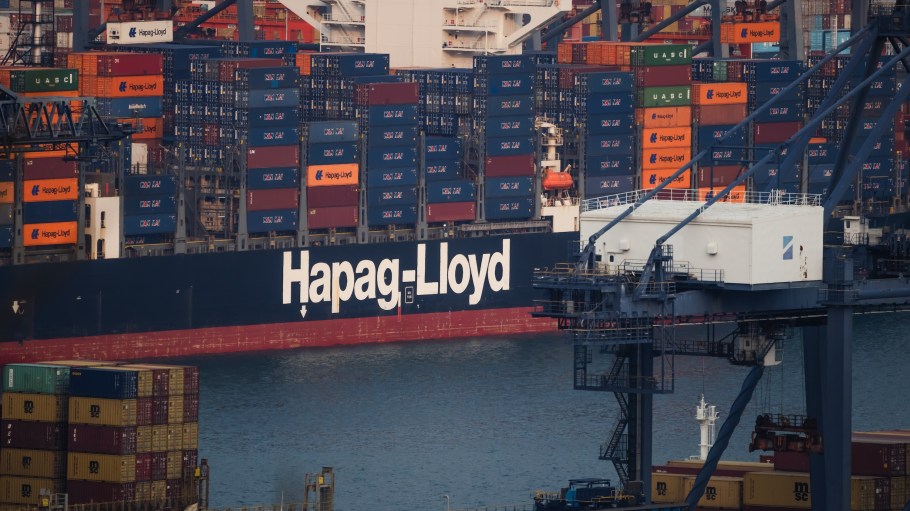
Hapag-Lloyd CEO Rolf Habben Jansen was blunt in his assessment of the ocean carrier’s first quarter during a Wednesday earnings call, saying the liner had an “unsatisfactory” start to the year due to escalating costs stemming from the war in Iran.
According to the carrier, revenue in its main liner shipping segment fell 18 percent in the first quarter to $4.8 billion, largely due to a 9.6 percent year-over-year decline in ocean freight rates to $1,330 per 20-foot equivalent unit (TEU). The dip was in line with market-wide rate declines of 9.7 percent, according to data from Container Trades Statistics (CTS).
Related Stories
Transported container volume inched down 0.7 percent to 3.2 million 20-foot equivalent units (TEUs), which the company attributed to weather-related operational disruptions.
But the decline in volume coincided with a major uptick from Gemini Cooperation partner Maersk, which saw its own container volumes rise 9.3 percent in the quarter. CTS said global volumes across the container shipping industry increased 4.4 percent, insinuating that Hapag-Lloyd lost some market share in the period.
Carriers including Ocean Network Express (ONE) and Orient Overseas Container Line (OOCL) already unveiled 4.1 percent and 1.7 percent increases in volumes, respectively.
According to Hapag-Lloyd, the weather issues largely affected Europe and North America and the trans-Atlantic trade, which resulted in ongoing disruptions of terminal operations and supply chains.
In total, first quarter revenue at Hapag-Lloyd declined 7.5 percent to $4.9 billion. Net losses totaled $256 million, swinging downward from $469 million in net income. The Middle East conflict is still weighing on the company’s costs, with extra weekly expenses amounting to $58 million to $70 million.
“We try to pass that on similar to when you go to the petrol station and you also have to pay a higher fuel price,” said Habben Jansen, who highlighted the carrier’s ability to serve the Upper Persian Gulf via a land bridge from ports in Oman through Saudi Arabia. “Of course, those volumes are limited…this is a solution that is a lot more costly for customers because the land bridge is very expensive and the capacity of it also remains somewhat limited.”
The container shipping company did not alter its guidance despite the headwinds, maintaining an EBITDA range of $1.1 billion to $3.1 billion. EBIT is forecast to be within a $1.5 billion loss and a $500,000 profit.
Hapag’s outlook comes as the container market is “holding up reasonably well,” Habben Jansen said.
“If we also look at forward bookings and when we look at futures markets, when we look at talking to customers, then I think there is an expectation that we will have a fairly normal peak season,” said Habben Jansen. “We’ve seen spot rates go up a bit. We see now a bit more momentum going into May. Of course, the truth will always be, or the important moment will always be end of June and July.”
The shipping firm’s guidance mirrored the confidence of Port of Los Angeles executive director Gene Seroka, who said Monday that cargo flow for the coming months “looks good.” The National Retail Federation and Hackett Associates did not share as bullish of an outlook in their Global Port Tracker, indicating forward demand is weakening due to stalling retail re-stocking efforts.
Hapag-Lloyd is still dealing with uncertainty elsewhere in its network.
While Maersk is currently reviewing whether to make a return to the Red Sea, Hapag-Lloyd appeared less enthusiastic about the prospects.
“I think it’s still difficult to judge when that is going to open. I personally see it difficult going through the Red Sea as long as the Iran conflict is still ongoing. Just reading the news flow on that conflict is certainly not concluded just yet,” said Habben Jansen. “In terms of escort, we were prepared to go through the Red Sea under close protection earlier on in the year. It turned out that at that point in time, also because of everything that happened, there was not sufficient capacity available to allow us to go through in a planned and orderly fashion.”
Capacity remains the key barrier, with Habben Jansen suggesting that there are not enough ships in its fleet to facilitate another network overhaul just yet. The concerns have ultimately made it difficult for the company to put a timestamp on a Suez return, he said.
“We will not go back with all the services at once because then the terminals in the Mediterranean and in North Europe in particular, and to a lesser extent in the U.S., will collapse,” said Habben Jansen. “That we will try to avoid, and as such, it will be a gradual process over multiple months.”
In the call, the CEO also said he was optimistic that the deal to acquire ZIM would close in the fourth quarter. Hapag-Lloyd had acquired the rival carrier for $4.2 billion in February, but Israeli business Haim Sakal surpassed the offer earlier this month with a $4.5 billion cash bid, according to various reports.
ZIM shareholders have already approved Hapag-Lloyd’s offer.