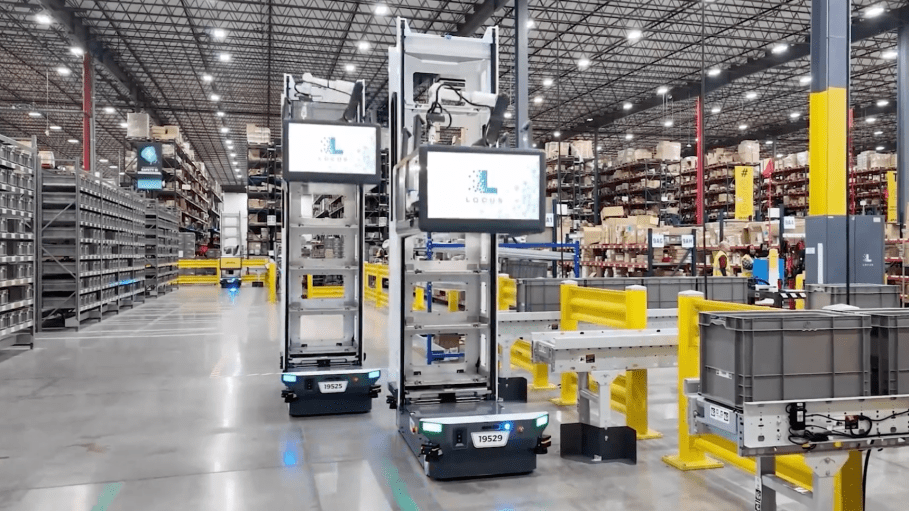
While most warehouse robots still ferry goods to human pickers, Locus Robotics has aimed to flip the script with the debut of its Locus Array “robots-to-goods” system, which rolls an AI-powered arm directly into the aisle to pick, stow and replenish autonomously, with no human hand required.
Locus Array can autonomously execute picking, putaway, inventory replenishment and other workflows for tote-eligible SKUs directly in warehouse aisles without manual intervention.
Locus Robotics leverages the concept of “physical AI”—when artificial intelligence is integrated within physical hardware such as sensors to enable machines to perceive a real-world environment—to power the robotics system.
Related Stories
Physical AI is vital to the 10-foot-tall Array robot’s success in that better helps the technology understand pressure points, like how a human can differentiate picking up and egg versus a pen, according to Kait Peterson, vice president and head of robotics at Locus Robotics.
Typically, end effectors have been holding back robotics from applying the pressure successfully, but Peterson said the vision system paired with AI has enabled the robots to better identify items and determine the proper pounds per square inch (PSI) needed to grab an individual SKU.
Additionally, robotics systems are often stationary, which creates more of a need for human intervention to prevent mispicks.
“By putting it onto a mobile platform, the only SKUs going into Array are SKUs that Array can pick,” Peterson told Sourcing Journal. “You eliminate mispicks, and you maximize what the robot’s actually doing. Mobile is the last piece, in that you are able to put that arm on a mobile base that does work in the aisle, rather than having to bring that product to a stationary position.”
The robotics technology is designed to address three core challenges in warehouse operations, including labor constraints, rising costs and the need to maintain service levels as demand fluctuates.
According to Locus, Array reduces reliance on manual labor by up to 90 percent, maintains consistent throughput under changing market and employment conditions and enables operations to scale and adapt without redesigning infrastructure.
When designing Array, Locus conducted a full SKU analysis of 7 billion picks across its network, and identified that it needed to be able to pick the 60 percent to 70 percent of those units weigh under 4.5 pounds.
“Most of them are in a variety of different packaging that enables a typical picking end effector or suction cup, which is what we have,” Peterson said. “If you think about bags, like apparel bags, or like a pair of socks with the cardboard on it, those can be picked.”
Array can store six 24-inch-by-16-inch totes vertically, with each tote weighing 66 pounds.
Deployments are already underway with early access customers in North America, as the company prepares to scale Locus Array globally across Europe and APAC to meet accelerating demand for fully autonomous fulfillment.
Sally Miller, global chief information officer at DHL Supply Chain, said the launch marked a pivotal moment in the company’s accelerated digitalization program to deploy innovative technology solutions in its business at scale.
“By being the first to deploy Locus Array, we are not just addressing today’s labor and capacity challenges; we are actively engineering a more agile supply chain,” Miller said in a statement. “This innovation allows us to maximize vertical space and dramatically reduce manual touches, ensuring that we continue to provide our customers with the speed and reliability they expect from the world’s logistics leader.”
Customers should expect an ROI within 12 months or less after implementing the Locus Array depending on the speed of deployment and the types of SKUs flowing through the system, Peterson said.
For such a major system overhaul, Peterson credits the quick ROI to the company’s robotics-as-a-service (RaaS) model, which enables companies to pay for the services on a subscription-based contract.
“Some companies are tied into $100 million long-term contracts and have to be locked into that system for seven to 10 years, and that capital is tied up in literal steel,” Peterson said. “With allowing our customers to move to the RaaS relationship, move it to an operational expense, rather than a capital expense, they can take more advantage of the capital that they do have to do other things so that ROI really accelerates that for them.”
Locus Array operates within the LocusOne orchestration platform, which is the company’s warehouse automation system that coordinates the actions individual robots throughout each facility. Along with Array, LocusOne powers the Locus Origin and Locus Vector robotics systems to operate as a unified fleet within warehouses.
LocusOne is built to dynamically assign work to each robot based on real-time demand, coordinating robots, workflows and inventory movement as a single system that scales and adapts with operations over time.