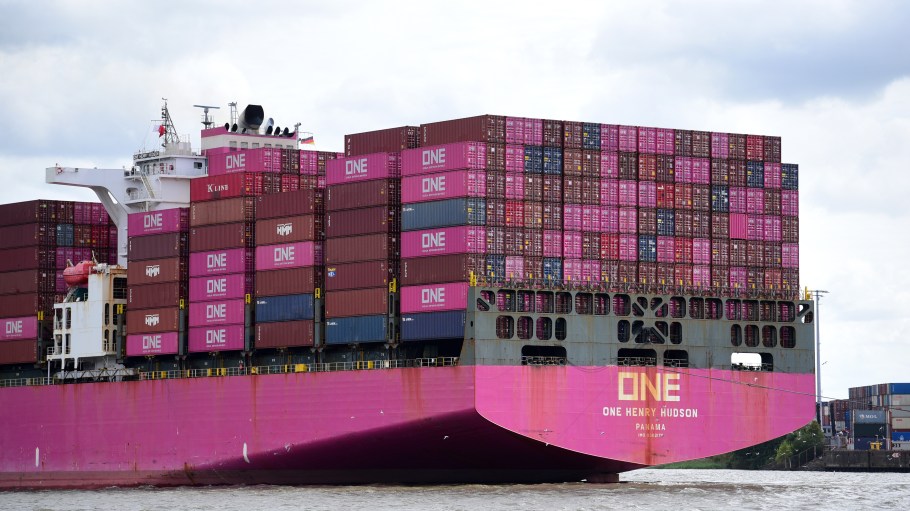
Ocean Network Express (ONE) is launching a Red Sea-to-China service line, just as its Premier Alliance made changes to its East-to-West shipping network set to go into effect next year.
The Singapore-headquartered shipping giant said Tuesday in a customer advisory that the new service has been introduced to meet the demand between China and Red Sea ports.
On Jan. 15, the weekly Red Sea China service (RCS) will see the SSF Dream debark from the Port of Shanghai before stopping at three other Chinese ports: Qingdao, Nansha and Shekou. The ship will travel through the Red Sea to stop at three Middle Eastern ports—Jeddah, Saudi Arabia; Sokhna, Egypt; and Aqaba, Jordan—before turning around.
Related Stories
The move follows fellow carrier CMA CGM’s decision to bring more services back to the Red Sea, although the ONE routes aren’t passing through the Suez Canal into the Mediterranean Sea.
On top of previous announcements that its Ocean Alliance would reintroduce select backhaul services on the Europe-to-Asia route, CMA CGM said its Indamex service between India/Pakistan and the U.S. East Coast would transit the Suez Canal in both directions this January.
The Premier Alliance changes are not accounting for a Red Sea return just yet, with the updated services based on the Cape of Good Hope route. The alterations will be set beginning in April 2026.
The alliance members, which include ONE, Hyundai Merchant Marine (HMM) and Yang Ming, said they were closely monitoring the Red Sea situation.
Although more consideration has been given among the container shipping community to make a Red Sea comeback, the insurers behind the possible returns are going to be a major factor behind each carrier’s decision.
According to a weekly update from Freightos on Tuesday, some experts field suggest insurance companies will need “at least another 60 to 90 days of quiet” before considering a Red Sea return.
“Regardless of when carriers feel ready to resume traffic through the Suez, vessels won’t be able to return until vessel and cargo insurers also agree that the risk of attack has dropped sufficiently,” said Judah Levine, head of research at Freightos, in the update.
Lars Jensen, CEO of container shipping consultancy Vespucci Maritime, noted in a LinkedIn update that there was optimism in the market related to a Red Sea return, but cautioned that the situation “is not necessarily as clear as it might seem.”
On Monday, the Houthis “Ministry of Foreign Affairs cautioned against what they termed ‘continued Zionist escalation in Gaza and flagrant violations of the ceasefire agreement,’” Jensen pointed out. “This can be interpreted as a thinly veiled threat that they could choose to end their self-imposed ceasefire against merchant shipping unless the situation in Gaza develops in a way they see as more favorable.”
On Monday, the United Kingdom Maritime Trade Operations (UKMTO) issued an alert of suspicious activity in an area just south of the Red Sea’s chokepoint, the Bab el-Mandeb Strait. A merchant vessel successfully defended itself against an armed assault by multiple smaller ships.
While the vessel had been located roughly 15 nautical miles west of Yemen, the Houthis have not taken credit for the attempted attack. Jensen said the activity more likely points to Somali pirates than Houthi aggression.
“Even when the Somali pirate activity peaked in 2011 with more than 200 attacks in a year, this did not result in the wholesale diversion around Africa which the Houthis have caused,” Jensen said. “Piracy activity alone will likely not prevent a return to a Suez routing for the large container vessels.”
As the Premier Alliance stays out of the Red Sea conversation for now, the group of carriers added two additional trans-Pacific services from Asia to the U.S. West Coast.
The Vietnam Shuttle Express will call at Singapore, Vietnamese ports Cai Mep and Haiphong, Los Angeles or Long Beach, South Korea’s Port of Busan, and Shanghai and Shekou. Pacific South 8 will call at Qingdao and Ningbo, one of the twin L.A./L.B. ports and the Port of Oakland, Calif.
As for its Asia-to-Europe network, all direct calls at Japanese ports are set to be dropped. Instead, the vessel-sharing alliance will introduce a dedicated feeder network connecting Japanese ports like Tokyo, Kobe and Nagoya to Busan.
According to a statement from HMM, the network update will be powered by additional capacity from newbuilds, which are expected to be delivered throughout 2025 and into 2026.