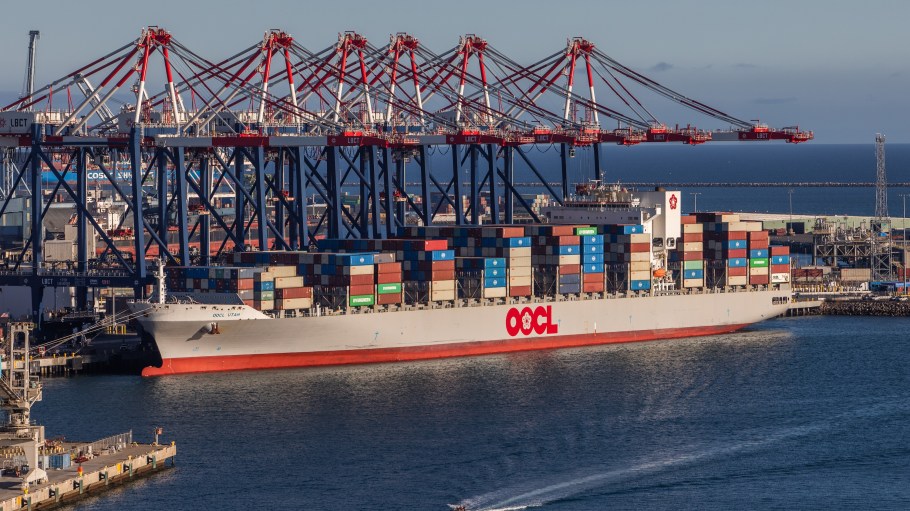
Chinese container shipping line Orient Overseas Container Line (OOCL) wants to overturn a federal ruling ordering it to pay $45.6 million in damages to the estate of bankrupt retailer Bed Bath & Beyond, all while challenging the constitutionality of the Federal Maritime Commission’s (FMC) ability to carry out legal proceedings against ocean carriers.
In April, the FMC ruled that the ocean carrier violated the U.S. Shipping Act on various grounds, including that OOCL unreasonably failed to meet its service commitments, refused to negotiate with the retailer on space accommodations and retaliated against it for complaining about the alleged service failures. The $45.6 million figure represents the highest single award of damages by the FMC in its history.
Related Stories
OOCL responded with its own lawsuit against the FMC Tuesday in a U.S. District court in Houston, seeking a temporary restraining order and injunction against the enforcement of the ruling.
In the 15-page complaint, OOCL declared the legal proceeding unconstitutional, in part on the claim that the FMC “does not possess subject matter jurisdiction over breach of contract claims.” OOCL, which is a subsidiary of Chinese state-owned ocean carrier giant Cosco Shipping, also contends “the Shipping Act provisions [Bed Bath & Beyond] relied upon do not afford relief to the shipper with respect to space allocation issues.”
The carrier’s response to the FMC’s judgment holds significant weight in that it directly challenges the expanded role the commission has taken in overseeing ocean carriers in recent years in the wake of the Ocean Shipping Reform Act of 2022 (OSRA). The Biden-era legislation was enacted after various American businesses had complaints over being bypassed for service by carriers, or being charged excessive late fees throughout the heavy supply chain bottlenecks throughout 2021 and 2022.
OOCL takes aim at the agency’s legal jurisdiction, instead arguing that such a case should be heard in federal courts before juries, and not by an executive branch-appointed administrative law judge.
No other container shipping firm has challenged the constitutionality of the FMC’s legal proceedings.
“If OOCL is successful, it could significantly weaken the FMC’s current enforcement framework and potentially reshape how detention, demurrage and Shipping Act disputes are handled in the United States moving forward,” said Amanda Bradfield, director of end-to-end logistics at freight forwarder EES Shipping, in a Thursday post on LinkedIn.
In the complaint, OOCL contested some of the claims asserted by Bed Bath & Beyond.
For example, while the retailer said OOCL retaliated against it by reducing its minimum quantity commitments (MQC) by 17 percent during service contract negotiations in 2022, the container shipping company countered that it reduced all cargo owners’ MQCs by 17 percent across the board that year.
OOCL also disputed Bed Bath’s contention that it was forced to move 4,000 containers via other ocean carriers, freight forwarders or other intermediaries because the shipping firm declined to carry its cargo. The carrier said “no data about bookings made or attempted was presented by the shipper” in its filing to the FMC.
The beleaguered retailer first logged the complaint against OOCL in April 2023, just four days after the company filed for Chapter 11 bankruptcy. That year, the company filed similar Shipping Act-related grievances against Mediterranean Shipping Company (MSC), Evergreen, CMA CGM and Yang Ming, all tied to a failure to meet service contracts.
The estate most recently launched an FMC complaint against Hyundai Merchant Marine (HMM) in January.
Bed Bath & Beyond, whose legal entity is officially known as 20230930-DK-Butterfly-1, Inc., has long claimed that the carriers’ collective failure to meet service requirements led the company to its downfall.
Starting with the 2021 holiday season, the home goods seller reported hundreds of millions of dollars in lost sales throughout the next year due to insufficient inventory.
Bed Bath & Beyond initially sought damages of $165.3 million when it first filed the claim.
The complaint from OOCL followed a win for the FMC, when a Washington, D.C. federal appeals court upheld the agency’s ruling against Evergreen over late fees imposed on a trucking company in 2020.
That court denied Evergreen’s petition for review and backed an FMC order finding the carrier acted unreasonably by charging TCW, Inc. $510 in detention fees during a three-day closure of the Port of Savannah.
The case stems from a shipment handled for Yamaha Motor Co., in which TCW was designated to move cargo inland to a Georgia manufacturing plant. Evergreen provided a container and chassis to TCW, giving the company 21 days to host the container and four days for the chassis, after which daily detention fees would apply.
Yamaha’s plant shut down due to Covid-19, delaying TCW’s ability to retrieve and return the equipment in the allotted time, but Evergreen still charged the fees.