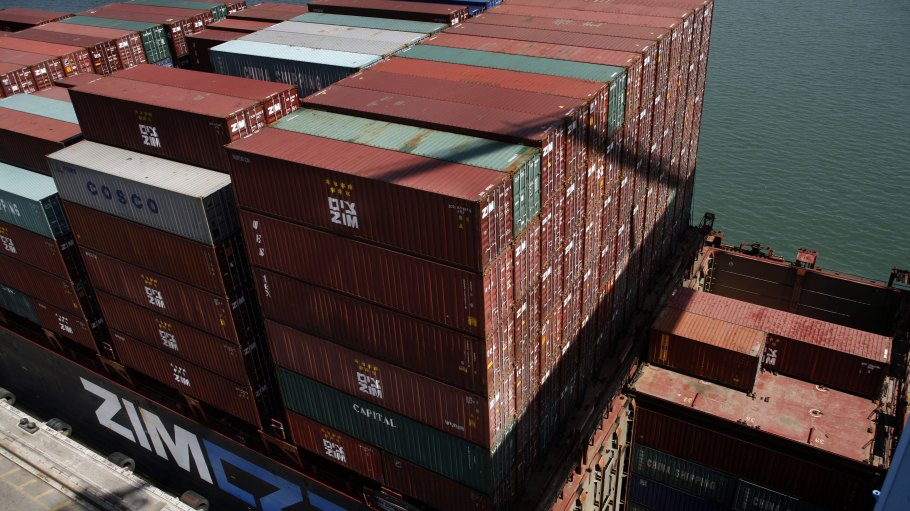
Hapag-Lloyd is acquiring fellow ocean carrier ZIM, ending the latter’s months-long strategic review.
The Germany-based Hapag-Lloyd said the deal had a $4.2 billion price tag, with ZIM valued at $35 per share in cash, a 58 percent premium to the liner’s closing price of $22.20 on Friday.
With ZIM under its control, Hapag-Lloyd brings on more than 704,000 20-foot equivalent units (TEUs) of container capacity, escalating its total to nearly 3.1 million total TEUs, said container shipping market research firm Alphaliner.
Related Stories
Until the closing of the transaction, which currently expected to be completed by the end of 2026, Hapag-Lloyd and ZIM will remain competitors and operate “business as usual.” Their operational collaboration will stay limited to existing vessel sharing and slot charter agreements.
The biggest change for ZIM will be the splitting of its operations into domestic and international, with Israeli private equity firm FIMI Opportunity Funds carving out a joint venture with Hapag-Lloyd to create a new container network operator and liner service provider, “New ZIM.”
Under FIMI’s ownership stake, the new liner will control ZIM’s fleet of 16 owned vessels that directly connect Israel to major ports in the E.U., U.S., Mediterranean Sea and Black Sea. New ZIM will also have access to Hapag-Lloyd’s Gemini Cooperation vessel-sharing alliance with Maersk.
FIMI’s stake allows the Israeli government to maintain its “golden share” in ZIM—assuaging a concern among those opposed to the company shifting under foreign ownership. The special state share is a provision designed to protect Israel’s interests in private companies deemed essential for national security.
Hapag-Lloyd will control ZIM’s international operations with the deal. The liner is significantly boosting its chartered capacity with the acquisition, adding roughly 99 container vessels to the 170 chartered vessels it operated as of Sept. 30.
This will increase the percentage of chartered ships in Hapag’s fleet from 39 percent to 52 percent.
In a briefing held Sunday, Hapag-Lloyd CEO Rolf Habben Jansen said a higher percentage of chartered ships can benefit the during down cycles, but acknowledged the number could still be too high for longer-term prospects.
“Dependent on how good or not so good the market is, you have a lot more flexibility in adjusting your cost base than if you do not have a large chunk of chartered tonnage,” Habben Jansen said. “Having said that, I think if this transaction is completed, then the percentage of chartered tonnage that we would have is probably a bit on the high side…So over time, one should expect that we then bring that down.”
According to Lars Jensen, CEO of container shipping consultancy Vespucci Maritime, only Ocean Network Express (ONE) and Yang Ming presently have charter ratios above 50 percent. The other top-10 carriers have charter ratios below 40 percent, with the percentages reaching 30 percent at Evergreen and 18 percent at Hyundai Merchant Marine (HMM).
“This can prove to be a competitive advantage as the market is heading towards a cyclical downturn,” said Jensen in a Sunday update on LinkedIn. “The ability to tactically reduce the size of the operated fleet by redelivering charter vessels can be an important element of maintaining a high utilization and low unit cost.”
The company remains the fifth-largest container shipping firm in the world with the ZIM capacity included.
In the presentation, Hapag-Lloyd said the overall combined tonnage share on the trans-Atlantic trade lane would be 27 percent across both carriers, only behind leader Mediterranean Shipping Company’s (MSC) 29 percent. On the trans-Pacific route, the Hapag/Zim combination will have a 12 percent market share, under CMA CGM’s 15 percent and MSC’s 13 percent and tied with ONE.
Boards of directors at both firms have approved the acquisition, but the deal is still subject to regulatory approval from the Israeli government and other competition authorities.
Many workers impacted by the acquisition are not happy with the transaction, with roughly 800 ZIM employees walking off the job Sunday. The strike has continued through Tuesday at the company’s headquarters in Haifa.
“Since this morning, we are not allowing any operations,” ZIM union head Ziva Lainer-Schkolnik told Reuters on Tuesday. “We have stopped several ships at the ports of Ashdod and Haifa.”
According to Lainer-Schkolnik, New ZIM is expected to employ only 120 people, putting the remaining 900 jobs at the shipping company at risk. A Hapag-Lloyd spokesperson told Reuters that jobs at ZIM’s headquarters and in management are secure.
Speculation of a sale to Hapag-Lloyd or another carrier had been rampant for months, with the Israeli ocean carrier confirming in November that it was conducting an internal strategic review.
ZIM’s CEO Eli Glickman had already sought to spearhead a group to take the company private late last year, but the board rejected the takeover bid, citing that it undervalued the container shipping operator.
The total deal price of around $4.2 billion will be funded from cash reserves and external financing of up to $2.5 billion. As of Sept. 30, Hapag-Lloyd had $4.6 billion in cash and cash equivalents.
The acquisition is the largest seen in the industry since Cosco Shipping’s $6.3 billion acquisition of Orient Overseas Container Lines (OOCL) completed in July 2018.
In recent years, Hapag-Lloyd has beefed up its container vessel fleet via acquisitions, scooping up the 6,589-TEU liner business of South African shipping company Deutsche Afrika-Linien (DAL) in 2022. A year prior, the company acquired the Rotterdam-headquartered NileDutch, which largely served West Africa and whose fleet had a capacity of roughly 80,000 TEUs.