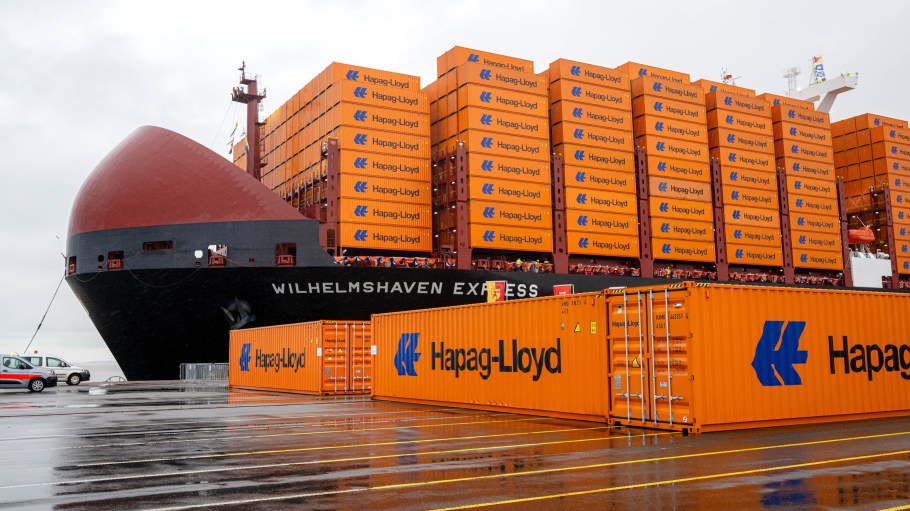
Hapag-Lloyd is spending an extra $40 million to $50 million weekly due to the war in Iran, CEO Rolf Habben Jansen said in a company earnings call Thursday.
The expenses are largely related to increasing rates for bunker fuel, as well as rising insurance premiums and added costs for container storage and inland transportation. Fuel costs have soared since the war began on Feb. 28, as Iran has taken steps to prevent ships from transiting the Strait of Hormuz—the vital oil conduit sitting between the Persian Gulf and the Indian Ocean.
Related Stories
With the company already seeing its top and bottom line figures hampered in the fourth quarter due to declining freight rates, the additional cost burden presented by the Middle East conflict is “not sustainable for a long time,” said Habben Jansen.
“We have introduced a number of contingency and emergency charges to try and recover that,” Habben Jansen said, mimicking decisions made by other container shipping firms to relieve some of the cost burden. “They always come with a certain delay.”
On Monday, the Federal Maritime Commission (FMC) unanimously rejected separate requests from Hapag-Lloyd, Maersk, CMA CGM and ZIM to waive a 30-day notice period to implement surcharges tied to the war, forcing the four carriers to wait until early April to charge their shipper customers.
“In my view, when a carrier seeks special permission to reduce the 30 days’ notice period for a surcharge, the carrier should demonstrate how its increased costs are linked to the dollar amount of the proposed surcharge,” FMC chairman Laura DiBella said in a statement. “An assertion that there are increased costs, without any data on what those costs are, how long they may last, and what steps the carrier is taking to mitigate them, is insufficient in demonstrating good cause.”
Most of the major carriers like Hapag-Lloyd have suspended all bookings to the Persian Gulf due to the conflict.
According to Habben Jansen, six Hapag-Lloyd vessels with a total capacity of about 25,000 20-foot equivalent units (TEUs) are still stuck in the Gulf. Roughly 150 crew members are aboard the ships.
“We will do everything possible to try and get them out, and we will explore every possibility that there is,” Habben Jansen said. “So far, we have not been able to find one.”
The liner has been unable to call ports inside the Gulf, but still calls at major Middle Eastern ports outside the area including Salalah in Oman and Jeddah in Saudi Arabia.
Two Cosco Shipping vessels turn back after attempted Hormuz transit
As carriers scramble for solutions, two Cosco Shipping container vessels aborted an attempt to exit the Persian Gulf through the Strait of Hormuz on Friday.
According to MarineTraffic data, two of Cosco’s ultra-large container vessels, CSCL Indian Ocean and CSCL Arctic Ocean, attempted to transit the trade artery eastbound but reversed course at approximately 03:20 and 03:50 UTC.
This marks the first attempted crossing by a major container carrier since the start of the Iran war.
The denial is notable for happening two days after Cosco resumed bookings for cargo headed from several ports in Asia to the Middle East, in a signal that the state-owned carrier was willing to brave out the risks associated with sailing through the Strait of Hormuz.
Both Cosco vessels operate on the liner’s MEX/ME5 service linking the Middle East with the Far East. That service, also known as MEA5 for the wider Ocean Alliance network, was suspended due to the ongoing hostilities. Cosco is the sole operator of the loop, using seven ultra-large container ships on the route.
The ships had departed from ports in the U.A.E., with CSCL Indian Ocean debarking from the Port of Jebel Ali and CSCL Arctic Ocean sailing out of Abu Dhabi Port.
There has been no confirmation as to why the Cosco vessels reversed course.
On Wednesday, Iran foreign minister Abbas Araghchi said in a post on X that the Islamic Republic permitted passage through the Strait of Hormuz for “friendly” nations including China, Russia, India, Iraq and Pakistan.
Without identifying any vessels, Iran’s Islamic Revolutionary Guard Corps (IRGC) said Friday that it had turned back three container ships of various nationalities trying to cross the strait.
The IRGC added that all ship traffic to and from ports of supporters of the U.S. and Israel was prohibited, according to Iran’s Nournews, which is affiliated with the country’s Supreme National Security Council.