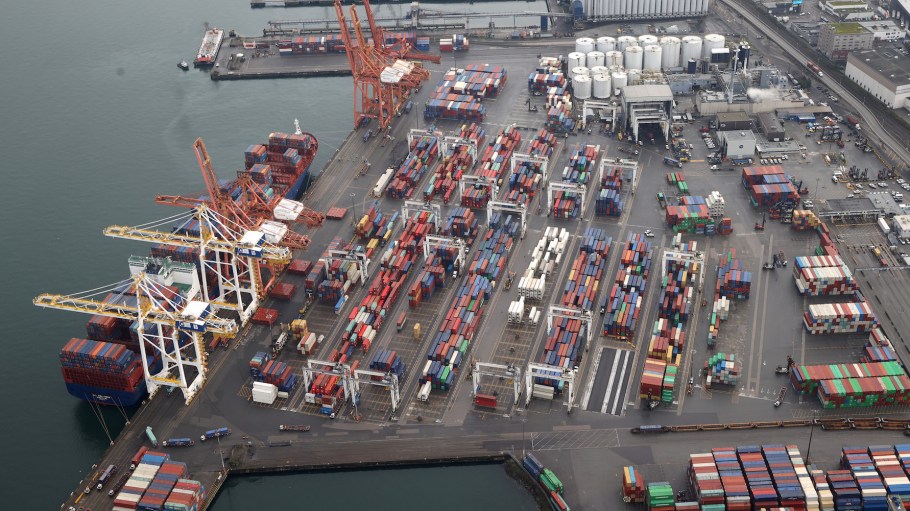
More than 7,000 workers represented by the International Longshore & Warehouse Union (ILWU) Canada have overwhelmingly voted in favor of supporting a strike, throwing yet another wrench into an already complicated situation at the West Coast ports and giving North American retailers new cargo concerns ahead of peak season.
ILWU Canada president Rob Ashton revealed that 99.24 percent of the union’s workers voted on Friday and Saturday to support strike action against the member companies of the British Columbia Maritime Employers Association (BCMEA), if the workers deemed it necessary.
Related Stories
The BCMEA represents 49 member companies at Canadian West Coast ports, including its two biggest gateways—the Port of Vancouver and the Port of Prince Rupert.
Workers would have to file a notice before June 21 to provide 72 hours of advance warning about a disruption, meaning June 24 is the earliest a walkout could occur if negotiations stall.
Contract negotiations started March 28 ahead of the March 31 expiration of the collective bargaining agreement.
“The ports of Vancouver and Prince Rupert are vital gateways for international trade, handling over $350 billion in goods every year,” said Bridgitte Anderson, president and CEO of the Greater Vancouver Board of Trade, in a statement. “We want to avoid another disruption that risks fueling inflation and higher prices for consumers and businesses so soon after the devastation inflicted by the Covid-19 pandemic, heat domes and catastrophic flooding.”
A dockworker strike at the two Canadian ports would compound current labor strife at U.S. West Coast ports. Ports across Los Angeles, Long Beach, Seattle and Oakland, Calif. are among those that have experienced severe disruption since the start of June as the separate, U.S.-based ILWU remains embroiled in its own year-long contract negotiations with the Pacific Maritime Association (PMA), which represents both port terminals and ocean carriers.
With a portion of ILWU dockworkers no-showing their shifts, several terminals across the ports have been affected this month, with the Port of Seattle closing on Saturday through the weekend.
Dockworkers represented by the ILWU want at least 70 percent higher pay while employers represented by the PMA are offering about a 30 percent increase, according to Peter Tirschwell, vice president at S&P Global Market Intelligence.
According to the Vancouver Fraser Port Authority, about 15 percent of U.S. inbound and outbound laden and empty containers move through the Port of Vancouver, which moved 141.4 metric tons of cargo in 2022. Approximately 2 percent of U.S. international laden imports arriving at West Coast ports each year flow through the port, the agency said.
The Port of Prince Rupert moved 24.6 million metric tons of cargo last year, but a larger portion of those goods goes to the U.S.
Approximately two-thirds of containerized import volumes coming into the Port of Prince Rupert are destined for the U.S. market by rail, according to Prince Rupert Port Authority’s vice president of trade development and real estate Brian Friesen.
The Ports of Vancouver and Prince Rupert didn’t immediately respond to Sourcing Journal’s request for comment.
Potential strikes at the Vancouver port would also add to broader West Coast performance problems. In a May report using vessel wait times as an indicator of overall efficiency, the World Bank and S&P Global Market Intelligence listed Vancouver at No. 347 out of 348 worldwide in container port performance—and dead last among ports of similar size.
Eight of the 14 lowest-ranked container ports were in North America, including Prince Rupert, Los Angeles and Long Beach.
RILA encouraged by Julie Su’s involvement in West Coast negotiations
Already closely monitoring the West Coast port problems, the Retail Industry Leaders Association (RILA) indicated that its member retailers are “encouraged” that Acting Labor Secretary Julie Su has engaged with both the ILWU and PMA to help broker a deal.
Su was previously secretary of the California Labor and Workforce Development Agency, and she has longstanding relationships with both labor and management in the state.
“Retailers have successfully navigated myriad supply chain obstacles over the last several years to deliver for consumers, but current disruptions are already leading to ships waiting offshore and unloaded containers piling up,” said the RILA statement. “Further strain on supply chains will put extreme pressure on the economy and inflation. The stakes couldn’t be higher; peak shipping season is just around the corner, which includes back-to-school and holiday items. Uncertainty in retail supply chains at this juncture is unacceptable.”
Tirschwell noted that the dockworker negotiations aren’t the only labor issue to watch on the West Coast. “Further disruption could come from upcoming, separate negotiations with the ILWU Office Clerical Union whose current contract expires on July 1,” he said.