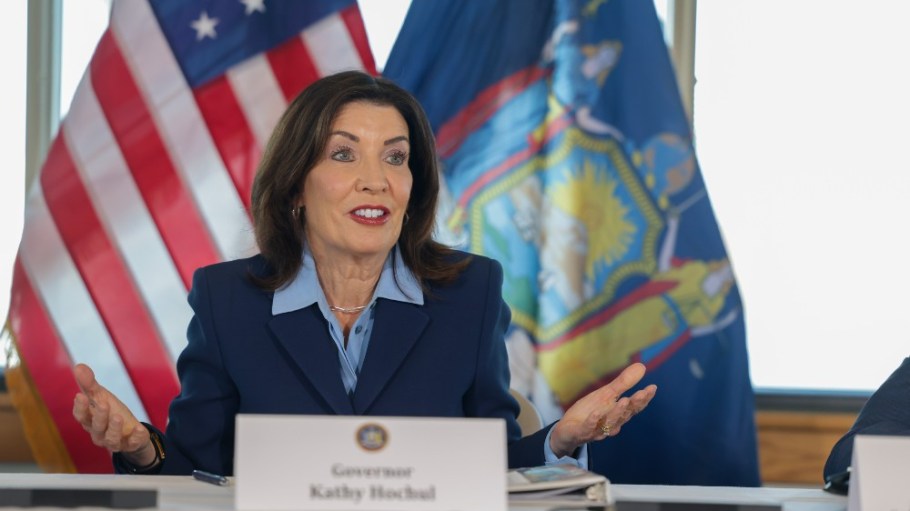
Days after New York joined a 24-state coalition in filing a lawsuit against the Trump administration to block the implementation of its new tariff strategy, Governor Kathy Hochul is suing for tariff refunds on behalf of small businesses and consumers.
Hochul held a roundtable discussion on Monday with New York business leaders, mayors and farmers and called for the immediate return of approximately $13.5 billion that she said was illegally collected from the state under President Donald Trump’s tariff regime.
Related Stories
“The Trump administration’s chaotic tariff policies have put unnecessary and careless financial burdens on farmers, small businesses, and families across New York State,” Hochul said. “The federal government should be uplifting the people that they represent—not taxing them unlawfully,” she added.
Hochul recently met with Victor Schwartz, the owner of VOS Selections, a lead plaintiff in the recent Supreme Court lawsuit against Trump’s International Emergency Economic Powers Act (IEEPA) tariffs. The meeting spurred the writing of a letter to Treasury Secretary Scott Bessent demanding that federal agencies begin the process of refunding tariff payments to New Yorkers.
“New Yorkers have felt the consequences of these tariffs ripple through every sector of our economy. Consumers have paid dramatically more for everyday goods. Small businesses have faced increased supply and equipment costs,” the letter said.
“Millions of New Yorkers are owed a refund for the real and widespread consequences of President Trump’s reckless and illegal tariff policy. Compensation is owed to the people of New York, and New Yorkers look forward to receiving our payout in full,” she wrote to Bessent.
Hochul’s office pointed to data from the Yale Budget Lab showing that households have incurred about $1,751 in new costs since the tariffs were put in place in 2025, adding up to the $13.5 billion in estimated statewide impact. “We are suing for the $13.5 billion that we believe is owed to us. I want to see that money. I don’t care if Donald Trump puts his name on the check. I don’t care. Just get it back to New Yorkers because this money is owed to us,” Hochul said Monday.
Hochul and the business leaders who spoke at the roundtable also pointed to the knock-on effects of tariffs and adversarial actions from the U.S. government, like reduced traffic from Canada, that have eaten way at New York’s revenue. According to the governor’s office, border crossings at the Ogdensburg-Prescott International Bridge fell by 23 percent last year, amounting to a 34.9 percent decrease in toll revenue worth $536,000.
That figure doesn’t even include the losses from tourism in the North County, she added, saying that tariff policies have cost small businesses patronage they thought they could count on and created financial strain.
“The connections between communities on the border in particular are so tight. It’s one larger community, it’s not even viewed as a foreign country, but yet the costs are going up,” Hochul said. “The frustration with this country has led to far fewer Canadians coming across the border, about 3.4 million fewer Canadians across the border, and that has an effect on tourism across the state.”
“Enough is enough—it is time that the federal government refunds the money and helps our businesses, farmers, and families get back on their feet,” she added.
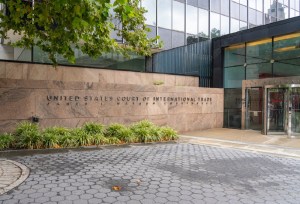
The move follows Thursday’s actions by New York Attorney General Letitia James, who joined 22 other Democratic attorneys general and two governors from states like Arizona, California, Oregon, Maryland, New York and Vermont in suing the Trump administration in the Court of International Trade (CIT) to halt the imposition of a 10 percent universal baseline tariff under Section 122 of the Trade Act of 1974. The Trump administration moved quickly to leverage the little-known, never-used statute in an attempt to preserve some of the tariff revenue lost when the Supreme Court struck down the IEEPA tariffs on Feb. 20.
“Once again, President Trump is ignoring the law and the Constitution to effectively raise taxes on consumers and small businesses,” James said in a statement last week. “After the Supreme Court rejected his first attempt to impose sweeping tariffs, the president is causing more economic chaos and expecting Americans to foot the bill.”
Political leaders aren’t the only ones taking on the administration over its fresh wave of tariffs. On Monday, two small businesses, including Queens, N.Y.-based spice importer Burlap & Barrel, became the first to sue the administration in the CIT over the Section 122 duties.
Represented by the Liberty Justice Center—which previously provided counsel for the plaintiffs in the VOS Selections v. Trump case—the businesses argued that the president is again overstepping his authority to impose tariffs by bypassing Congressional approval. The complaint also argued that Section 122, which pertains to balance-of-payments issues, does not imbue the Commander in Chief with authority to impose tariffs under the current circumstances.