Jyrki Raina, former general secretary of IndustriALL Global Union, which represents more than 50 million working people worldwide, can sum up labor conditions in the garment industry in a single sentence: “Democracy is sliding, it’s still difficult to join a union and nobody’s earning a living wage.”
The statement is no less of an indictment of what he says are the “beautiful,” if ultimately hollow, words that make up brand and retailer promises about safeguarding the rights of the people who make their clothing. If Covid-19 helped broker a loss of trust between buyers and suppliers, then the ongoing supply chain challenges caused by volatile consumer demand, geopolitical turmoil, trade issues and mounting regulatory pressures could threaten to damage the relationship irretrievably. Workers, too, are increasingly leery of their employers, who, for their part, see those fighting for greater freedom of association as troublemakers.
Related Stories
“As we see in countries like Bangladesh now with the unrest, people are not passive,” the recently inducted Fair Wear Foundation board member said of the worker disquiet that has continued to brew in the aftermath of former prime minister Sheikh Hasina’s unceremonious ouster in August, compounding production delays that have raised questions of whether brands are cutting and running in the face of the nation’s uncertain future. “When I talk to workers in factories, they all say that ‘I just want dignity, a better life and a better wage.’ These are very simple things.”
Or perhaps not so simple, as the events of the past year have demonstrated. When fashion purveyors respond to disruptive crises such as conflict and natural disasters by abruptly axing orders or dropping suppliers without a responsible exit plan, vulnerable workers at the “sharp end of fashion supply chains”—most of them women in the global South—end up bearing the brunt when they lose their jobs or miss out on wages, said Natalie Swan, labor rights program manager at the Business & Human Rights Resource Centre. Migrant workers, too, are frequently overlooked despite a higher risk of exploitation that can result in what is essentially bonded labor.
The nonprofit organization says it has logged a spike in the coverage of garment factories—and therefore workers—being negatively affected by changes in buyers’ commercial practices. Between March and September alone, it logged 28 cases of alleged human rights abuses involving thousands of workers across the world, which it says were exacerbated by the continuing price squeeze, growing order instability and an increasing shift to alternative sourcing countries. This has led to a trail of shuttered factories, many linked to some of Main Street’s most recognizable names, and already precarious livelihoods left hanging in the balance.
It’s all very fraught, as Ayesha Barenblat, CEO of fashion advocacy group Remake, said of an industry where authoritarianism remains much on the ascent, resulting in “outright assaults” on workers’ ability to organize.
“What we are seeing across the board with our worker and union partners is a lot of state-sponsored violence, union-busting cases, precarious commercial practices that put workers in further harm’s way when they try to collectively bargain, and a lot of deafening silence when it comes to brands and retailers in supporting or lending their voice to building healthy industrial relations, which we know is so core to ensuring good working conditions,” she said.
Discounting worker voices is particularly dangerous in an age of worsening climate change and the heightened risk of sickness and death that extreme heat, drought, flooding and other hallmarks of rising global temperatures bring. And things are, indeed, getting worse. Research from Cornell University this month found that five major apparel production centers, including Dhaka in Bangladesh, Ho Chi Minh City in Vietnam and Karachi in Pakistan, have seen a 42 percent surge in high-heat stress days over the past two decades.
“If you are on a short-term contract, if you aren’t part of a healthy, functioning union, then when there is a flood or a heat event, you don’t have a voice at the table to advocate for better conditions,” Barenblat said. “Core to the solution when it comes to the climate crisis is what we in the labor rights and human rights community have been asking for all along, which is healthy industrial relations.”
‘Have not delivered’
That wages haven’t experienced the same kind of breakthrough that occupational health and safety has—thanks, in no small part, to the International Accord for Health and Safety in the Textile and Garment Industry—requires a “paradigm change” in the way multinational corporations are held accountable for their supply chains, even “little by little,” Raina said. Even if the European Union’s corporate sustainability due diligence directive is further watered down, as rumors in Brussels are suggesting, it’s still “symbolically important” because it holds large businesses to the same legal standard.
“Until now, [while] some brands have done voluntary initiatives, others have not. They’ve just been hiding and keeping their head down and thinking, ‘Please don’t see us, then we can continue our way,’” Raina said. “What has happened so far is that brands say that [they] can’t act alone, so they’re looking to others for joy because they can’t lose their competitive edge. Part of that is crap as well—yes, you can if you’re as good as you say you are on your website and in your annual sustainability reports.”
The fact is that brands “have not delivered” when it comes to improving wages, he said. According to The Industry We Want, a joint initiative by Cascale, the Ethical Trading Initiative and the Fair Wear Foundation, this past year maintained a 49.5 percent overall gap between minimum and living wages for garment workers across 28 key countries, meaning they’re receiving a little over half of what they need to attain a decent standard of living. The improvement from the year before? A mere 1 percent.
Wages that cannot meet price increases fueled by skyrocketing inflation and other fiscal ills is one of the foundational grouses behind Bangladesh’s worker protests, which have refused to be quelled despite efforts by the interim government and the support committee holding up the Bangladesh Garment Manufacturers and Exporters Association, both of which are poised to hold elections in the coming year. An annual 9 percent salary increase beginning this month has been met with mixed feelings: from factory owners, who are struggling to pay off their bills, and from workers, who deem the hike completely insufficient.
Nazma Akter, executive committee member of IndustriALL, executive director of the Awaj Foundation and president of the Sommilito Garments Sramik Federation, called the increase a “pittance” that continues to leave garment workers “unable to survive.” She urged the government to establish a new minimum wage board as soon as possible and revise wage levels so they no longer have to contend with “starvation wages.”
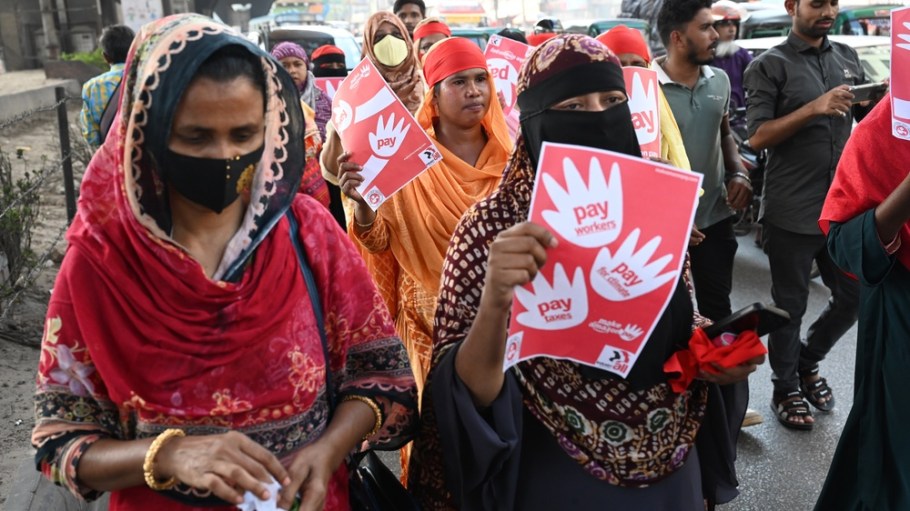
On Friday, Akter was on the frontlines of a “Make Amazon Pay” demonstration in the capital of Dhaka. Among the protestors’ demands were fair wages, freedom of association and for the e-tail Goliath to sign the International Accord.
“When it comes to living wages, it’s really about, fundamentally, a shift in the business model, and it’s going to cost companies money, and that’s why I think we’re stuck in this continual phase of piloting living wages or having policies around trying to aspire toward them,” Barenblat said. “Really, it comes down to money. When it comes to some of the other issues around occupational health and safety or eradicating child labor, I think we’ve made more progress.”
There are also the Sheins and Temus of the world to grapple with. With ultra-fast fashion’s tack of stratospheric production volumes at exceedingly low prices becoming the “most powerful way” that we’re producing clothes, there’s “simply no room” in business models to pay workers to have dignified, climate-resilient jobs. What we’re doing is “tinkering on the edges,” she said.
“No sustainability CSR team has the power to make any progress around living wages, because that’s where you have to have the board and the executives and the CEO involved to say what we’re needing to do is fundamentally make a doable, different kind of product that costs more and that respects people on the planet,” Barenblat said. “Most voluntary efforts are about business as usual, which is why we’re needing regulation.”
Shifting the power balance
Jeff Vockrodt, who joined the Fair Labor Association as the multi-stakeholder organization’s president and CEO a year ago, considers himself a “stubborn optimist.” He said he has seen progress in 2024 because transparency and accountability in supply chains are increasingly no longer options but rather requirements, especially with mandatory due diligence coming into play.
“I think there’s also a greater recognition that there’s value in doing the right thing, and I think we can’t underestimate that,” Vockrodt said. “And that shows up in workers’ pride in working for a brand and their commitment to the company if they think the company is respecting human rights. So I think there’s that increased sense among employees as well as investors and workers, that helps drive progress. I mean, nobody wants to be satire on SNL.”
Vockrodt is similarly bullish on Bangladesh. He pointed to a statement that the organization published with Cascale, the Fair Wear Foundation and others in August about the importance of maintaining responsible business practices in the country as conditions evolve.
“I think it is very important to have a unified approach to responsible business conduct and responsible purchasing practices in a time when Bangladesh is going through this crisis,” he said. “That statement reflects our optimism about the future of Bangladesh, and also highlights specific steps that companies can take to address risks to workers and to maintain and grow good relationships with suppliers.”
At the same time, as someone who spent a “good chunk” of his career in the union movement, Vockrodt says there can be no substitute for engaging with workers and worker representatives if the industry seeks to understand the “reality of a workplace,” complete with the massive power differential that stymies genuine dialogue.
“I do think that democratically elected representatives of workers have a very fundamental role to play in the overall effort to advance human rights at work,” he said. “So I think continuing to improve the way companies engage with workers and their representatives, and stakeholders in general, is a real opportunity.”
J.J. Rosenbaum, U.S. director of the nonprofit Global Labour Justice agreed, bringing up the example of the two-year-old Dindigul Agreement, a binding pact between the Dalit-woman-led Tamil Nadu Textile and Common Labour Union, Eastman Exports, Gap Inc., H&M Group and Calvin Klein owner PVH Corp. to end gender-based violence and harassment in southern Indian factories like Natchi Apparel, as a rare success story—one that modified a Withhold Release Order from U.S. Customs and Border Protection, no less.
“I think that it’s really critical, given the power dynamics in supply chains, that workers themselves have an organization, usually a union, that can sit across from management and work it out to solve problems,” she said. “And that’s just going to be fundamental to challenging day-to-day things like gender-based violence and harassment or ongoing health and safety problems in the workplace.”
Voluntary programs have their place, she said, but they’re not “fundamentally” going to challenge that power imbalance.
“On the other hand, strong labor management relationships, backed up by sourcing commitments, can help solve all kinds of problems,” Rosenbaum said. “You know, if these programs have been in place during the pandemic, there could have been a much different conversation about what workers needed to survive those very difficult times. If there needs to be changes in the the assignments of workers, or if there are shifts in sourcing in a factory, discussions with the union can enable that to happen much better.”