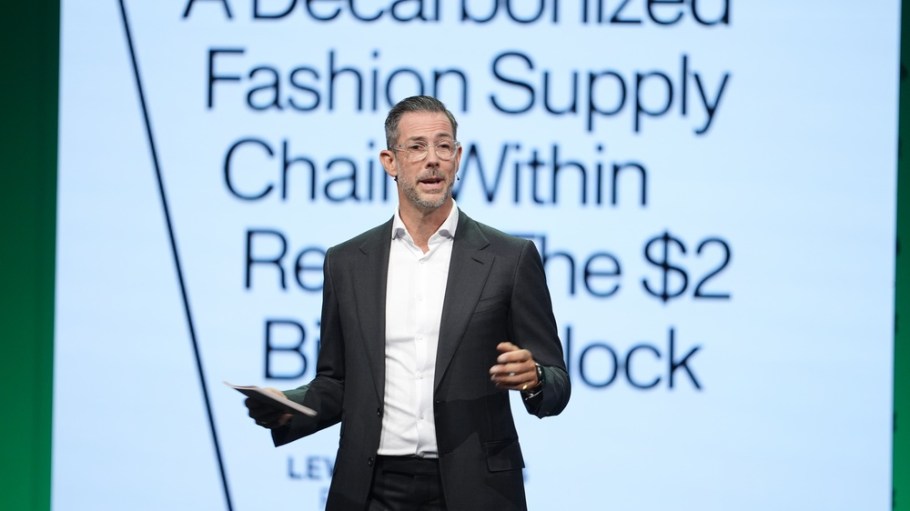
When Lewis Perkins, president of the Apparel Impact Institute, made his pitch for a “fashion climate fund” at the Global Fashion Summit in Copenhagen in 2022, he expected brands to clamor to sign on.
Yes, the industry was still recovering from the debilitating aftereffects of Covid-19, but a phenomenon known as “revenge spending” was also surging as hordes of consumers stormed shops in search of normalcy after months in lockdown.
Then there was the intensifying need to move beyond talking about climate change to tangible, measurable action. The $250 million war chest Perkins envisioned would unite the “power of big philanthropy” with corporate leadership to identify, fund and—most important—scale verified solutions capable of slashing 100 million metric tons of carbon dioxide by 2030.
Related Stories
H&M Group, H&M Foundation, Lululemon and The Schmidt Family Foundation each chipped in $10 million as lead donors. With that early momentum, Aii’s goal of “unlocking” an estimated $2 billion in blended capital, including debt and equity, to help the sector halve its greenhouse gas emissions, didn’t seem far-fetched.
Already, the nonprofit was running programs in regions responsible for 70 percent or more of garment manufacturing’s carbon emissions, including Bangladesh, China, Pakistan, India, Italy and Vietnam. It just needed more to do more.
“The biggest challenge we face today is not a shortage of ambition, or of ideas or even money,” Perkins said onstage at the Danish capital’s famed Royal Opera House. “The biggest challenge we face today is in bringing all the right players to the same table, to bring the most powerful forces together, and to properly resource this work in order to unlock even greater impact.”
Four years later, however, the “new era of climate finance” he hoped to usher in hasn’t quite materialized. Other big names did come on board, including Calvin Klein and Tommy Hilfiger owner PVH Corp., Target and HSBC. But grand corporate gestures, paired with equally flashy press releases, have given way to a more cautious silence as companies grapple with tariff volatility, conflict in the Middle East and a growing political backlash against “woke” causes that makes aligning with sustainability a fraught proposition.
That pullback is evident in Aii’s 2025 annual report, published last week: Of the 100 million-metric-ton target, only 10.9 percent has been achieved, up from 8.6 percent the previous year. Just 9.41 percent of the hoped-for $2 billion has been unlocked, a small uptick from 7.81 percent in 2024.
The paltry level of progress was illustrated once more with the silhouette of an iceberg and the number of gray rectangles left unfilled by George Washington-fronted greenbacks.
Perkins, a little older now, attributes the slowdown to prevailing conditions that make multi-year commitments a tougher ask, certainly, but also because the proverbial “low-hanging fruit” of improving factory efficiency—think improving insulation, installing meters, recovering heat—is being exhausted.
“These projects are relatively low cost, and therefore of relatively low risk to suppliers,” he said. “Now we’re talking about real investments as we go into total electrification over the next 10-15 years. We’re looking at steam heat pumps and other seven-figure investments. The numbers are only going to get bigger, so what is the business case?”
What’s needed now, Perkins said, is a narrower focus that makes the worst-performing factories less bad and the less-bad better. The math bears out: Some 1,500 facilities across nine countries are behind 80 percent of the industry’s carbon emissions, according to Cascale and Reset Carbon. Continuous improvement is one thing, but it’s often radical, targeted action that’s required to move the needle.
“We’re sitting at a moment where actual deployment of capital into these projects is going to be trickier, but it’s also going to hopefully yield bigger results,” he said. “We’re obviously going to collect better and more data. We’re going to recruit more facilities. We’re going to learn about new technologies. But for the most part, we have everything that we need.”
This is why, over the next five years, Aii plans to invest at least 20 factories annually to implement capital-intensive, technologically advanced climate solutions capable of delivering high-impact emissions reductions. While the money raised through the Fashion Climate Fund is “nowhere near good enough,” it’s still a sizable sum that can take a number of facilities “across the finish line.”
“If we did 20 a year over the next five years—and that’s a conservative number—that’s 100 facilities,” Perkins said. “If you take that number, and you look at [Higg Facility Environmental Module] data, you look at our benchmark data, and you start to align this to the highest potential CO₂ emissions reduction, it’s a lot more meaningful to do 100 strategic suppliers than 1,500 minor ones.”
Even so, financing is only part of the problem. Suppliers also need to know that buyers will stick with them for the long haul to justify these major improvements. In a sector built on short-termism, that can be a significant roadblock. What manufacturers want to see from brands, Perkins said, is some “skin in the game,” the ability to co-design solutions rather than receive commandments from on high and a line of sight that extends beyond 12 months.
“Suppliers are in the position to tell us what will or won’t work for them,” he said. “And obviously, free money and lots of it is always going to be a thumbs up. But what we’re beginning to learn is they can self-finance some of these projects, or at least a large portion of them, if there is confidence in the relationship to the brand longer term.”
Another important piece is starting the right conversations earlier.
“If we’re going to run a feasibility study on a steam heat pump that says five to six months down the road that this is a viable solution for your facility, we don’t want to find out at that point that there isn’t financing teed up or it was never going to make the investment in the first place because management doesn’t see it as important enough,” Perkins said.
Perkins didn’t attend this year’s Global Fashion Summit, but he wasn’t surprised to hear about the palpable shift in how sustainability was being branded: less as a moral imperative and more as an existential financial priority. It’s the only way to make the business case land, he said.
“I think this is the right way to frame it,” he said. “Supply chain improvement budgets or philanthropy are only going to go so far, and there’s an appetite for an ROI beyond just the climate or just the carbon reduction. There’s a large emphasis on getting the CFO to the table. We’re having the right conversation we should have been having all along. But we didn’t have the information we do now.”
Perkins still identifies as the optimist from 2022, albeit one tempered by realism.
“I think I’m more thrilled at what we pulled off in 2022, knowing what challenges we’ve seen since,” he said. “Present-day me is thrilled that we got as much as we got, because we’ve been able to really use those resources to build something strong that’s now got an opportunity to continue. I think everybody’s pretty sober at the table about it, and that’s good, because we’ve moved beyond the maybe fluffier stages of the work.”
“I remain ambitious,” Perkins added.