Under the motto “Lead the Change,” Heimtextil 2026—the premier global trade fair for home and contract textiles, held this week at Messe Frankfurt in Germany—considered how the sector’s challenges can actually be chances for change.
“In challenging times, Heimtextil offers the industry a stability,” said Olaf Schmidt, vice president of textiles and textile technology at Messe Frankfurt. “Heimtextil translates social movements into tangible business opportunities.”
Related Stories
One solution? An updated layout.
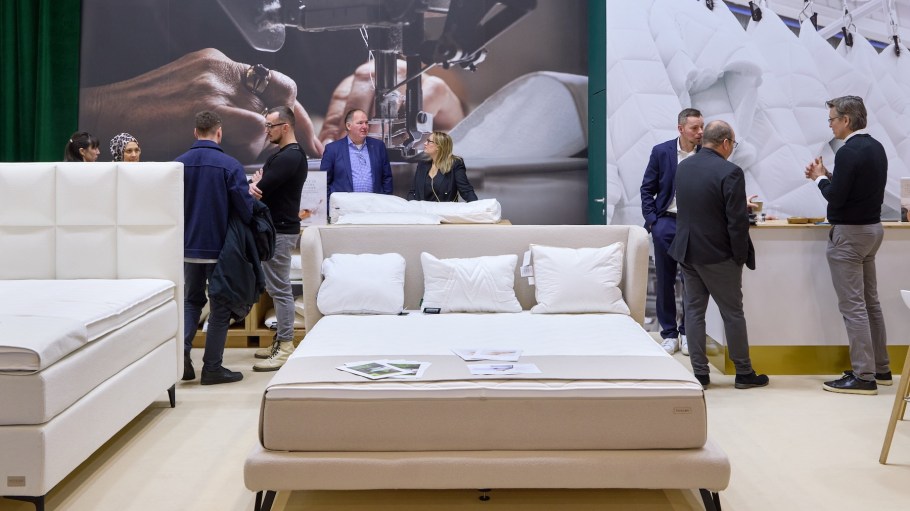
The 2026 edition launched a new hall concept—one combining product groups across the gamut of textile and non-textile interior design. Together with the German Mattress Industry Association, Heimtextil’s “Sleep & Meet” area connected bedding retailers with hospitality players and volume buyers in an exclusive setting,” the trade show said, one “supporting new product range strategies and consumer developments.” Plus, the nascent hub of the Smart Bedding segment within this area serves as the “central meeting point” for the mattress and sleep sector.
“Together with the industry, it continuously evolves in line with market needs—in terms of content, strategy and structure,” Schmidt said. “With the new hall layout, we create a business tool that increases visibility, strengthens synergies, brings supply and demand together in a targeted manner and opens up new markets.”
For HeiQ, the new hall has proven positively impressive.
“The footfall has been excellent; we had a really good first day and the morning was excellent,” said Musa Raibin, chief sales officer of textiles at HeiQ. “Usually, the first day is a journey of discovery for a lot of people. I think the new layout has made people want to come in and have a conversation the first time they see a company.”
At Heimtextil, the Swiss-based international textile and materials innovation company focused on its biotech solutions. Such as HeiQ Allergen Tech, a biobased, proprietary technology that reduces exposure to allergens (such as house dust mite matter and pet and pollen allergens) by leveraging “probiotic textile technology.”
This combination of prebiotics and probiotics—thus becoming “symbiotics,” per HeiQ—colonizes textile surfaces with good bacteria. The technology’s blend of active probiotics produces a range of enzymes that break down various allergens. The patent-pending biotechnical solution is ideal for reducing irritants in home textiles, such as mattress fabrics, bed linens and upholstered furniture.
“We don’t consider ourselves a giant in terms of scale, but we want to make a difference, so we do things very differently,” Raibin said. “That creates a lot of impact and that’s how we want to picture and question ourselves in the market.”
Eastman, meanwhile, saw slow-to-steady foot traffic on the first day of the show. While it’s the Tennessee-based fiber maker’s third straight year at Heimtextil, the quality of conversations from that foot traffic was better than before.
For Chad Doub, Eastman’s global segment market manager of casualwear and home textiles, the difference is both palpable and promising.
“At the end of the day, we want to have the opportunity to engage and have good, quality discussions,” Doub said. “I’ve seen a few folks that came to our booth last year; some have already come back and they’re asking different questions. It’s not so much ‘what’s easy’ or ‘what’s new’ but what to do now—they want to know and understand more to be part of what’s next.”
On that note, while Eastman’s Naia cellulosic fiber is made from sustainably sourced wood pulp, Naia Renew incorporates recycled waste plastics. By focusing Heimtextil on Eastman’s home textiles solutions, then, it is an effort to advance Eastman’s overall objective of making sustainable textiles accessible to the masses.
“We can’t be everything to everybody, right? But we do have a play here. I think it’s important with innovations to really help our value chain partners know what options they have,” Doub said. “Because ultimately, we don’t make pillows, we don’t make sheets, we don’t make duvets. We’re just part of that solution as an ingredient fiber to help them deliver the end product to the consumer.”
Trident Limited, the flagship company of Trident Group, presented its TG collection at Heimtextil, built around the theme “Visible Invisible,” bringing together contemporary design and innovation—plus a particular focus on sustainability and artificial intelligence (AI) in home textiles.
The Indian business conglomerate and global player’s participation at Heimtextil underscores Trident’s focus on expanding its European footprint amid improving trade prospects driven by proposed Free Trade Agreements (FTAs). Commenting on the group’s European strategy, Abhishek Gupta, CEO of strategy and marketing, said that the global home textiles market is estimated at around $136-140 billion, plus steady growth expected over the coming years.
“With favorable trade developments on the horizon, we are investing in local leadership and showcasing collections that reflect European preferences for sustainability, quality and design,” Gupta said. “Against this backdrop, Trident is positioning itself to deepen partnerships with European retailers and scale its business responsibly.”
That said, the global home textile market is poised to grow from $25 billion in 2025 to $32.6 billion by 2030, according to a report from Mordor Intelligence, driven by a steady real estate market and consumer spending on home renovations. To put such growth into perspective, that increase is comparable to the projected expansion of the smart home devices market—set for substantial gains in the same period—underscoring significant investment opportunities in the home textile sector.
It’s one of the reasons Heimtextil already has a new partnership with the Hospitality Interiors Europe (HINT) planned for next year. That launch will coincide with a complementary event alongside Heimtextil 2027, targeting decision-makers in the hotel and high-end hospitality design sectors.
“In hospitality, textiles are drivers of guest experience and market relevance. At Heimtextil, we demonstrate their full impact for interior design and hospitality on a global scale,” Schmidt said. “Together with Hospitality Interiors Europe, we expand our reach in contract business and enhance our offer: We create a shared space for innovative, high-end hospitality design—and open up significant opportunities for architects, interior designers and project developers.”