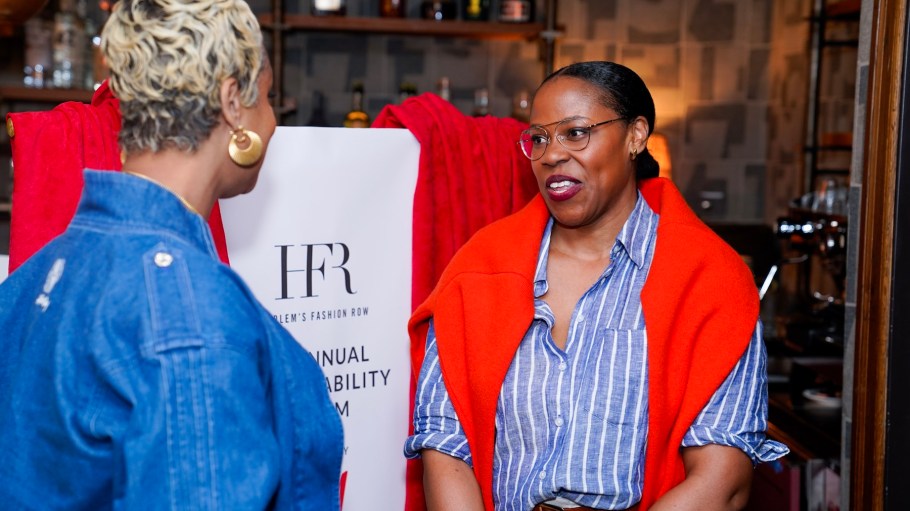
At a moment when sustainability efforts are facing economic pressure and increased scrutiny, Harlem’s Fashion Row (HFR) opened its annual event with a more measured tone.
Founded in 2007 to showcase designers of color, HFR is positioning sustainability as a collective, evolving goal. At its fifth annual Sustainability Forum—held in partnership with H&M on Earth Day in New York—speakers emphasized inclusive, actionable steps over perfection, reinforcing the importance of diverse participation in shaping the industry’s future.
Related Stories

“This is not the most ideal time for us doing sustainability work,” said Brandice Daniel, founder and chief executive officer of HFR. “But it is more important than ever that we recognize people who have intention to do this work. Not any of us are going to get it 100 percent right.”
Daniel also stressed the role of representation in shaping the conversation.
“A lot of times in this space, not all voices are heard,” she said, adding that inclusion is a necessary part of how sustainability is defined and practiced. Such framing carried throughout the following discussions, positioning sustainability less as a fixed standard and more as an evolving system—one spanning material choices, business models and, increasingly, cultural inclusion.
“It’s hard to believe that it’s been five years and we have been on this journey with you for four years,” Donna Dozier Gordon, head of inclusion & diversity for H&M Americas, said.
For H&M—a returning partner to the summit—the multinational retailer’s sustainability efforts are increasingly tied to measurable outcomes. The Swedish company recently reported a 25 percent reduction in greenhouse gas emissions across its supply chain, bringing it closer to its goal of a 30 percent reduction by 2030.
“A lot of the work that we do is on the back end,” said Randi Marshall, head of sustainability and public affairs at H&M Americas. “Working with suppliers . . . That’s really where the big impacts are.”
Marshall also pointed to the growing intersection between environmental targets and regulation—noting that policy considerations now shape decisions about materials, sourcing and compliance.
Resale emerged as a central driver of the discussion. H&M has expanded its “pre-loved fashion” inventory through in-store concepts—in New York with Awoke Vintage and in Los Angeles with Wasteland. The idea is to source secondhand inventory from local players, beyond its own previous offerings.
“We’re targeting the fashion-aspire customer,” Marshall said, adding that the model allows shoppers to access a wider range of brands and experiment with style. The shift, she continued, also matches customer patterns. Approximately 65 percent of Gen Z consumers have purchased resale items in the past year—what Marshall suggested reflects continued growth in the category.
At the same time, Marshall acknowledged the operational complexity of scaling resale within a traditional retail framework.
“Getting the right products to the right person at the right time is completely different than it is for our regular assortment,” she said. Going forward, Marshall pointed to regulatory developments in the European Union, where upcoming eco-design requirements will set standards for materials and durability.
“If you do not meet the threshold, you cannot put it on shelves,” she said in reference to proposed regulations that would determine market access based on product criteria.
In addition to operations, the conversation addressed shifting perceptions of resale across different communities, including long-standing stigmas associated with secondhand clothing—and how those perceptions are evolving.
“I have a gold mine in my closet,” Marshall said, describing increased consumer awareness of value in existing garments; reuse remains a priority within broader sustainability frameworks in turn. Regarding waste hierarchy principles, Marshall stated that the “highest and best use is reselling or reusing what you already have.”
As brands work to implement circular initiatives, Marshall highlighted the difficulty of scaling secondhand sourcing and distribution—reiterating that achieving sustainability requires persistent effort and creativity in overcoming operational barriers.
“Sorting is going to be the next big thing,” she said.