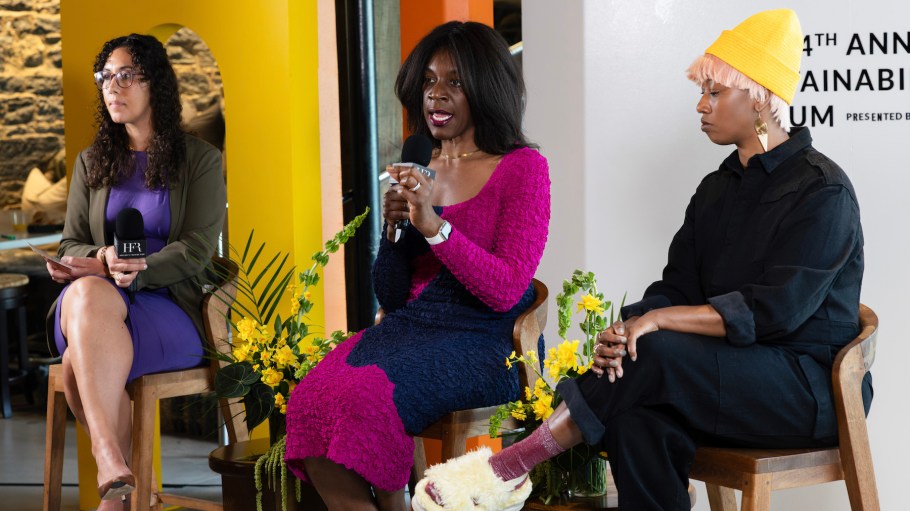
Harlem’s Fashion Row (HFR) held its fourth Sustainability Forum—presented by H&M—on Earth Day.
Hosted at Soho Works in Brooklyn, Macy’s was among the sponsoring organizations, alongside FabScrap, Cadence and Pickle. Founded by Brandice Daniel in 2007, the New York-based firm aligns brands with emerging talent to bridge the gap between multicultural designers and the fashion industry at large.
“We can’t do this work in isolation; we can’t do this work siloed. We have to do it with each other,” Daniel said to the crowded room. “It’s going to take every perspective, every voice, and every kind of movement at the table. This is what makes this summit so special—this is a safe space to stretch our thinking, ask real questions, and, most importantly, find collective strength.”
Related Stories
The first panel—titled “Threads of Change”—set the bar high, hitting all three efforts in under 20 minutes. Moderated by NYC Fair Trade Coalition’s executive director Andrea Reyes, the panelists redefined “sustainable fashion through equity, community and craft.”
For Dominique Drakeford, that began with establishing a baseline; one she believes to be in a pivotal period: the Renaissance. As co-founder and chief curator of Sustainable Brooklyn, Drakeford works to “bridge the gap between the sustainability movement and targeted communities” to elevate disenfranchised voices.
“We have been conditioned and inundated—almost psycho-socially pushed—to understand sustainability in one way,” the Compost, Cotton & Cornrows podcast host said. “There has been a very whitewashed narrative around sustainability; who are the vanguards, who gets to benefit—financially and otherwise—on top of lackluster discussion around Black and brown indigenous communities who are the most affected by unsustainable practices globally.”
When Drakeford moved to New York City from Oakland, the self-described “cultural sustainability vanguard” was lonelier than the Best Coast, leading Drakeford to “make some decisions” surrounding how she showed up.
“I didn’t see myself represented—but, more powerfully, the system with which people are dying and experiencing violence and harm from the environment are the very people—or are part of the engine—who are talking about sustainability,” she said. “How [can I] be a catalyst…to reframe how we understand and interpret sustainability so we can get to the root of the issue.”
The root of the issue is not capitalism, by the way. It’s colonialism.
“I call it the colonial climate crisis because we have to call the spade a spade and have honest conversations about [sustainability],” she continued. “We have honest conversations about what is creating this system, who is maintaining this system, who is benefiting from this system and who is not,” said Drakeford. “It was important to me to tap into the DNA of folks who have created astounding models of sustainability—across all different industries and interests—so that I can be part of the solution challenging mainstream discourse.”
Many are unaware of that definition anyway, according to Ngozi Okaro, founder and executive director of Custom Collaborative. When visiting the award-winning activist, advocate and attorney’s nonprofit, one South African woman shared that she hadn’t heard of “sustainability” before. However, her community in Angola regularly performs the very same practices, just without a designated definition.
“There’s nothing new about creating clothing,” said Okaro. “There is something new about disposable clothing and disposable people.”
To that end, Drakeford’s “unsustainable system” comprises three pillars—marketing, education and policy—as “the primary drivers conditioning our perception to create unequitable systems that are super exploitative and extractive.” It’s also why Drakeford’s definition of sustainability centers around the oft-neglected pillar of culture.
“The Venn diagram of ESG never quite resonated and I didn’t understand why, and then I realized that the cultural piece of sustainability is the pulse of what it means to be regenerative,” said Drakeford. “I define sustainability from a very culturally rich landscape rooted in Black and brown indigenous care and practices. It’s about being able to not only be part of an ecosystem, but build an ecosystem connected with the land—connected with culture, connected with people—while also mitigating the BS that has been taught to us.”
For Okaro, sustainability means people, planet and practice.
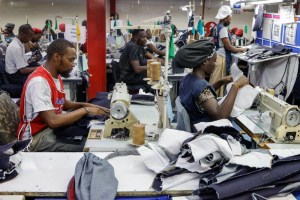
“I do not care what the origin of your cotton is if the person who sold it was not paid a living wage,” said Okaro. “If that person did not have access to bathroom breaks. If that person was subjected to sexual harassment and assault in order to keep this underpaid job.”
Thinking about the people side hits “very close to home,” she continued, as estimates allege 80 percent of those workers are women of color.
“For me, it’s not a bargain if I buy a $5 T-shirt because I know who was cheated,” said Okaro. “And it’s the people who have always been cheated.”