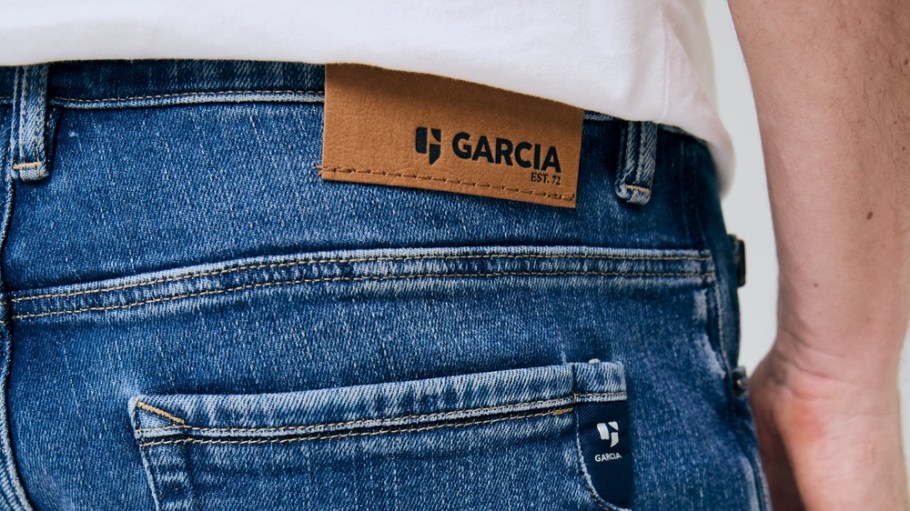
Scattered across Garcia storefronts in the Netherlands since the end of February, 800 pairs of jeans have a provenance worth pointing out. They’re the result of a yearlong pilot program to determine whether post-consumer textile waste collected nationwide can be sorted, recycled, spun and reintroduced into denim production.
The project was the brainchild of the Amsterdam-based Denim Deal, a global pact between brands, recyclers and manufacturers that aims to make circularity the industry standard by producing 1 billion pairs of jeans containing at least 20 percent post-consumer recycled cotton by 2030.
Related Stories
Funded by Stichting UPV Textiel, a Dutch nonprofit that helps producers meet extended producer responsibility obligations for textiles, the initiative brought together a full complement of stakeholders: Sympany and Cibutex, which did the sorting; Frankenhuis, which handled fiber opening and recycling; Spinning Jenny and Bossa, which spun the fibers into yarn and fabric; Garcia for designing the consumer-facing product; and Reverse Resources and TexRoad for data collection and analysis.
On paper, 800 pairs of “circular denim” doesn’t sound like much, admitted Laura Vicaria, program director at Denim Deal. The organization was hoping to get “maybe a couple of thousand” pieces but encountered challenges that it plans to detail in an upcoming report.
Then again, she said, scale was less the point of the pilot than the lessons it offered in how different scenarios might play out and where bottlenecks might form: cross-border waste flows, say, or poor quality-spec communication. The project also dug into technical attributes such as fiber quality, feedstock consistency and how material input relates to usable output.
“And then, of course, the big one is the pricing,” Vicaria said. “What is the cost of all of this? What type of eco-modulation is needed to adjust EPR fees based on recyclability?”
The Netherlands approved EPR for textiles in April 2023, putting the regulations into force three months later ahead of the broader European Union-wide effort to better manage the continent’s waste. In 2025, clothing and household textile producers, suppliers and importers were required to collect and prepare for reuse and recycling 50 percent of what they sold in the preceding year. This year, they must achieve 55 percent, rising 5 percent annually thereafter to reach 75 percent by 2030.
At present, producers must pay 0.24 euros (28 cents) per kilogram—double 2025’s preliminary rate of 0.12 euros (14 cents). Implementation of an eco-modulation regime with higher fees for “difficult to recycle” materials, such as multi-material blends or those with polyfluorinated chemicals, is still ramping up. Following the EU’s ecodesign for sustainable products regulation, the Netherlands also plans to factor in durability, lowering EPR fees for longer-lasting goods.
The pilot stands out because collectors, sorters and recyclers had never before engaged at this level with yarn spinners and mills, said Nicolas Prophte, a member of Denim Deal’s steering committee. Understanding how process inefficiencies, logistical barriers and less understood—or even underestimated—issues such as contamination and customs red tape impact the supply chain was invaluable, he added. They enabled Denim Deal to “move beyond assumptions” to determine the real-world constraints.
“We take some things for granted,” Prophte said.
To scale this, the industry needs to “retrain” itself from a linear way of working to grasping what a reverse supply chain entails, Vicaria said. This includes building systems that didn’t exist before and asking questions you didn’t anticipate.
“I think the thing that surprised me is that it’s actually quite simple,” she said. “It’s that sharing of information that just isn’t there, and it has created huge bottlenecks and a lot of surprises across the way in terms of what was sent, does it work, what type of software do you need, the type of data that needs to be shared in terms of quality.”
But creating that kind of visibility is also exciting, Vicaria added. Denim Deal’s goal isn’t to test in small volumes but rather apply the learnings to “go to the next level and move real amounts of post-consumer content,” she said.
Then, after this “transition point,” comes the overarching question: Will there be demand for the products?
“And that’s a question mark for all of us, and I think that’s the big role that UPV needs to play in terms of incentivizing that,” Vicaria added. “What is a bonus for brands to use post-consumer content that can really drive that use of post-consumer content? That’s, for us, the big elephant in the room.”