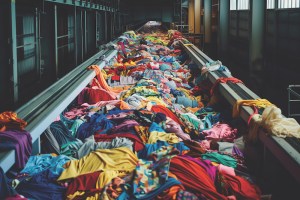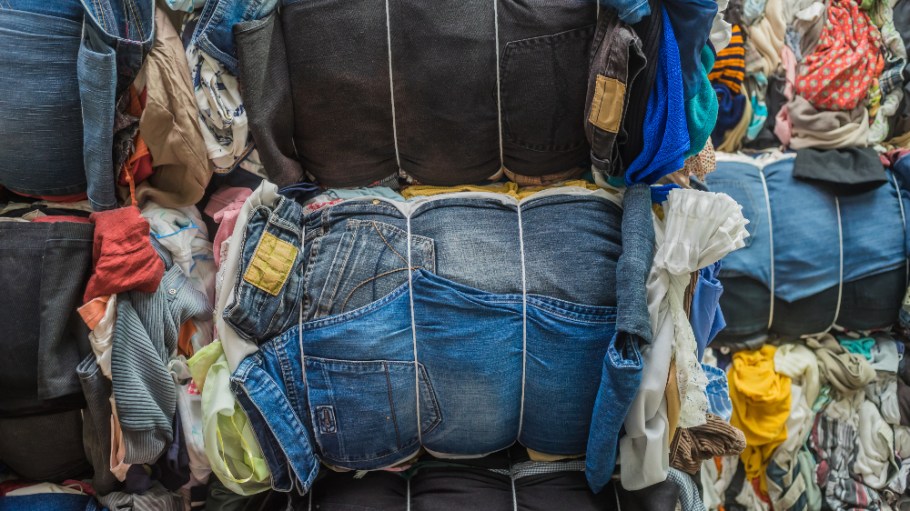
The United States published its first federal report on textile waste earlier this month, marking the first time the government acknowledged fashion’s (arguably biggest) challenge.
The Government Accountability Office (GAO)’s study, titled “Textile Waste: Federal Entities Should Collaborate on Reduction and Recycling Efforts,” comes as the GOA was asked—namely, by Representative Chellie Pingree (D-Maine), founder of the congressional Slow Fashion Caucus—to review issues related to textile waste and recycling, GOA-25-107165 states.
Related Stories
“GAO found that most federal entities’ efforts are nascent, and their approach depends on their mission and expertise,” the study reads. “Further, federal entities carry out individualized efforts on textile waste and recycling and give these efforts a lower priority than other goals.”
The resulting report hit three main points: how textile waste affects the environment, as well as how—and why—the rate of textile waste within the United States has changed over the last two decades. Federal actions to reduce textile waste and advance textile recycling, plus what collaborative opportunities are on the table, were also explored.
“GAO recommends that Congress consider providing direction to a federal entity (or entities) to coordinate and take federal action to reduce textile waste and advance textile recycling,” per the report. “GAO is also making seven recommendations to six federal entities, including that they coordinate through an interagency mechanism that follows leading practices. One entity, on behalf of the six entities, agreed with the findings but disagreed with the coordinating through an interagency mechanism. GAO maintains the recommendations are valid.”
Those six government agencies include the Environmental Protection Agency (EPA), the National Institute of Standards and Technology (NIST), the Office of Science and Technology Policy (OSTP), the Department of State, the Department of Energy, and the National Science Foundation (NSF). The only agency that agreed with the findings—and thus the need to coordinate through an interagency mechanism—was the EPA.
“Officials from each federal entity also told us that their efforts to reduce textile waste and advance textile recycling are not a priority,” per GOA-25-107165. “Further, no federal entity is required to address textile waste or advance textile recycling specifically.”
The report confirmed a pressing need for greater interagency collaboration, recommending congressional action and specific executive actions to combat this challenge. The GAO recommended seven specific actions for federal entities to address textile waste, including one to NIST, one to OSTP, one to the U.S. Department of State, one to the U.S. Department of Energy, one to the NSF and two to EPA.
“In addition to congressional direction, interagency collaboration is essential to implementing current and future efforts more effectively and efficiently,” per GOA-25-107165. “Increasing interagency collaboration through a mechanism that incorporates identified best practices, such as identifying and leveraging resources, may also help agencies better manage fragmentation amongst their efforts.”
Around the same time, Cascale formed a U.S. policy member expert team (MET).
This advisory group, comprised of industry leaders and experts drawn from the organization formerly known as the Sustainable Apparel Coalition’s membership community, will help shape Cascale’s approach to tackling the challenges and opportunities the sector faces. Cascale’s Elisabeth von Reitzenstein, senior director of policy and public affairs, and Gabriele Ballero, public affairs manager, will lead the MET.
“The United States has the world’s largest fashion market, with revenue exceeding $350 billion,” said Dr. Thiwanka De Fonseka, director of sustainability at Komar Brands. “The U.S. Policy MET, initiated by the fashion industry stakeholders, is critical to balancing the pressing need for sustainable development in the fashion industry with consistent growth. It ensures that products and services that enhance climate resilience, equitable partnerships, better livelihoods, and nature-positive impacts can move forward effectively without compromising environmental, social and governance safeguards under strong U.S. policies that will impact the entire world.”
While the MET focuses on delivering “actionable insights and recommendations to strengthen Cascale’s influence” within the states, it doesn’t plan on engaging in active lobbying.
“This initiative demonstrates the strength of member collaboration in shaping Cascale’s advocacy efforts. The U.S. Policy MET reflects our unwavering commitment to ensuring that our policy positions are firmly rooted in the insights, priorities and shared expertise of our members,” von Reitzenstein said. “At this pivotal moment, their collective knowledge will enable us to advocate for policies that not only support industry growth but also drive meaningful innovation and sustainability. Together, we are building a unified and forward-thinking voice to address today’s challenges and seize tomorrow’s opportunities.”