At Munich Fabric Start, sustainability is not only presented as a commercial goal but as a space for experimentation and artistic exploration.
This week, the trade show highlighted forward-looking projects and material innovations that may not yet be market-ready, offering designers a glimpse into emerging ideas, processes, and sustainable approaches. Curated by Simon Angel, the Sustainable Innovations section spotlighted new design principles and materials while exposing traditional designers and textile manufacturers to innovative techniques and perspectives—sparking conversation, inspiration, and opportunities for meaningful collaboration.
Related Stories
Jeanne Mora, the French product and textile designer behind KnitForm+, views textiles as active products rather than passive materials. This perspective has led her to develop inflatable pieces—such as 3D-knitted seats—that demonstrate how textiles can do more than define form; they can also create movement.
“For me, textile is not just a passive and flat surface. It’s also an elastic material that can extend with air,” she said.
Mora, a self-professed “knitting nerd,” uses knitting machines to create structures with distinctive structures defined by distinctive visual languages and aesthetics. However, her creative process begins with basic materials like paper, wood and foam to understand how to create shapes.

A recent graduate of the Design Academy Eindhoven, she is also interested in exploring how to “play with knitting after knitting.” By melting, cutting, and altering the knit structure—such as inserting metal tubes—she investigates how far a textile can be pushed to create compelling forms.
“It’s important to understand how things are produced in order to challenge way of production,” Mora said. “I play a lot with three dimensionality, and I try to push the limits of the knitting technique of the machine to understand how to build volumes and products out of it.”
Floor Berkhout, artist and researcher, explores the integration of weaving into modern programming and the historical role of women in computers and weaving.
Threaded Protocols is an abstract recognition of the importance of weaving and textile production in computational and technological development. The installation—a computer-like structure that “embeds the autonomous and embodied craft of weaving”—represents a process rather than an object.
“The jacquard loom is the European ancestor of the computer and computer language. This is a way to remember this heritage of computational technology,” Berkhout.
Threaded Protocols illustrates how jacquard looms operate through punch cards and a binary language: each card either contains a hole or it does not, instructing the machine to lift a thread or keep it down. Berkhout highlights how this binary language is translated into computer language through zeros and ones used for programming.
It also serves as a reminder of how the first computer programmers were women—a fact that Berkhout said has been “very actively forgotten” and rewritten through marketing materials over the years that emphasized men in technology.
Knit specialist Ache Wang takes a reverse approach to textile and technology with Bloom Scrolling, a knitted jacquard scroll that loops continuously, mimicking the repetitive and addictive gestures of knitting and consuming digital media.
The jacquard design data maps the journey of the Wisteria sinensis plant, which originates from China. Growing up in France, Wang said she always assumed it was native to Europe because it felt so seamlessly integrated into the landscape. It was only later that she learned it was introduced in 1816, when John Reeves brought it over by ship. Wang traced historical ship logs, revealing a global pattern of movement—a looping journey that mirrors how the plant spread and continues to circulate around the world.
“I wanted to show the colonial displacement of this fetishized plant,” Wang said.
Nature is a continuous theme in the interdisciplinary artist’s work. Wang is also interested in replicating the texture and aesthetics of tree bark in jacquard, particularly samples that are etched and carved.
Materia Futura launched last year as a design research project born out of Alessia Pasquini and Beatriz Sandini’s curiosity in biomaterials and the need to eliminate fossil fuel plastics. In the process, the researchers are challenging common misconceptions about the field.
“When we talk about biomaterials, we often have this immediate reaction from people, especially designers and in the fashion textile field, that it’s very raw and rough textured…But as designers, we know that doesn’t need to be like that,” Sandini said.
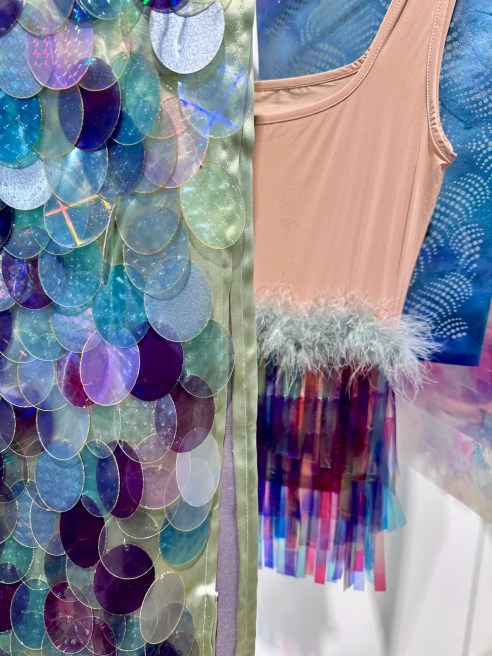
Through color, shimmering surfaces, and holographic effects, Materia Futura explores how bio-based, biodegradable materials can be made more desirable for the fashion industry. The studio’s bio-plastics are built from biopolymers such as agar and gelatin, with varying components used to control flexibility and translucency. Techniques like laser cutting and engraving add texture, while mineral pigments create metallic finishes. By layering these materials and processes, Materia Futura is able to produce an expansive range of material embellishments like sequins and paillettes.
From the metallic sheen of a beetle to the delicacy of a butterfly, Sandini described how Materia Futura plucks inspiration straight from nature.
“Nature is not just beige and green and muted colors,” she said, adding that there are things in nature that you’re instinctively drawn to look at. “You get mesmerized. So, we wanted to take this from minerals and insects and recreate this in materials.”