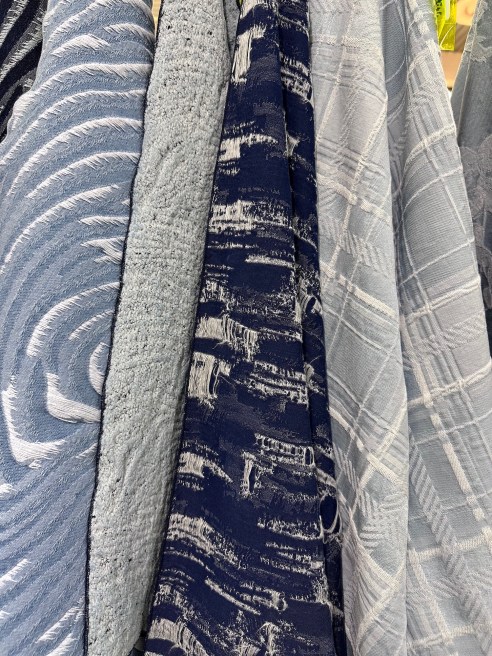
Jacquard denim is quickly becoming a buzzword in fashion. Its capacity to deliver one-of-a-kind textiles infused with custom artwork resonates strongly with premium and luxury denim brands, offering a compelling way to captivate customers and transform blue jeans from everyday commodities into runway-worthy statement pieces.
However, the process to produce jacquard is lengthy, and few brands can afford the luxury of long lead times.
496 Fabric Lab knows this well. The Taipei-based weaver has made its mark in the denim industry with it indigo yarn jacquard fabrics with irregular constructions, low twist yarns and intricate designs. Last week, the company presented its latest collection at Bluezone in Germany.
Related Stories
Wayne Chiang, 496 Fabric Lab founder and CEO, said it takes 8 to 10 days to manually translate a photo to a weaving pattern, and if a client wants multiple samples, it can take upwards to a month for a brand to move forward with their production.
The process’s complexity and repetitive nature make it a natural candidate for the use of artificial intelligence (AI).
“There’s a lot of talk in the industry about lead times, not to mention the chaos for international shipping and logistic issues. So, if at any point in the process we can save time, it gives us more possibility to create more things,” he said.

Recently, 496 Fabric Lab has started to utilize AI to speed up the design process and spend more time developing and testing jacquard denims. With AI tools, Chiang said photos can be converted into weaving patterns in less than 20 minutes.
“By saving all this time, we can make more than one pattern. We can give clients variations of the fabric so they can easily choose which one is the closest to their original design,” he said.
The technology also gives 496 Fabric Lab the ability to produce digital simulations of how a fabric will look and move as a garment on the body, enabling brands to reduce sample waste.
496 Fabric Lab sees AI as the way of the future. The company is in the process of translating its catalog, using AI to analyze the colors, layers and weaving patterns of previous design files. Chiang anticipates the designs will become more precise over time.
While creatives are understandably wary of AI’s impact on the job market, Chiang is adamant that the technology is being deployed to fill operational gaps and accelerate photo processing—not to generate designs or artwork. “The lack of manpower directly affects our lead time, and this is a huge problem when we cannot maintain basic shifts,” he said. “It has become a real headache.”
Chiang acknowledges that AI is often assumed to mean automation, workforce replacement, and cost-cutting. He emphasizes, however, that its introduction is not intended to diminish the value of jacquard—or the depth of weaving and pattern-making expertise it demands.
While the mass market can have their printed designs, Chiang believes jacquard denim—even when supported by AI—will continue to occupy the highest tier of the denim market.
“For us, AI isn’t a replacement for craftsmanship. Instead, we believe that AI is a protection for the craftsmanship,” he said. “Complexity is a cost. For luxury brands, jacquard denim is protection of design, brand value and knowledge.”