No other fabric transforms quite like denim. Rugged or refined, vintage-inspired or experimental, it thrives on the street and captivates on the runway without losing its coolness. That’s why denim attracts such a wide range of fans. But among all denim wearers, there’s a devoted subculture that not only enjoys wearing denim, but also collects, documents and treats the textile as a reflection of their personal history.
Meet the denim head, an individual who is extraordinarily passionate about denim.
Related Stories
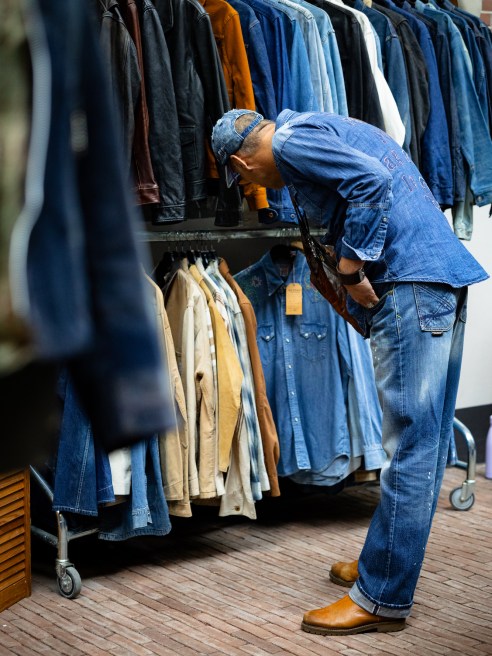
Wouter Munnichs, a Netherlands-based denim specialist and founder of Long John, describes the quintessential denim head as “someone who lives and breathes denim, with indigo running through their veins—a true blue-blooded person for whom a pair of jeans is far more than just a piece of clothing.”
Traditionally, a denim head is a “special breed of connoisseur” who is into all things related to indigo, selvedge and raw denim, according to Amsterdam-based Mariette Hoitink. She would know—as the co-founder of House of Denim, Denim City, Jean School and Denim Days Festival, Hoitink has been immersed in denim head culture for the last decade, spearheading several of their biggest events while preparing the next generation of denim gurus. They’re also “mostly bearded guys,” she said, jokingly.
Or half-jokingly. For years, the denim head community has been compared to a boys’ club, though Hoitink said there are more women at the forefront than ever before.

Ruedi Karrer, founder of the Jeansmuseum in Zurich, notes that most denim heads are men who not only appreciate raw denim, but also share an interest in traditionally rugged, jean-adjacent passions such as rock ’n’ roll, motorbikes, leather, and vintage culture. In many ways, the denim head embraces a rebellious lifestyle—at least in spirit and aesthetic.
This version of denim head culture was born in from the 1950s to the 1970s, when the rebels (i.e. rockers, hippies, and punks) adopted denim as their cool-guy uniform. Though the original denim heads were arguably the miners, builders, farmers and cowboys from the mid-1850s until WWII, who wore raw denim as a practical uniform, Karrer said.
Most denim heads, he added, favor raw denim—no stretch, washing, distressing or artificial fades—from Japan, Europe or the U.S. Their passion for U.S. selvedge denim was on full display earlier this year, when the future of 45 historic Draper X3 shuttle looms once belonging to the iconic White Oak plant became uncertain after Vidalia Mills shut down. The looms have since found a new home at Mount Vernon in Trion, Ga.
However, just as denim evolves and mirrors the zeitgeist, the very definition of a denim head is becoming more layered and nuanced.
Munnichs said the contemporary definition of a denim head would be “someone with a deep passion for the long history and heritage of denim, but open for more sustainable ways of making the blue denim world greener.” He added that denim heads want to “future proof” the garment and have an open mind without “losing the coolness of denim.”
“A modern denim head is a curator of history, sustainability, and personal expression—someone who honors the craft and story of denim while embracing ethical practices, diverse voices, and a love for garments that last a lifetime,” Hoitink said.
Like all conscious consumers, denim heads can’t get escape the environmental impact of their purchases. While brands work to reduce their use of water and chemicals usage, denim heads are also shifting toward more circular solutions.
In some ways, denim heads have one foot in the past and one in the future. Munnichs said the community appreciates repair, but mostly traditional methods such as sashiko or upcycling old pairs into something new. They also enjoy personalization, like embroideries on denim jackets to make them more unique and special.
“Slowly, the mindset is shifting toward more conscious choices, even among hardcore denim enthusiasts. You could say that true denim connoisseurs have always been sustainable in their own way—they buy less but better, investing in quality that lasts for years. They also wash their jeans less often, both to preserve the fabric and to achieve those authentic vintage fades,” Munnichs told SJ Denim.
Hoitink argues that the idea of authenticity in denim culture is evolving. “It’s no longer only about raw selvedge, vintage looms, or perfect fades; for many denim heads today, being authentic also means being responsible. Denim that honors both its heritage and its impact—crafted with integrity, worn with intention, and made in a way that respects the people and the planet behind it,” she said.
A modern denim head, she added, is someone who deeply appreciates denim—not just as a fabric, but as a medium of craftsmanship, sustainability, innovation and personal expression. “They value the stories woven into the material, whether through fades, repairs, heritage techniques, or new technologies, and they share that passion in a way that is inclusive and evolving,” she added.
However, Hoitink added that denim is as much about structure and aging as it is about fiber or color. “Once you remove the twill, indigo/fade potential, or the experience of wear, it becomes something denim-inspired rather than true denim,” she said.
Don’t expect denim heads to peacock in printed “look-a-like” jeans any time soon, or even denim made with fibers other than cotton, according to Munnichs. “Adding too much other fibers on traditional denim fabrics creates new fabrics which isn’t genuine denim,” he said, doubling down that the notion that genuine denim is sturdy 100 percent cotton fabric that shapes and fades over time.
“Hardcore raw denim purists and raw denim lovers are just excited about raw and sanforized denim,” Karrer, noted. “You can also count corduroy or duck pants or even leather jeans to be loved by the denim community.”
Panos Sofianos, denim curator at Bluezone, said the core challenge for denim’s future—particularly its high-stretch and digital technologies—is cultural, not technical. “The denim head community cherishes the physical ritual: the rigid break-in, the unique fade, the permanent story etched into the cotton. For high-stretch and digital tools to gain acceptance, they must pass the purist’s test: do they compromise the story or enhance it,” he said.
Raw and selvedge denim is also having a fashion moment, indicating a real possibility to go mainstream as consumers seek more authentic and durable apparel.
Heuritech names “brut denim,” or unwashed and untreated pure denim, as one of top 10 trends for 2026. Baggy jeans and jackets are the most seen in designers’ collections and there’s a strong emphasize on head-to-toe raw denim looks.
Casablanca, Givenchy, Dior and Zimmerman use this denim in their Spring/Summer 2026 collections. Heuritech said the fabric showed a 200 percent growth in visibility on the runway compared to Spring/Summer 2025 fashion weeks. The AI-powered trend forecasting firm reported that brut denim is projected to boost visibility by 6 percent among women and 3 percent among men.
Connections and community
The rise of Instagram introduced a global perspective to the niche community.
Josh Guillory, the founder of Louisiana-based Iron Shop Provisions, said he “went down that rabbit hole” in 2010 and began following and searching denim-related hashtags, learning about shrink-to-fit denim, the history of Japanese denim and which brands were leading the heritage revival. These social connections led Guillory to open his own heritage-focused denim stores in Lake Charles, La. and New Orleans and more recently, launch A New Medium, a brand that offers Japanese denim jeans sewed in Los Angeles.
Similarly, Thomas Stege Bojer, the founder of the men’s wear and denim blog, Denimhunters, has spun his love for all things indigo to a new small batch jean brand called Weirloom.
Despite their deep appreciation for analog technology, denim heads remain active on socials, especially on Instagram. Some have migrated to TikTok for explanatory videos about raw denim and rare Japanese denim brands by content creators like Alejandro Jomar and Drew Joiner.
Next to that, denim heads keep themselves informed by reading blogs such as Long John, Heddels and Denimhunters. They also gather at B2C events like Denim Days in Amsterdam and Heritage Post Trade Show in Dusseldorf, Germany and even B2B sourcing events like Kingpins Shows and Bluezone, which have embraced denim heads as part of the denim industry.
From the perspective of a trade show that “sits at the intersection of supply chain innovation and consumer culture,” Panos Sofianos, denim curator at Bluezone, said forming relationships with creators and cultural ambassadors is essential to the long-term health and relevance of the denim industry.
“While Bluezone is fundamentally a business-to-business platform, the modern denim industry operates on a constant feedback loop that connects raw fiber to finished garment and, ultimately, to the dedicated consumer. Denim head culture is not just a consumer segment; it is a powerful validation and quality control mechanism for the entire supply chain. Working together with dedicated bloggers and influencers is a deliberate strategy to service our B2B clients better by leveraging their reach and authenticity,” he told SJ Denim.
Sofianos added there’s a notable shift in how the supply chain communicates and position their values, with many established mills like Italy’s Candiani Denim working to build their presence as B2C brands in recent years. Partnering with denim heads, particularly ones with an online following, has become an authentic and transparent way for these companies to communicate their new novelties and innovations to the end consumer.
Denim head outlook
Gen Z and younger generations will further evolve the subculture.
“More and more designs are blending into unisex styles, mixing other influences such as streetwear and outdoor into denim. The young generation is open to wear more special created shapes of denim tops, more fashionable instead of true workwear related styles,” Munnichs said.
Despite denim enthusiasts often being drawn to traditionally masculine iconography—such as the Wild West, cowboys, and Hollywood rebels like Marlon Brando and James Dean—what truly defines the subculture is a deep appreciation for nostalgia, freedom, and self-expression. When it comes to topics like inclusivity in denim, Karrer said “the raw denim community is mostly very open and liberal.”
The globalization of denim fandom will also change its culture. Though denim head culture is strongest in the Western hemisphere like North America, Europe and Japan, Karrer said there is a “crazy young raw denim community” has popped up in Southeast Asia in the last 15 years. He said the community is especially growing in Indonesia, Thailand, Malaysia and the Philippines.
Sofianos anticipates a major shift in denim head culture as it “evolve from a purely nostalgic movement into an era of informed connoisseurship.”
While their devotion to longevity and patina will remain, he said the standards for quality are becoming more elevated and diversified. “Future enthusiasts will not just assess the ounce weight and the selvedge ID line; they will audit the environmental footprint. The new gold standard demands a perfect union of traditional shuttle-loom craftsmanship with certified low-impact and circular production methods,” he said.
This means increased acceptance of diverse, sustainable fiber—from regenerative cotton to Tencel lyocell—and the utilization of digital product passports, which will provide verifiable, immutable proof of its origin, water usage and repair history
“The future denim head is an informed activist—a collector who demands that their prized possessions serve the longevity of the planet as much as the longevity of their personal style,” Sofianos said.