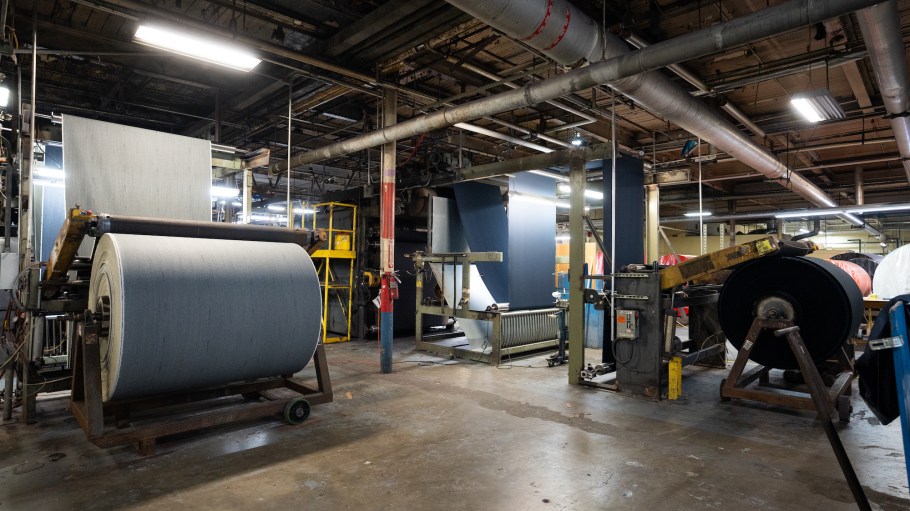
The 45 historic Draper X3 shuttle looms once belonging to the iconic White Oak Plant in Greensboro, North Carolina are making the 460-mile journey from Vidalia, La. to Mount Vernon’s Trion, Ga. flagship facility.
“It is our intention for the looms to never leave Trion,” Bill Rogers, Mount Vernon Mills president told SJ Denim.
Last week, the U.S. textile manufacturer announced it has entered a strategic partnership with KaKa Cotton, LLC to acquire and relocate the Draper X3 shuttle looms and 45 Picanol President shuttle looms to its Georgia production site to further expand its selvedge denim weaving capacity.
Related Stories
Earlier this year, the future of the looms was thrown into doubt during the sheriff’s sale of Vidalia Mills in Louisiana. Though the looms were in use by the doomed mill for a brief period, Kaka Cotton, LLC, a New York-based financial firm, claimed ownership and sought a new home for them.
Rogers said the Draper X3 shuttle looms have been on Mount Vernon’s radar since they left Greensboro, N.C. in 2018, but the timing wasn’t right.
“Now with the changing economies of the world—not just in the United States, but globally—I think it’s a great fit right now. There were some people that were probably a little overzealous about the looms to begin with, but we just felt that at the end of the day, they’ll land where they need to be. And we felt all along that was us,” he said.
While terms of the deal remain vague, Rogers confirmed that KaKa Cotton “has no desire” to sell the looms and that Mount Vernon is not leasing them. Instead, he described the transaction as “an open-ended agreement” at Mount Vernon’s discretion.

“We want to keep them here forever and we have a good agreement that will also make it economically viable for the customers,” he said.
Not one to romanticize the legacy of the machinery or its place in denim culture, he’s pragmatic about his approach: “I do want to run a business—not a museum—and I think we’ve put together the economic model to make it not only good for the heritage of it, but also good for the business of it.”
Behind the scenes, Rogers said the company has been in discussions with major and boutique brands since news of Vidalia’s sale broke. “We got a lot of excitement there and a lot of support, but we also look at this as a business too. It’s a fun business, but at the end you must make the math work, and we know how to make the math work,” he said.
With 180 years of history and a facility built with the flexible wood floors ideal for shuttle looms, Mount Vernon Mills is uniquely positioned to handle the production. The company also controls every component of denim manufacturing—from indigo dyeing and finishing to yarn production.
“Just because you have the looms doesn’t mean you can make quality selvedge denim,” Rogers said.
That’s a lesson Vidalia’s team—and perhaps their clients—have took away from the experience. While Vidalia’s executives had a grand vision for their Louisiana mill, the operation often leaned on Mount Vernon as a crutch. Mount Vernon supplied the dyed yarn and even handled denim finishing during Vidalia’s early days.
Unlike Vidalia, which “was going to live and die by selvedge denim,” Rogers said Mount Vernon already maintains a core denim business producing 150,000 yards per month. Though he aims to increase selvedge output, it won’t be the company’s only focus.
“I would love to get to the point where we ultimately are at 100,000 yards per month, but I’m not going to sit here and tell you today I have absolute 100 percent confidence we’ll be doing 100,000 yards a month either,” he said.
Mount Vernon plans a phased rollout, starting with one shift and a target of 20,000 yards per month “because we want to make this right,” Rogers explained, adding that some of the looms will require repairs.
The Draper X3s will be set up in a dedicated weaving area that dates to the 1800s, while other processes will integrate into Mount Vernon’s broader denim operations. Rogers said the mill will likely use higher-grade, engineered yarns rather than the standard varieties typically found in traditional workwear denim. The mill’s in-house innovation team has some untraditional ideas for selvedge denim as well.
Beyond denim, Mount Vernon also hopes to revive other legacy textiles—such as Cramerton Army Cloth—using the 45 Picanol President shuttle looms included in the KaKa Cotton deal. The innovation team plans to adapt techniques from modern looms to recreate the heritage fabric on shuttle looms.
“I think we can bring some innovation to the selvedge market and the non-denim market,” Rogers said.