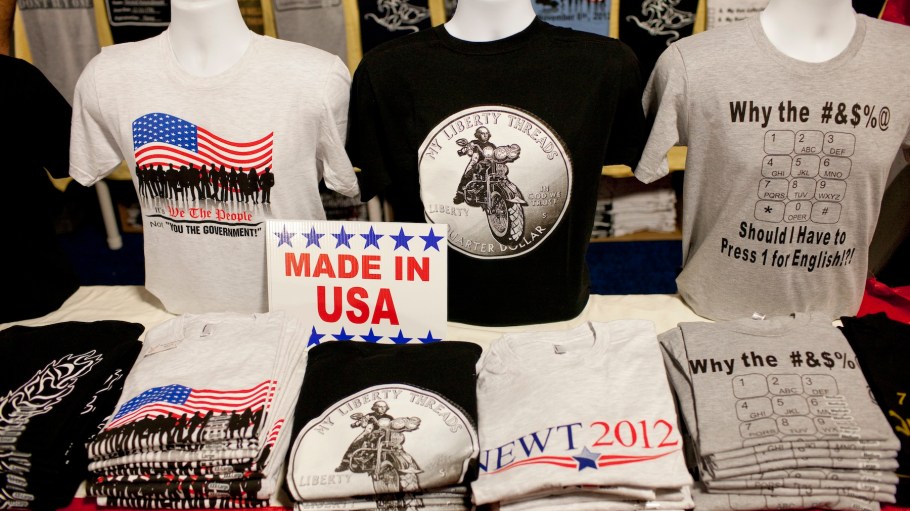
The White House is stepping up scrutiny of “Made in America” claims, directing the Federal Trade Commission (FTC) to prioritize enforcement and explore new rules that could shift compliance obligations onto online marketplaces.
In a March 13 executive order, the administration framed the move as part of its expanded effort to bolster domestic manufacturing, while signaling a more aggressive regulatory posture toward brands, retailers, and platforms that market U.S.-origin goods.
Related Stories
To note: the order doesn’t impose new legal requirements for “Made in USA” claims; instead, it reinforces the FTC’s existing “all or virtually all” standard, while outlining a policy agenda that could materially increase enforcement risk.
“Americans have a right to clear, accurate, substantiated, and accessible information regarding whether products advertised as ‘Made in America’ are actually made in the United States,” the order states. It adds that “American citizens attempting to buy American products should have certainty as to what American-origin claims mean.”
Among its key provisions, the order directs the FTC to treat deceptive origin claims as an enforcement priority, after a relative lull in public case activity in recent years. It also calls on the agency to consider rulemaking requiring online marketplaces to establish procedures to verify country-of-origin claims made by third-party sellers. While the order does not define what those systems would entail, it suggests that failure to implement such measures could be treated as an unfair or deceptive practice.
The directive surpasses the FTC, encouraging coordination across agencies on origin labeling and promoting voluntary “Made in America” claims. At the same time, it instructs federal procurement agencies to increase oversight of Buy American Act compliance and refer violations to the Department of Justice—raising potential exposure under the False Claims Act.
“The FTC shall, wherever appropriate, prioritize enforcement actions” involving misleading “Made in America” claims, the order states, adding that the agency may treat “failure of an online marketplace to establish procedures for verifying country-of-origin claims” as a potential violation of the Federal Trade Commission Act.
That combination of enforcement and potential rulemaking is expected to reshape how companies assess risk around origin claims. Julia Solomon Ensor, counsel in the advertising and media industry group at global law firm Reed Smith—and a former longtime program manager for the FTC’s “Made in USA” program—said the order signals increased enforcement activity, with the FTC likely to more actively identify and pursue companies making unsupported claims.
“The EO does not create any new requirements. However, it highlights four policy goals that, if implemented, will dramatically change the risk and compliance analysis associated with MUSA advertising claims,” Ensor said. “Expect the agency to respond by carefully canvassing the marketplace for enforcement targets.”
She also pointed to the order’s focus on marketplace accountability as a potentially significant shift. Rather than revisiting the FTC’s existing standard, the agency is being steered toward rules requiring platforms to verify origin claims made by third-party sellers, introducing a new layer of compliance expectations for e-commerce operators.
“The EO contemplates a rule requiring online marketplaces to establish procedures to verify country-of-origin claims,” she said. “Failure to maintain such a program may constitute an unfair or deceptive act or practice.”
At the same time, Ensor noted that the administration’s push to encourage voluntary “Made in America” labeling could have unintended consequences. Companies that lack a clear understanding of the FTC’s strict substantiation requirements may adopt such claims prematurely, increasing their exposure to enforcement.
“Encouraging voluntary MUSA labels may give U.S. manufacturing a boost,” she said. “But it also risks pushing companies…to label products as MUSA when they don’t actually comply with the FTC’s rigorous standard.”
For government contractors, she added, the directive’s emphasis on Buy American Act compliance further raises the stakes, particularly considering the potential for False Claims Act liability arising from inaccurate origin representations.
“False origin claims risk exposure under the False Claims Act, which can result in significant penalties,” Ensor said.
Taken together, the executive order signals that while the legal definition of “Made in USA” remains unchanged, the regulatory environment surrounding it is tightening, with greater scrutiny—and greater risk—for brands, retailers and marketplaces.
“Although the EO doesn’t impose new legal requirements, it suggests MUSA compliance should be top of mind,” Ensor said. “Manufacturers and sellers should review their claims now and expect aggressive enforcement.”
The policy push may also gain traction on Capitol Hill. In response to the order, U.S. Senator Tammy Baldwin (D-WI) called on the administration to support her bipartisan Country of Origin Labeling (COOL) Online Act, which would require online retailers to clearly disclose country-of-origin information for products sold online.
“As more and more Americans turn to online shopping, we’ve seen an explosion of knockoff products stealing business from ‘Made in the USA’ businesses,” Baldwin said in a statement. “My bipartisan bill makes sure that online shoppers know whether they are supporting American businesses or not.”
Industry groups echoed that view, framing the executive action as a starting point rather than a complete fix. Jon Toomey, president of the Coalition for a Prosperous America, said the order is “an important step toward restoring transparency,” but argued that legislation is needed to ensure consistent disclosure requirements across e-commerce.
Similarly, Scott Paul, president of the Alliance for American Manufacturing, said that while the order moves enforcement “in the right direction,” passage of the COOL Online Act would extend country-of-origin transparency already required in brick-and-mortar retail to online marketplaces.
If advanced, the bill would amend the Federal Trade Commission Act to require that country-of-origin information be “clearly and conspicuously” disclosed in online product listings—effectively codifying the kind of marketplace transparency the executive order asks regulators to explore.