Levi Strauss & Co. will turn 175 years old in 2028. The U.S. patent the company received in 1873 for “an improvement in fastening pocket openings” not only changed the course of the business but also transformed how consumers dress in modern blue jeans.
It’s a legacy the San Francisco-based company and Tracey Panek, Levi Strauss & Co. historian, is steadfast on persevering through the Levi’s Archive. Earlier this month at the AAFA Executive Summit in Washington D.C., Panek emphasized the importance of having an archivist responsible for a company’s history and archive—factors that are increasingly valuable to brands as younger consumers seek heritage names and throwback fashion.
Related Stories
“Your heritage is really your differentiator,” she said.
Levi’s archive plays a critical role in the design and marketing of its new collections. Employees can view pieces in person at the company’s San Francisco headquarters or view them online through the archive’s digital catalog. Panek said the designers are the biggest users of the archives and use pieces from the past to create the latest Levi’s looks.
Some of the latest archive-inspired designs have included a pair of cutoff shorts based on a worn and sun-bleached pair of Levi’s from the 1970s worn by a surfer and a reproduction of the jacket worn by Albert Einstein on the cover of Time magazine in 1938. Levi’s vintage advertising campaigns also serve as a source of inspiration. A colorful 1950s silkscreen rodeo ad influenced the brand’s campaign for its collaboration with Pixar celebrating the 30th anniversary of “Toy Story.”
The 250th anniversary of the United States will offer a major opportunity to spotlight Levi’s history. Panek said significant garments and artifacts highlighting the brand’s ties to the nation’s DNA will be displayed at the company’s newly remodeled museum, The Vault, at its headquarters in July.
LS&Co. is the American Dream personified. It was founded by Levi Strauss, an immigrant with humble origins, who found success in America. “You start with that story, and then a business that is rooted in America—was born in the American West—and as company, we linked into that identity with tag lines like ‘America’s finest overalls.’ That’s what we call those original riveted denim products,” Panek said.
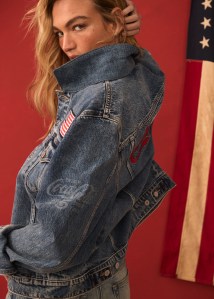
Panek said the company is using its archives to look back and see how Levi’s celebrated America’s Bicentennial in 1976 with products like a “very ruby” pair of Levi’s and ads produced during the era. It was during this time when Levi’s joined forces with other U.S. companies Ford and The Coca-Cola Company to launch a sweepstakes, creating 10 custom “Denim Machine” vans decked out in red shag carpet and denim interior to give away.
“Our archives also give us some insight into how our fans have customized Levi’s products to express their patriotism,” she said.
Though LS&Co. is over a century old, the company has been rebuilding its archive for the last 40 years. Original records and artifacts were lost in the 1906 San Francisco earthquake. Along with recouping garments, Panek and her predecessors are collecting the stories behind garments. It is also her job to edit what’s worthy of being saved. “There’s no way you can save it all,” she said. “You have to be selective about key products. Your iconic products are the ones that have been saved.”
Preserving Levi’s rich history is truly a collective passion within the company. The thrill of the hunt is a team effort.
“I urge my fellow employees to be on the lookout for things that they think might be useful in the archives,” she said. “We recently acquired a World War II Levi’s jacket worn by a woman who was probably one of the few female pilots, and that came from an employee who saw it at Goodwill. It was up for auction,” she said. “So, they take pride in preserving history as well.”