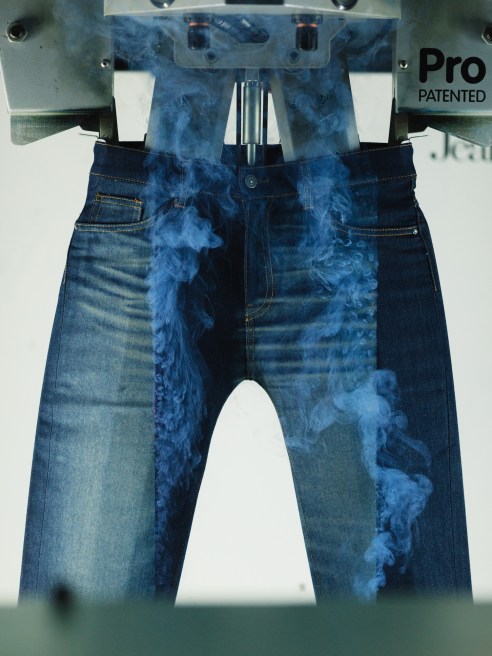
Famously, blue jeans have remained relatively unchanged since their inception 150 years ago. Despite consumers’ changing lifestyles and seasonal trends, the riveted design Jacob W. Davis patented in 1873 remains the industry standard for durable, functional and timeless design. The story couldn’t be any more different behind the scenes, however. Driven by 21st-century factors like cost and speed-to-market, and aligned with the industry’s sustainability awakening, denim is benefiting from an innovation renaissance.
Jeanologia’s laser technology is one of those game-changing innovations.
Related Stories
Since 1999, laser technology has transformed the jeans industry by eliminating harmful processes for workers, reducing operational costs, and improving environmental impact, while pioneering completely new ways for creativity. The finishing technology acts as a thermal source that eliminates the indigo dye of denim fabrics by sublimation, which means evaporating dye from solid to gaseous form through heat. It can create holes, tears, fraying and punctures, replacing time-consuming manual techniques. The technology also has a wow factor with consumers, as the laser’s flame dances over the denim fabric without destroying it.
From barely-there whiskers, vintage washes and natural-looking abrasions to logos, artwork and repeated patterns to texture and destruction that pushes denim into a whole new dimension, the technology is unique in that it can deliver on nearly everything the market demands and designers dream up.
Enrique Silla, Jeanologia CEO and founder, said the initial goal of laser technology remains the same today: to completely transform the way dry processes are done in denim production. Before laser, the primary method for dry processing was sandblasting, which was extremely unethical and dangerous for workers.
“Our goal was to revolutionize dry processing, replacing not only sandblasting but also potassium permanganate spray and manual scraping. This has remained a core purpose of using laser technology,” Silla said. “The laser’s ability to reduce water and chemical use aligns perfectly with the increasing importance of sustainable practices in the industry. So, while the original purpose remains, its relevance and impact have only strengthened as sustainability has become a critical focus.”
Silla and José Vidal, who died in 2020, established Jeanologia in 1994 as a consultancy to transform how jeans were produced by eliminating water, chemicals, contamination, and waste from the production process. Though its clientele included 120 laundries and spanned more than 100 countries, Silla said its reach was limited by the technology that was available to the denim market at that time.

“We strongly believe that the way a product is manufactured is part of its DNA,” Silla said. “From our beginnings in 1994 until 1999, we realized that while we could reduce the environmental impact of denim production by 10 percent, 20 percent or even 50 percent through consulting, we could never make a significant industry-wide impact.”
In 1999, the company decided it needed to create new technologies—not just new processes—and that’s when Jeanologia’s journey with laser technology began. Silla said the idea originated from Jeanologia’s pursuit of a system to locally wear and age jeans perfectly and quickly, without using water or chemicals.
“Our technical team came up with the idea of sublimation, where the indigo dye would transition from solid to gas directly, without using water, which required energy,” he said. “During a visit to a car factory, we noticed that lasers were already being used for ablation, removing paint and dye from speedometer panels. This inspired us to test the technology on denim, and we saw it could work.”
This led the company to embark on a project called Tattoo Jeans, the idea that designers could tattoo designs onto jeans. Later, the company realized it was also effective for creating vintage finishes.
Though there was a “small boom” in 2001 when other companies tried to enter the market with their lasers, Silla said many abandoned their efforts due to the initial challenges, like achieving a natural look and the technology’s early failures.
“When lasers started becoming a significant trend again, these companies returned to the market. Their competition with Jeanologia helped us improve our product and build trust among manufacturers, who now had several options and brands to choose from for their production processes,” he said.
Breakthrough moments
It took Jeanologia about 10 years to perfect the technology and prove its legitimacy as a scalable solution for finishing.
From 1999-2008, Silla recalled some resistance from designers because they thought laser effects on denim didn’t look natural. “They were right. At the time, we didn’t realize how we couldn’t compromise on the look. We also underestimated how difficult it would be to change the mindset of designers who saw technology as opposed to artisanal and handmade,” he said.
A pivotal moment came in 2008 when Jeanologia launched an exhibition called “Truth & Light” in Paris, Munich, Tokyo, Sao Paulo and New York. “We demonstrated how to achieve real vintage finishes with lasers,” Silla said. “It was then that designers understood the potential of laser technology. When designers started to see it as a new tool for tech-artisan collaboration rather than an enemy, the technology truly took off.
Commercially, the most decisive moment came in 2018 when Levi’s introduced Project F.L.X., a digital operating model that uses technology, including Jeanologia’s laser, in the design and development of denim finishing. Concurrently, Fast Retailing Group established a laser development center in Los Angeles, signaling a critical industry-wide shift towards adopting laser technology as indispensable.
At the time of launch, Levi’s touted Project F.L.X. as a solution to create a more responsive and sustainable supply chain, reduce lead times from more than six months down to weeks or days, and slash the number of chemical formulations used in its finishing processes from thousands to just a few dozen. Using Jeanologia’s laser, Levi’s said it would reduce finishing time from two to three pairs per hour to 90 seconds per garment, followed by a final wash cycle.
“From the very beginning, Levi’s has been instrumental in investing in and passionately supporting the development of our laser technology,” Silla said.
Receiving votes of confidence from behemoths like Levi’s and Fast Retailing altered the arc of Jeanologia’s story. However, Silla describes the earliest adopters as “the silent soldiers who helped make this transformation a reality.”
“I fondly remember our first customers when production was still strong in Europe, especially in Italy,” Silla said. “Our very first client was Ingeniero Cosiri, a laundry processing 40,000 garments a day in Italy, known as Itac. They were the first to believe in our technology.” Additionally, Sartex in Tunisia, Coudon in France and Morocco (which no longer exists), and Pizarro in Portugal took a leap to use the technology. “These companies, along with Levi’s plants in Laresa, Lavapan, and Lirsa, which had three laundries in Spain at the time, were the first to use our laser technology in Europe,” he said.
“We are deeply grateful to these pioneers who believed in the technology and the need for change. Their support was crucial when we were a consultancy company manufacturing and selling machines globally,” Silla said. “Our first 120 machines went to 70 different countries, making it extremely challenging to manage.”
Next phase
Jeanologia has sold over 5,000 laser units to over 1,000 companies operating in 78 countries.
Among the company’s largest clients—those with over 100 lasers—include Crystal Group, a Hong Kong-Chinese corporation with facilities in Cambodia, China and Vietnam, and Pacific Jeans, recognized not only for being the first to introduce lasers to Bangladesh but also as a major supplier to Fast Retailing worldwide. Additionally, Silla said Artistic Milliners in Pakistan “holds substantial importance for us.”
In Mexico, VF Corporation and Kontoor are noteworthy clients. Silla noted that Egypt is emerging as a significant denim sourcing market with companies like Lotus and international players such as Taypa Turkey and Eroglu establishing strong presences there.
It has taken Jeanologia 25 years to transform the industry, with 50 percent of global denim production now utilizing its laser technology. Silla anticipates that number will reach 100 percent within the next five years. “Developing and establishing expertise in a new technology typically spans a minimum of 10 years, and shortcuts are hard to come by,” he said.
As brands and retailers face challenges to quickly integrate innovations across their supply chains, Silla said progress for any new technology can be frustratingly slow. However, wading it out and allowing the industry to catch up to its technology may go down as one of Jeanologia’s greatest strengths.
“The most important advice I can offer is this: Take your time. When we launched our technology in 1999, it promised a return on investment of approximately 1-2 years, it was visually appealing and easy to apply, yet it took us 25 years to fully implement it,” he said. “Patience and perseverance are key. You must believe in your vision and remain steadfast. Changing entrenched mindsets in longstanding industries requires time, effort, and proactive leadership. Brands will support your initiative, but true leadership often needs to come from within.”
This article is published in Rivet’s Fall 2024 issue. Click here to read more.