The global denim industry’s next phase of innovation and craftsmanship was on display last week at Kingpins Amsterdam. The trade show spotlighted creative collaborations as well as partnerships that aim to scale sustainability. A wide range of exhibitors—from Lenzing with its latest Tencel fiber to Soko’s water-saving Hydrogel technology—underscored the industry’s growing commitment to eco-conscious production. Meanwhile, Japan’s revered mills received their own spotlight, reinforcing their influence on luxury and selvedge denim trends.
Cone Denim revisited Rooted, its collaboration with Amsterdam-based AMK Atelier. Rooted follows the work of farmers at De Stadsgroenteboer in Amsterdam, documenting wear patterns and testing fabric durability for a full year in custom workwear designed by AMK Atelier. The garments were made with a range of Cone Denim fabrics, including the most recent Cone Denim Community Deforestation selvedge fabric.
Related Stories
The duo displayed worn garments at Kingpins Amsterdam to showcase the fabrics’ durability and wear patterns. On top of highlighting how sustainable denim fabrics can withstand the daily wear and tear of farm life, AMK Atelier founder Maria Gunnarsson said the collaboration has revealed a real need for workwear designed for specifically for women.

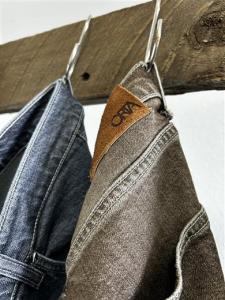
Orta linked with Sam Zegelink, the founder and designer of the Amsterdam-based sustainable streetwear brand Saint Muze, to upcycle scrap fabric into handbags and puffer jackets. The pieces include distinct denim details like pockets and waistbands. Though working with denim was challenging—Zegelink broke many sewing needles during the process—she said the collaboration with Orta has magnified the possibilities of using denim in new categories.
The Lycra Company partnered with Diamond Denim by Sapphire to develop a seven-day wardrobe inspired by Donna Karan’s “Seven Easy Pieces,” a capsule wardrobe the designer introduced in 1985 to simplify the art of getting dressed.
For the collection, Diamond Denim used Lycra’s various technologies across garments that spanned tailored suiting for Monday to cozy wide-leg jeans for Sunday. The purpose of the collection is to show denim can be woven into everyday wear in untraditional ways and how Lycra fibers can be applied to a variety of styles, including ones that do not hug the body.
Italian chemical supplier Soko presented the Purity Collection with Pakistani vertical denim manufacturer Soorty. The collaboration utilizes Soko’s safer solutions to hazardous substances such as sodium hypochlorite, ootassium permanganate, petroleum-based dyes and pumice stone. Biodegradable mineral dyes, waterless enzyme and abrasion boosters were among the alternative processes.
The show was an opportunity to showcase the benefits of Hydrogel, Soko’s technology that alters the physical state of water, turning it from a liquid to a gel. This process, according to Luca Braschi, Soko’s marketing and technology manager, reduces water consumption to 4 liters per garment and helps protect the strength of fibers.
Tonello highlighted its first fleet of dryers at the show. With the launch, Alberto Lucchin, Tonello’s marketing and sustainability manager, said the company can better control and eliminate issues like staining and damaged garments. The company can also work on improving the energy efficiency of this stage of production. The machines are compatible with Metro, Tonello’s a digital platform that measures the laundry’s consumption.
Neela by Sapphire Fiber partnered with materials science company Recover on a collection that promotes circularity and traceability. The collection includes three fabrics that blend Recover’s proprietary RCotton and RDenim fibers with conventional cotton and modal. The physical tracer in Recover fibers means the final garment can be verified using a scanner.
By blending the fibers with modal, the collection achieves rich denim shades of blue and black (baby blue, medium blue and black/grey), without the use of indigo rope dyeing. This combination eliminates the need for additional laundry processes, significantly conserving water and energy while preserving core denim aesthetics, Recover stated. Some of these fabrics feature Neela’s Purify 2.0 indigo dyeing process, a technique that uses 90 percent less water, energy and chemicals.
The Flax Company, the maker of Marmara Hemp, the first hemp fiber to be certified as sustainable, Cradle to Cradle platinum level, showcased hemp blended fabrics from its growing roster of mill partners. Hemp is just five percent of what the company produces, however. With interest in other natural fibers growing, the Levi’s supplier showcased Smart Linen, the first GRS certified linen made from spinning industry waste.
Lenzing is meeting the demand for linen-like fabrics with Tencel 2.2., a longer and coarser fiber compared to the original Tencel fiber that has a drier hand feel and less shine. Dennis Hui, Lenzing’s global business development manager, denim, said Tencel 2.2 is a price and quality solution for denim mills working to navigate linen’s price fluctuations and overcome inefficiency as linen can be difficult to control. Lenzing showed fabrics using the new fiber in bottom and top weights by Artistic Milliners.
The fiber is part of Lenzing’s Application Innovation Collection (ALC), a seasonal round up of garments made by 8-10 mill partners that showcase new ways to use the company’s fiber technologies. The latest ALC includes fabrics comprised of cotton, Tencel and real linen, Ecovero jacquard, Tencel and pineapple fiber blends and 100 percent Tencel fabrics that are digitally printed by Stella Blu’s Cooltrans technology from NTX.
Hui said fabrics that look like they’re made with 100 percent cotton continue to be in high demand, nothing that mill can achieve by using 100 percent Tencel in the weft. Ecovero is also gaining popularity to enhance the bulkiness of fabrics
The Lycra Company is feeling the momentum from newly launched partnerships. The company is growing its roster of mill partners using FitSense, a targeted sculpting technology, while Spanx has introduced it to the market. Additionally, Agolde recently debuted the first jeans made with bio-derived Lycra EcoMade, Lycra’s collaboration with Qore to scale renewable Lycra fiber. The fabric was produced by Orta in Turkey.
Ebru Ozaydin, The Lycra Company’s global strategic marketing director for denim and wovens, said having a Los Angeles-based premium brand like Agolde be the first to bring the innovation to market is a important vote of confidence in the technology that will hopefully inspire other companies.
Unexpectedly, Lyrca is also seeing interest grow for Lycra Adaptiv, a stretch solution that adapts to the wearer’s needs. The company launched in 2021, originally positioning it for the women’s category. However, more clients are asking for it for men’s. “They like Adaptiv’s easy soft stretch. Brands can use it for men’ slim fits,” Ozaydin said, adding that C&A was the first to introduce the technology in men’s last year. Now the European retailer is adding it to their women’s denim range.
Twin Dragon’s new family of fabrics have “great hanger appeal,” a rep said. The mill introduced Duo Stretch, a fabric with two Lycra dual-core yarns. This helps the weft yarns lay flat, giving fabrics that are distressed and destroyed a cleaner look.
Jacquard for prints, fabrics with the texture of boucle and wovens that mimic the feel of sweatpants are among the mill’s novelties for Fall/Winter 2026-2027. Twin Dragon also unveiled the first denim collection crafted from Panda Biotech’s sustainably sourced, American-grown hemp, backed by the Southern Ute Indian Tribe. The collection includes rigid and stretch constructions with up to 30 percent hemp.
Naveena Denim Mills took a mystical approach to describing denim’s past, present and future with novelty tarot cards that described the mill’s collections. The Pakistani mill presented Trueshape, a garment collection made by Egyptian garment manufacturer Eroğlu featuring Lycra’s FitSense technology. The collection showcased the wide variety of garments—from jumpsuits and dresses to jeans—that can utilize the sculpting technology.
Naveena also presented Lume, a denim collection made with silk. Along with highlighting the fiber’s sheen and drape, Naveena touted silk’s benefits such as moisture-wicking comfort, hypoallergenic properties and biodegradable sustainability.
AGI Denim presented an expanded version of Tomorrowlab, the future-focused collection developed by Jonathan Cheung in 2023. Henry Wong, AGI Denim’s VP of product development and marketing, explained that the purpose of the collection is to showcase the next technologies and fibers poised to become mainstream in the denim industry. For F/W 26-27, the Pakistani mill is betting on premium and circular fiber blends, such as fabrics made with 10 percent banana fiber, 26 percent bamboo and 5 percent silk. The silk is blended with modal for “extra oomph,” Wong said. He added that the industry’s intrigue in cottonized flax fibers like hemp and linen is having a halo effect on banana fiber.
The collection features Lycra FitSense technology, collagen-infused fabrics and denim with honeycomb constructions to maximize the effects of Coolmax All Season technology. The collection also introduces EarthGlaze, a reformulated version of EarthColors, Archroma’s line of natural dyestuff. Wong noted that the coating is unique because it uses a biodegradable binder.
Fashion and functionality are the driving forces behind Isko’s S/S 26-27 collection. Sustainability is a non-factor as its incorporated into each fabric family and article. “Sustainability doesn’t need to be a consideration anymore—it’s just there,” said Keith O’Brien, Isko senior PR manager.
With We’Raw, Isko addresses the demand for denim with a raw look. A proprietary technology maintains the fabric’s deep indigo look, so it doesn’t fade or wear like traditional raw denim. The mill’s zero stretch concept, Isko Rigid, gets a color refresh with overdyed tints. Isko also gets into some catwalk-ready looks with high gloss 100 percent Tencel black denim.
Stretch is important for Isko’s R&D and trend teams. “We’re seeing skinny jeans come back, especially for men,” O’Brien said. The mill’s Comfort Series provide fabrics of various weights and constructions with 20-30 percent stretch. With Wonder Soft, Isko creates permanent softness through a mechanical process on the fabrics. The fabrics have a drapey look and silk-like touch.
Recode Denim is an evolution of Ctrl+Z, which Isko launched in 2022. Whereas Ctrl+Z focused on fabrics that contain only recycled and regenerated fibers, Recode offers fabrics made with a minimum of 50 percent recycled content to achieve GRS certification and contain zero virgin cotton. “We’re trying to be more democratic with what people want,” O’Brien said. “Every brand has their own objectives when it comes to sustainability.”
Trends
Denim and PFDs with chenille wefts, fabrics with big yarn in the warps and soft and lightweight versions of Japanese-inspired fabrics are part of Isko Luxury by PG Denim’s collection. Paolo Gnutti, PG Denim founder, said last year’s leopard print fad kindled a bigger print trend as brands and retailers seek fresh ways to customize jacquards and laser prints. The collection also offers a sustainable alternative to the flood of real fur looks seen on the runway with fringe denim.
The Agency by AGI Denim showcased the mill’s best fabrics with trending colors, wash effects and fits. The collection included shorts of various lengths and styles, padded jackets made with AGI’s 100 percent recycled denim and 27 tint options, spanning parchment to rose gold. In general, Karl Chiara, AGI’s director of concept, design and co-creation, said tint and shade manipulation is increasingly important. Abstract wear patterns, water marks and spray coatings on garments add visual interest too.
Spotlight on Japan
Kingpins introduced a dedicated space for denim mills and manufacturers from Japan.
Many exhibitors said they see opportunities in the European market, including Betty Smith, Japan’s first women’s denim manufacturer, and Kurabo, which showcased new lightweight fabrics and constructions made with regenerative cotton. A representative for Kurabo said Japan’s level of denim craftsmanship makes it an important source for European luxury and premium brands. Others use source Japanese denim for special “upgraded” or limited-edition collections.
Japanese mills are also benefiting from an uptick in selvedge denim, which the rep said is “hot across many markets.”
Kibata Denim, distributed by San Marino Co. Ltd., highlighted its range of unsanforized denim. While the fabric’s notable shrinking and twisting makes it difficult to manage in production, it offers the vintage character sought after by denim heads. However, Keisuke Nonaka, San Marino’s executive officer, noted that Kibata’s factory is experienced in controlling the fabric.
During a talk, Doug Gunn, co-founder of The Vintage Showroom, discussed denim’s transformation from American workwear to an important cornerstone of Japanese craftsmanship. He said the story of Japanese denim “is one of cultural reinterpretation” and appreciation of subtle beauty in details and a deep respect for tradition and authenticity, adding that jeans were never the uniform of the working classes in Japan in the way they were in North America and then in Europe. Instead, during post World War II denim became a prized and valuable garment.
“Over several decades, Japan has emerged as a global leader in high quality denim production, influencing fashion scenes and trends around the world,” Gunn said.