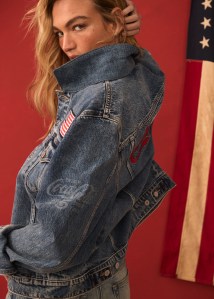
The era of denim made exclusively from cotton is over—but that doesn’t mean synthetics have taken over by default. Today, denim producers have access to a wider range of fibers than ever before, including natural alternatives like hemp and linen. Recent mill collections have highlighted the diverse aesthetics these fibers can bring to denim—some introduce a subtle texture or lightness, while others enhance the fabric with distinctive tactile effects. Regardless of the look or feel, the priority remains the same: creating denim with a reduced environmental impact.
Related Stories
“Alternative natural fibers that can work independently and in combination with cotton have gained significant attention in the last two years. This surge in interest is driven by the industry’s efforts to reduce environmental impact, diversify supply chains, and enhance product performance,” said Nicole Ajimal, WGSN sourcing editor.
Ana Paula Alves de Oliveira, founder and strategic director of the consultancy Be Disobedient, said regenerative fibers are gaining attention for good reason: they require less water, fewer chemical inputs, and are more adaptable to sustainable practices. “Overall, these fibers allow us to diversify the material base of denim beyond the traditional cotton-elastane-polyester mix, which is long overdue,” she said.
Linen lessons
Though the fibers gained popularity for their low environmental footprint, innovative products like Smart Linen from The Flax Company are taking sustainability even further.
In 2022, the French company launched Smart Linen, a GRS-certified recycled cottonized linen fiber made of pre-consumer waste. Applicable to denim, knitwear and home textiles, the fiber is reportedly stronger than cotton and contains antimicrobial and moisture-wicking properties.
The Flax Company offers two versions of Smart Linen: one is a 55/45 recycled linen/virgin linen blend, and the other is 100 percent recycled linen. “As with all linen blends, the linen comfort starts to be felt in blends in 40 percent or higher,” said Denis Druon, The Flax Company CEO. “Also, these blends start giving a linen drape to the fabric and the unique, irregular look of linen, which is a huge difference.”
From a plant and fiber standpoint, Druon noted that Smart Linen carries ‘no additional environmental premium’ compared to traditional linen. However, it tackles the industry’s waste problem by enabling brands to repurpose industrial waste in a more meaningful way—rather than relegating it to low-value uses or discarding it entirely.
Additionally, Smart Linen is just 10 to 20 percent more expensive compared to virgin fibers when the price of virgin is at a low level. “In today’s market price, the virgin and recycled prices are very similar,” he said.
The Flax Company’s core business is in linen fiber, both for the pure linen industry and cotton spinning applications. Hemp accounts for just 5 percent of The Flax Company’s turnover.
Thirty years ago, Druon said linen was considered a “fashion fiber,” with sales largely dependent on whether designers chose to feature it in their collections. That mindset has since shifted. “Nowadays, linen is purely a commodity fiber that can be found in all collections. We have a strong feeling that hemp will follow the same path in the years to come,” he said.

Hemp on the horizon
The Flax Company anticipates that the looming regulation requiring companies to include 30 percent low environmental impact fibers in all clothing by 2030 will have a major impact on the use of Marmara Hemp. The company launched the brand of cottonized hemp fiber in 2021. It is the first hemp fiber to be certified as sustainable, Cradle to Cradle (Platinum level) and with a Life Cycle Assessment performed by a certified body. No chemicals are used in its production.
Though hemp is prevalent in mills’ concept collections, market options of the natural bast fiber are less common—at least at scale. “Demand is up and down, and we can see that hemp has not yet found its place in industrial bulk production,” Druon said. “However, there are more capsule collections being produced for the big names in denim. We take this as a positive sign for the continued interest in hemp fibers.”
U.S. brands have shown interest since the beginning of Marmara Hemp. Some are purely for the novelty and eco-friendly message, while others are for the unique look of hemp fabrics. Others need the nudge from policymakers.
“Many of them are showing an interest but are perhaps waiting for the regulations to impose a minimum percentage of recycled or low environmental impact fiber before using our certified fiber,” Druon said. “The economic environment does not necessarily encourage brands to pay a little more to offer a more virtuous product, especially as consumers are still showing a reserved interest in sustainable products. Our supply chain is ready.”
Mills are also ready. Denim’s adoption of hemp is an example of how the industry innovates for sustainability. For spinners, hemp is a harsh fiber compared to cotton, but more compatible spinning techniques have been developed, allowing hemp to easily blend with cotton or man-made fibers. On average, mills use 20 percent Marmara Hemp in their blend ratios. The Flax Company does not recommend ratios of more than 30 percent.
“The mastery of hemp and the level reached by manufacturers has been spectacular over the last three years. Hand feel has now been mastered to perfection, and it is now hard to tell a cotton hand feel from a hemp one in denim,” Druon said.
Stephanie Poon, Twin Dragon’s director of marketing and merchandising, agreed, describing how early generations of hemp fabrics often had limitations in softness and consistency. “Over time, improvements in fiber processing and spinning have allowed us to create fabrics with a much cleaner hand and more consistent performance. Today, hemp can be blended seamlessly into premium denim, offering not only sustainability but also a differentiated look and drape that designers love,” she said.
Making hemp denim is “getting easier every day,” according to Dixie Carter, president of Panda Biotech. For mainstream denim, Carter said a 30 percent hemp blend has proven optimal for both performance and economics. Premium denim brands tend to look at 50 percent or higher for unique texture, style and a bolder sustainability story.
The Dallas-based, privately-owned company celebrated the opening of its 500,000 square foot gin in Wichita Falls, Texas in June. The facility can process 22,000 lbs. of hemp stalk per hour, producing up to 150 million lbs. annually. It is the largest hemp decortication facility in the Western Hemisphere.
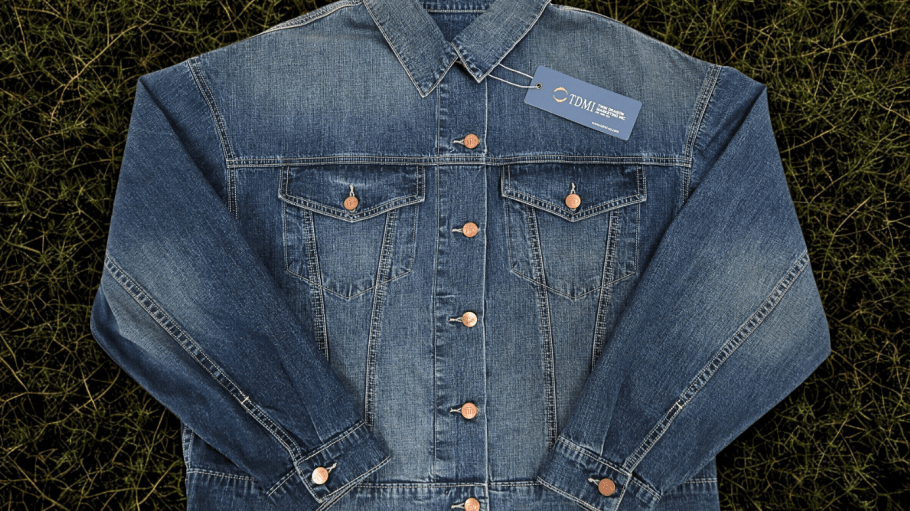
Earlier this year Twin Dragon launched fabrics made in Mexico with Panda Biotech’s sustainably sourced, American-grown hemp, backed by the Southern Ute Indian Tribe Growth Fund. The collection includes 11oz. to 13oz. constructions, offering weights for bottoms and jackets. Most are cotton-rich blends enhanced with 20–30 percent hemp, tailored to achieve the desired balance of aesthetic and performance. While the current range is indigo-based, Poon said the mill is preparing to expand into natural grounds for garment-dyed applications.
“Brands are excited by the sustainable angle, but equally important is the hand feel and modern look we’ve been able to achieve with hemp—it’s not the coarse, rustic fabric many people expect,” she said.
Sourcing traceable hemp from Panda Biotech was an important milestone for Twin Dragon, which previously sourced the fiber from China. Having access to U.S.-grown fiber not only shortens the supply chain, but it also strengthens the mill’s “Made in the Americas” story, which is increasingly important to brand partners. Poon said it “resonates particularly with clients who want to minimize supply chain risk and emphasize regional sourcing for speed-to-market, transparency, and sustainability.”
While those articles made with Chinese hemp remain available, Twin Dragon’s focus now is on scaling its partnership with Panda Biotech to strengthen local sourcing. “We are applying insights gained from established hemp manufacturers to refine our processes and hone our craft on this side of the world,” Poon said.
With hemp being a relatively new crop in the U.S., Panda Biotech is refining seed varieties, genetics, processing settings, and cottonization methods to deliver consistent, spinnable fiber. Carter said partnerships with mills like Twin Dragon and Global Denim have been invaluable, providing feedback that has helped the firm steadily improve fiber quality and deliver denim that meets both performance and design expectations.
“Collaboration is essential. Processors and spinners must work hand-in-hand to achieve the right yarn quality,” she said.
Alt choices
Hemp and linen are not the only options. Ajimal noted that mills are exploring fibers like pineapple, banana, soy, ramie and silk blends—alternatives that offer various natural properties, promote recyclability and even biodegradability—though they’re being adopted at a much slower pace.
“It’s not about fitting new fibers into old molds—it’s about redesigning the mold altogether,” Alves de Oliveira said. “Innovation doesn’t have to follow the rules of legacy systems.”
Scaling these fibers will require a fundamental shift in how the supply chain is built. “Right now, most industrial systems are designed around standardized cotton and synthetics and not equipped to handle differentiated fibers like hemp or linen at scale. We need more flexible and regionalized processing infrastructure, and above all, the ability to offer a wider variety of yarns that are compatible with both traditional and more conscious consumption patterns,” she said.
More education about the characteristics of alternative fibers is crucial, as different blends serve distinct purposes based on performance and aesthetics. “We need to ensure that industry buyers and consumers can fully appreciate the diverse attributes these natural fibers offer, their key benefits and price points and why that differs from 100 percent cotton composition,” Ajimal said.
The industry also needs to ask the right questions. “But more than just asking if they’ll go mainstream, we should be asking: what’s holding them back? Often the issue isn’t feasibility, but lack of visibility, funding, or risk-sharing,” Alves de Oliveira said. “As industry players, we can’t wait for these materials to be ‘ready.’ We need to be the ones stress-testing them, co-developing, and communicating their value in ways that reach both brands and consumers. We’re curating ecosystems.”
This article was published in SJ Denim magazine. Click here to read more.