American and British naval forces shot down 21 missiles and drones in a Red Sea skirmish Tuesday, in what British Defense Secretary Grant Shapps called “the largest attack by the Iranian-backed Houthis to date.”
U.S. Central Command, which oversees U.S. military operations in the Middle East, confirmed the incident Tuesday night, saying it was the 26th Houthi attack on commercial shipping lanes in the Red Sea since Nov. 19. No injuries or vessel damage were reported.
Houthi military spokesperson Yahya Saree said the target of the attack was an American-flagged ship that was “providing support” to Israel amid its ongoing war with Hamas.
Related Stories
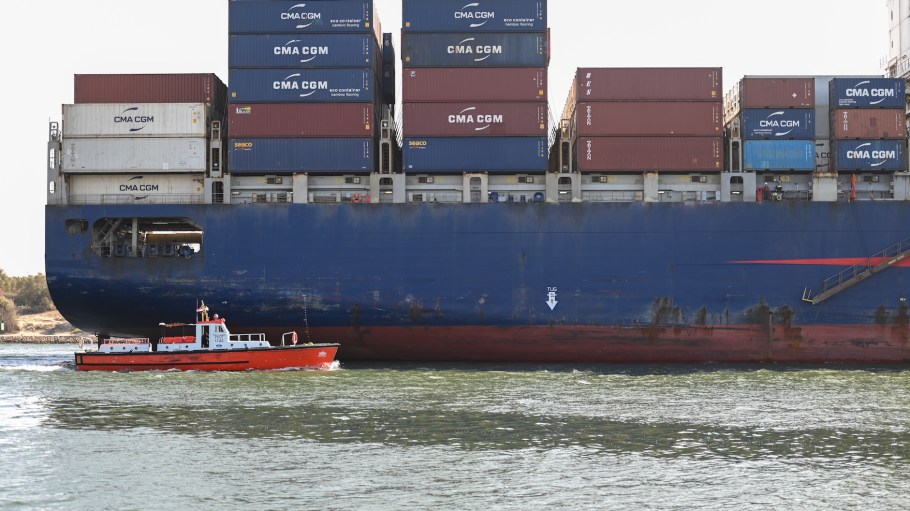
The repeated attacks have thrown a wrench in global trade, forcing major ocean carriers including Maersk, Mediterranean Shipping Company (MSC), CMA CGM, Hapag-Lloyd and Evergreen to divert vessels away from the sea’s conflict-ridden chokepoint, the Bab el-Mandeb Strait. Many of these ships sailed south around Africa’s Cape of Good Hope, which can tack two weeks onto an Asia-to-Europe trade lane.
Since the attacks began, volume through the Suez Canal has decreased an average of 61 percent per day, from an average of 15 container vessels per day down to 5.8 in the week of Dec. 31-Jan. 7, according to data from Project44. The supply chain visibility platform provider said the median number of days that vessel schedules are trending late has increased as much as 310 percent on some lanes.
As of Tuesday, freight forwarder Kuehne + Nagel has identified 419 vessels impacted by the Red Sea situation. The total capacity is estimated at 5.65 million 20-foot equivalent container units (TEU). In a customer advisory, the company said the first diverted vessels have started to arrive at their destinations.
According to Kuehne + Nagel, container resupply into Asia will be delayed, resulting in a shortage of equipment in the run-up to the Chinese New Year.
This could pose potential delays for Chinese exporters as international businesses are likely scrambling to bring in goods ahead of the Lunar New Year, when factories close for two weeks starting Feb. 10.
Philip Damas, managing director, head of Drewry Supply Chain Advisors, told Sourcing Journal that “there is currently something of a panic” in China due to the reduced availability of shipping capacity weeks before the Chinese New Year rush.
Both Drewry and Freightos, each of which measures ocean spot freight rates, point to container prices skyrocketing because of the attacks. The market price for an average 40-foot container from Shanghai and Rotterdam more than doubled at a 115 percent pace to $3,577 as of Jan. 4, before increasing another 23 percent to $4,406 Thursday.
Freightos Baltic Index estimates released on Monday suggest an even pricier jump, finding that average Asia to Northern Europe spot rates have soared 226 percent since the diversions started in mid-December to $4,789 per container.
“Ocean spot freight rates have jumped since the Red Sea attacks started in December and are causing a return to price volatility,” said Damas. “But there is plenty of ship capacity available globally—the problem now is that many of the ships are in the wrong place.”
Damas advises shippers to closely monitor the capacity situation and focus on getting estimates of the extra sailing time and carrier costs. The maritime consultancy has “flagged a big increase” in the number of sailings canceled in January because of the Red Sea situation, he added.
On the plus side, Damas said Drewry expects trans-Pacific contract rates from May to “still be very favorable” to importers and exporters despite the Red Sea situation.
The Houthi militants claim their assault on commercial vessels is in response to the Israel-Hamas War in Gaza, with the Yemeni faction initially warning that it would prepare to attack any boat connected to Israel. However, the targeted ships have often had very little or no connection to Israel.
When it confirmed the attacks Tuesday, Central Command reiterated a Jan. 3 joint statement from 14 countries, including the U.S., saying the Houthis would face “consequences should they continue to threaten lives, the global economy, or the free flow of commerce in the region’s critical waterways.”