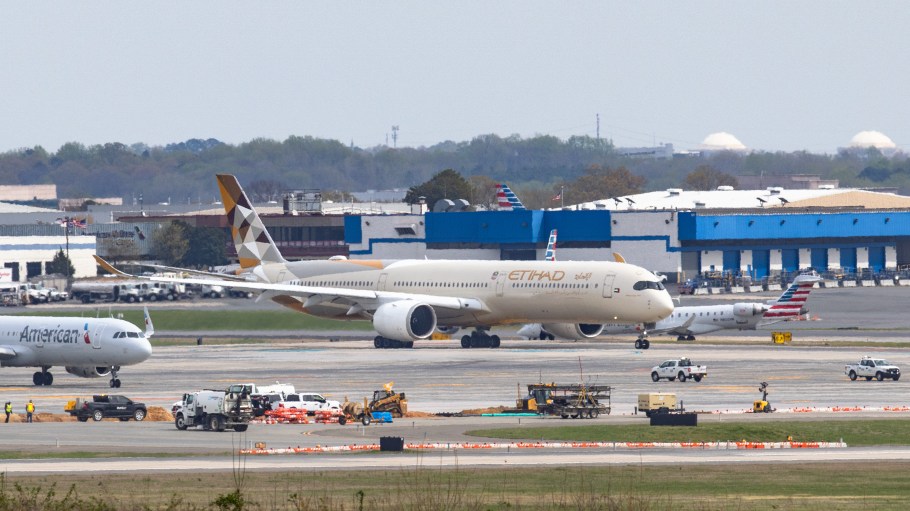
Severe disruptions at major airports in the Middle East dealt a blow to global air cargo demand in the first month of the war in Iran.
Total demand, measured in cargo tonne-kilometers (CTKs), fell by 4.8 percent compared to March 2025 levels, according to data from the International Air Transport Association (IATA). For international operations, the number fell an even deeper 5.5 percent.
The international figures were dragged down by carriers operating out of the Middle East. Carriers including Qatar Airways, Emirates and Etihad Airways experienced a 54.2 percent contraction in demand as airports in regional cities like Doha in Qatar and Dubai and Abu Dhabi in the U.A.E. grounded flights after hostilities broke out.
Related Stories
Asia-Pacific airlines benefited as customers sought alternative routes around the conflict-riddled region, generating 5.4 percent year-over-year growth in air cargo demand.
Broadly in line with the demand reduction, industry capacity for the month declined 4.7 percent.
“The timing of the usual post-Lunar New Year slowdown also added to the decline,” said Willie Walsh, director general of IATA, in a statement. “The underlying demand trends, at this point, appear strong and the recent World Trade Organization and International Monetary Fund revisions to trade and GDP projections continue to see growth in 2026.”
Rates not expected to slow down on Hormuz, oil volatility
Air freight rates escalated as energy markets remained volatile amid the constriction of shipments through the Strait of Hormuz, which typically hosts 20 percent of the world’s oil and natural gas supply daily. The slowdown in traffic to near-standstill levels tightened aviation fuel availability, with various global airlines committing to curtail their flight schedules in April in the wake of possible shortages.
Jet fuel prices rose sharply in March, up 106.6 percent year-on-year and 92 percent from February to average $183.70 per barrel—the highest point measured by IATA in more than 23 years, in the months prior to the Iraq war.
On a yearly basis, dated Brent crude oil prices increased alongside a 43.1 percent increase in and a 320 percent surge in refining margins.
Cargo yields rose alongside the energy costs, increasing 18.9 percent year-over-year and 13.6 percent month-over-month to reach $2.75 per kilogram.
The sequential increase of $0.33 per kilogram reflected both supply-side constraints and demand substitution from disrupted sea freight, according to the IATA. Longer routings with the Middle Eastern airport disruptions, elevated fuel burn, reduced maritime reliability and constrained cargo lift combined to create a sharply inflationary pricing environment across global freight markets.
“All eyes are on fuel supply and price, which are expected to test the industry’s resilience in the coming months,” Walsh said.
Despite the U.S. and Iran currently operating under a ceasefire, both Iran’s threats on the Strait of Hormuz and an American naval blockade of Iranian ports suggest oil prices are likely to stay elevated.
As of noon on Wednesday, crude oil futures had risen more than 6.6 percent on the day to $106.78 per barrel, with President Donald Trump asserting in an interview with Axios that the U.S. naval blockade will remain in place until the Iranian regime agrees to a deal that addresses U.S. concerns about its nuclear program.
“Airfares are expected to rise in the short term. Air cargo costs will increase, which also means there is an impact on pharma, electronics and high-value goods,” said Arun Lawrance, team lead of oil and gas research at procurement intelligence firm Beroe. “Jet fuel disruption is driving higher airfares and flight cancellations, with airlines passing on rising costs to consumers.”
According to data from Beroe, the U.S. has roughly 25 days’ worth of jet fuel supply left, while the E.U. has three to six weeks. However, the U.S. concern is much more manageable due to the country’s domestic production of oil, whereas Europe is almost entirely dependent on foreign oil imports.
If the disruption continues over the next month, prices will be elevated in North America, although supply will be broadly available, according to Lawrance. A second month of disruption would bring tightening of supply due to export demands, alongside limited refining flexibility, while a third month would deliver “moderate” risk to North American carriers if refinery outages and summer demand coincide with global disruption.
Europe’s situation is more dire, with supply “broadly manageable” via stocks and imports for a two-week stretch. Beyond that, there will be visible tightening, rising premiums and longer lead times for shipments out of the country. Once week six is reached, Lawrance identified a high risk of shortages if the interruptions surrounding the Hormuz strait don’t let up.