Air cargo rates have kept rising more than one month into the start of the war in Iran as carriers continue to face capacity and operational disruptions, as well as increasing jet fuel costs.
Average global contract air freight rates rose by 7 percent week over week as March 22 to $2.84 per kg, according to air cargo market data from WorldACD. The jump follows two weeks that saw 10 percent rate growth and 8 percent growth, respectively.
For the week, spot rates rose 6 percent to $3.38 per kg.
Related Stories
The figures, which are based on more than 500,000 weekly transactions covered by WorldACD’s data, indicate that global tonnages were relatively stable compared with the previous week, with capacity dipping 1 percent. However, air cargo capacity has seen a 6 percent drop compared to last year, further propping rates up.
Depending on the origin and destination of the cargo, price increases have seen substantial accelerations as planes have either remained grounded or taken out of service.
According to Drewry Airfreight Insight, air freight rates from Shanghai to Dubai have soared 95 percent since the start of the war, to $8.60 per kg. Rates could exceed the 2020 pandemic record of $9.40 if fuel surcharges continue to rise, the supply chain consultancy said.
Different pricing components across specific routes are amplifying some of the increases. For example, Drewry says fuel surcharges skyrocketed as much as 290 percent from month to month in March for Singapore-to-London flights. On the other hand, security surcharges rose 44 percent on shipments from Dubai and Abu Dhabi to Amsterdam in the same time frame.
Air freight routes connected to the Middle East constitute 15.6 percent and 18.2 percent of airfreight traffic and capacity, respectively, while the ongoing conflict impacts air trade lanes beyond those originating from the Middle East.
The Middle Eastern conflict has upended the air cargo industry over the past year, leaving questions about the demand landscape if prices to fly goods continue to increase. The International Air Transport Association (IATA) initially projected in December that air cargo demand was projected to reach 2.6 percent in 2026 to 289.5 billion cargo tonne-kilometers (CTK).
“The outbreak of war in the Middle East…makes it difficult to see how full-year performance will unfold. Sharply rising fuel costs, fuel scarcity in parts of the world, and the severe disruption to key cargo hubs in the Gulf are major shifts,” said Willie Walsh, IATA’s director general, in a statement. “While air cargo has repeatedly proven its resilience in the face of disruption, an early resolution of the war along with a normalization of fuel supply and costs would be in everybody’s interest.”
The association will reveal its March figures at the end of April. On Monday, IATA revealed that global CTKs throughout February had accelerated, rising 11.2 percent ahead of the war in Iran.
February benefited from post year-end normalization after the December holidays, pre-Lunar New Year shipments and steady Asia-linked flows with the Chinese holiday providing a notable short-term boost.
The IATA data noted that air cargo rates were starting to increase before the hostilities, with global jet fuel averaging $95.7 per barrel, up 6 percent month over month and 1.2 percent from February 2025.
The increase propped global rates up 6.6 percent year over year, which marked the first annual rise in 11 months and the highest such growth in 13 months.
Vietnam’s airline industry plans capacity constraints in Q2 on fuel prices
Going forward, shippers looking to fly their cargo out of Vietnam could be in for more of a capacity struggle if the war endures.
Vietnamese airlines are planning to significantly reduce flights and scale back operations next month due to the high costs brought upon by the conflict, as well as potential jet fuel shortages. Roughly 70 percent of the country’s jet fuel is imported, with most coming from China and Thailand.
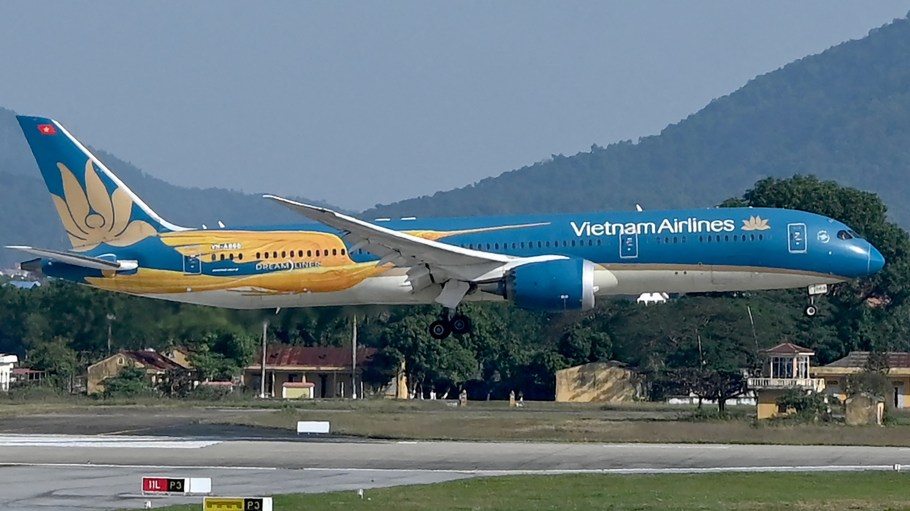
National carrier Vietnam Airlines will suspend seven domestic routes starting Wednesday, according to the Civil Aviation Authority of Vietnam.
The airline plans to cut 10 percent to 20 percent of its flights per month in the second quarter if jet fuel reaches $160 to $200 per barrel, the authority said. That could mean the cancellation of up to 18 percent of its international flights and as much as 26 percent on domestic routes.
Other carriers including Vietjet Air, Bamboo Airways and Pacific Airlines are also scrapping capacity in April.
VietJet is targeting an 18 percent capacity reduction next month, accounting for a 22 percent cut in domestic flights and an 11 percent decrease in international routes. Bamboo is more than halving its daily flights from 36 to 17, while striving to maintain flights during peak travel periods. Pacific will have fewer flights on off-peak days, and expects to cut capacity by between 8 percent and 30 percent.