The U.S. and China are postponing their tit-for-tat port calling fees initially placed on each other’s vessels for one year after Presidents Donald Trump and Xi Jinping concluded their heavily anticipated meeting in South Korea Thursday morning.
That meeting, which Trump touted as an “amazing” talk, saw the U.S. knock down its fentanyl-related tariffs on Chinese goods from 20 percent to 10 percent, bringing total average duties to roughly 47 percent. China is also suspending its recently announced export controls on rare earth minerals for one year.
Related Stories
In a statement, China’s commerce ministry said the U.S. will suspend the punitive measures, which stem from the U.S. Trade Representative’s (USTR) Section 301 investigation against China’s maritime, logistics, and shipbuilding industries.
There has been no explicit date listed for when the suspension will begin.
That probe had concluded that China had an “unreasonable” dominance over those sectors, largely due to allegations that the country uses state subsidies to lessen competition and create dependencies on it for non-market entrants.
The fees went into effect on Oct. 14, with many of the USTR-levied charges being finalized as far back as April. Those penalties had essentially forced major container shipping alliances like the Gemini Cooperation and the Ocean Alliance to rework their networks to minimize voyages of Chinese-built ships calling at American ports. Additionally, carriers also re-flagged some vessels.
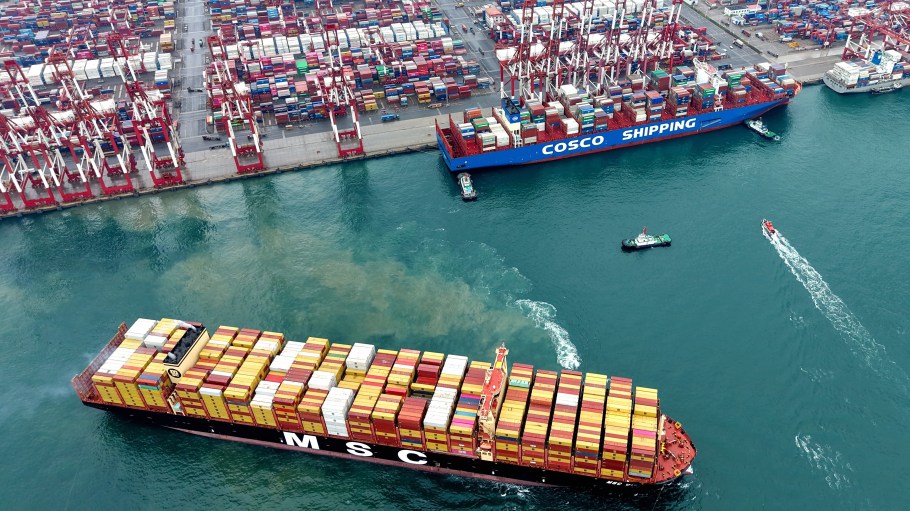
Chinese state-owned ocean carriers Cosco Shipping and its subsidiary, Orient Overseas Container Line (OOCL), were the most affected by the fees. The shipping giants reportedly incurred as much as $42.8 million in fees the first week the penalties went into effect. Combined, both companies were expected to incur $2.1 billion in charges in the first year of implementation.
Another Chinese carrier, China United Lines, is estimated to have paid one $1.3 million fee for one U.S. port call.
It wasn’t just Chinese companies that were affected. Shipping firms that had a high concentration of Chinese-built container vessels in their fleet, like ZIM, had incurred fines as well.
“Given this is a time-limited suspension it would likely see shipping lines maintain a deployment stance whereby they to some degree still abide by the restrictions and certainly keep a plan for vessel-reshuffling handy,” said Lars Jensen, CEO of container shipping consultancy Vespucci Maritime, in a LinkedIn post.
Following the U.S. suspension, China will also suspend its countermeasures against the U.S. for one year. On the day the port fees went into effect, China had also opened its own probe into the U.S. Section 301 investigation.
Those countermeasures included a similar fee slapped on U.S.-owned, built and -flagged ships, but only affected 24 ships visiting Chinese ports, according to Linerlytica. Matson, the largest U.S.-based ocean carrier, had 11 of those ships.
Along with the countermeasures, China also sanctioned five American units of South Korean shipbuilder Hanwha Ocean, effectively banning them from dealing with Chinese interests.
It is unclear if those sanctions have been, or will be, lifted.
Shipbuilding remains the wild card for both countries as they attempt to iron out their trade skirmish, especially as the U.S. seeks to fill a massive gap with China that has grown wider in recent years.
“We’re trying to rebuild shipbuilding,” said USTR Jamieson Greer aboard Air Force One, in response to a question on whether Trump and Xi had agreed on port fees during their South Korea meeting.
The U.S. has recently cozied up to South Korea and Japan—the second- and third-largest shipbuilders after China—to partner on shipbuilding initiatives as part of their respective trade deals.
South Korea is contributing $150 billion to help revive the industry in the U.S., with Hanwha Group and another shipbuilding conglomerate, HD Hyundai, expected to play a major role. And Japan and the U.S. signed a memorandum of understanding to expand the U.S.’s maritime ambitions.
As ocean freight stakeholders breathe a sigh of relief regarding the port fees, the jury is still out on whether the USTR’s additional 100 percent duties on Chinese ship-to-shore (STS) cranes will go into effect Nov. 9.
U.S. ports have been heavily pushing back on the decision to tariff the cranes, saying it only makes cranes delivered from allies more expensive and would “only serve to delay port modernization.”
Tariffs on the STS cranes were already set at 25 percent last year by the Biden administration as an extension of the Section 301 punitive measures.