The 90-day reduction in tariffs on Chinese imports have sent bookings out of the country soaring almost immediately—and ocean spot freight rates are following suit.
Numerous indices tracking rates on the trans-Pacific trade lane are seeing abrupt spikes in the cost to move cargo out of China toward to the U.S.
The Shanghai Containerized Freight Index (SCFI) released Friday said deliveries from Shanghai to U.S. West Coast ports soared 32 percent from the week prior to an index rate of $3,091 per 40-foot container. The Shanghai-to-U.S. East Coast route saw a healthy 22 percent week-over-week jump to $4,069.
Related Stories
Drewry’s World Container Index (WCI) saw weekly Shanghai-to-New York sailings take the highest growth rate at 19 percent to $4,350 per 40-foot container (FEU), while trans-Pacific routes reaching Los Angeles shot up 16 percent to $3,136 on average.
For Drewry, both routes buoyed the total WCI composite across eight major East-West trade lanes, which increased 8 percent from the week prior, to $2,233 per container.
Xeneta’s newest data released Friday had Far East-to-U.S. West Coast average rates reaching $2,722 per FEU, with average East Coast-bound rates at $3,883.
“There is no time to waste for these shippers and the rush of cargo will put upward pressure on spot rates on trans-Pacific trades,” said Peter Sand, chief analyst at Xeneta, in a weekly update. “Spot rates will peak and then flatten as carriers redeploy capacity to match demand, then rates will begin to slide again just as we saw in Q1. This is expected to happen over the next two to four weeks.”
With rates naturally increasing due to the quick turnaround in ocean freight demand, container shipping liners no longer have to resort to artificially propping yields up by cutting capacity via methods like blank sailings or vessel swapping.
According to Drewry’s container capacity insight online tool, blank sailings from Asia to the West Coast of North America will decrease 28 percent month-on-month from 33 in May to 24 in June.
The number of blank sailings from Asia to the East Coast of North America will decrease from 23 in May to 17 in June, a 23 percent drop. This will result in double-digit increases (or returns) of ship capacity to these trades, after the recent cuts.
“It is a feature of the current volatile macro-environment that ocean carriers are ‘cancelling cancellations’ of sailings,” Drewry said in a post on LinkedIn. “We notice that the container shipping market is reacting to trade policy announcements with swings in trade volumes, capacity volumes and spot prices, similarly to the stock market.”
CMA CGM expects ‘much more active’ June for volumes
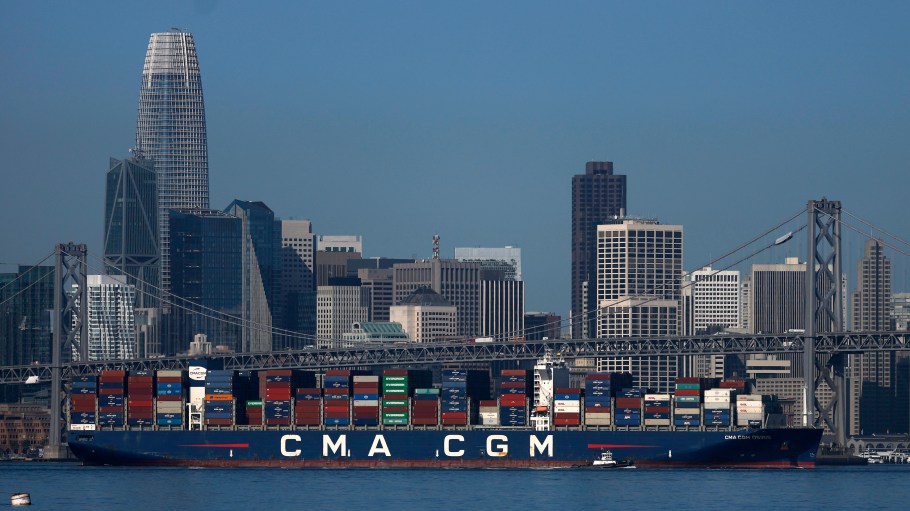
CMA CGM, which saw freight bookings for China exports to the U.S. get cut by 50 percent after President Donald Trump began his escalation of tariffs on April 3, is another ocean carrier seeing the quick rebound in bookings.
“Trade will restart on this route very, very vigorously in the coming weeks and months,” said CMA CGM chief financial officer Ramon Fernandez during a first-quarter earnings call, calling the duty rollback an “indisputably positive signal for maritime transport.”
“Everyone is expecting trade in June to be much more active than was feared just a few days ago,” said Fernandez.
The carrier, which plans to invest $20 billion into the U.S. throughout Trump’s presidency, posted a 12.1 percent increase in revenue to $13.3 billion in the first quarter on net income of $1.1 billion. Volumes carried ticked up 4.2 percent to 5.85 million 20-foot equivalent units (TEUs).
Additionally, the French shipping conglomerate gave more color on the anticipated U.S. port docking fees on Chinese ships, with Fernandez indicating “we will organize ourselves in order not to have to pay these fees.” He added that less than half of the company’s 670 vessels were built in China.
Fernandez said Ocean Alliance partners including China’s Cosco Shipping and would adapt to the fees, although he did not say what the wider impact would be to the vessel-sharing agreement.
CMA CGM has added peak season surcharges on trans-Atlantic trips to the U.S. as the tariff situation remains at an impasse.
From June 1, all cargo headed for the U.S. from northern Europe will carry an extra fee of $400 per TEU or $800 per FEU. And from June 15, cargo from Mediterranean ports to the East and Gulf Coast will get a $500 surcharge.
Maersk is slapping peak charges on China- and east Asia-originated cargo to U.S. and Canada as well, hitting them with an extra $1,000 per TEU and $2,000 per FEU.
“Given the tighter capacity on the trans-Pacific, ocean carriers are in the driver’s seat to push freight rates meaningfully higher,” said Jefferies analysts in a research note Tuesday.