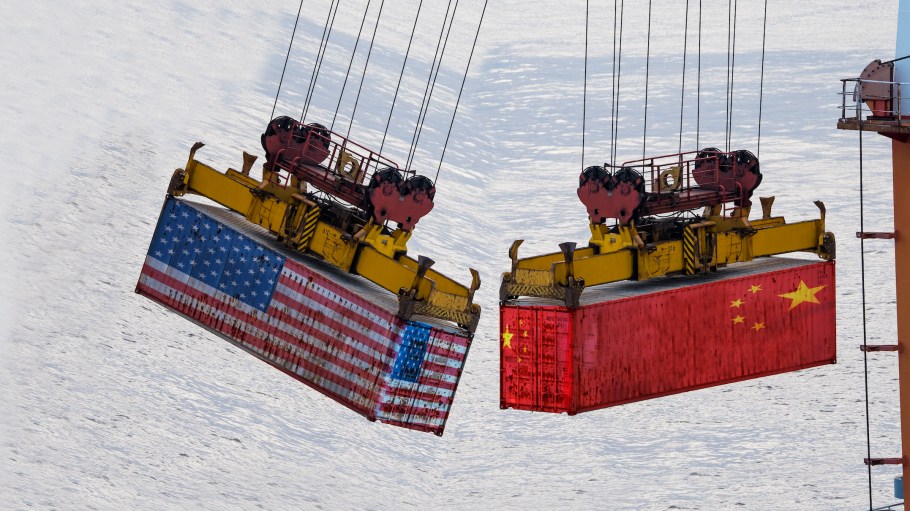
With a new administration in place that is already instituting more protectionist measures across global trade, the U.S. could soon see priorities shift to reestablish worldwide maritime dominance. But such a shipping renaissance might be felt in the pockets of U.S. importers and exporters.
In December, the bipartisan Shipbuilding and Harbor Infrastructure for Prosperity and Security (SHIPS) for America Act was proposed in Congress as a matter of addressing the growing gap between the U.S. and China in shipbuilding.
Related Stories
The bill, if passed, would have significant consequences on American supply chains. But the legislation itself is primarily rooted in national security, and is aimed at establishing national oversight and consistent funding for U.S. maritime policy.
The legislation has been largely praised in maritime circles, particularly due to the lofty goal of building 250 ships within 10 years. The current U.S.-flagged fleet stands fewer than 200 vessels, 80 of which are trade in international commerce—a paltry sum compared with 5,500 vessels controlled by China.
Additionally, the bill would establish both a maritime security advisor within the White House and create a Maritime Security Trust Fund to reinvest $250 million in collected duties annually into U.S. shipyards.
The weight of such an endeavor comes with costs, warned Lars Jensen, CEO of container shipping consultancy Vespucci Maritime, when the Act was introduced in December.
“In short, if this is applied as proposed it will increase shipping costs for U.S. importers and exporters—except those exporters who are slated for government subsidies,” Jensen said in a LinkedIn post.
Likely the biggest impact of the bill for supply chain operators, if passed, would be the establishment of “commercial cargo preference.” This would require that within 15 years, 10 percent of all cargo imported into the U.S. from China must be imported on U.S.-flagged vessels that are also and built in the U.S. and staffed by American crews.
Any individual shippers that don’t comply with the requirements would be subject to a fine, which may not be as easy to maneuver in practice depending on the agreements they have in place with ocean carriers, and their point of origin.
“It will create significant supply chain headaches for individual U.S. shippers needing to clearly measure the share of cargo moved on U.S. ships—especially if much of their cargo is from origins not necessarily served by such U.S. vessels,” Jensen said.
Sal Mercogliano, an associate professor of maritime history at Campbell University and former merchant mariner who is a major proponent of the SHIPS for America Act, prefers that shippers be financially incentivized to hit that kind of quota, rather than penalized if they don’t.
“I was hoping to see a tax incentive to ship on American ships,” Mercogliano said in his YouTube series, What’s Going on with Shipping? on Dec. 19. “I think that would be a great way to encourage the use of American vessels.”
In a post a X on Tuesday, Mercogliano again floated the idea of incentives, particularly in an era where President Donald Trump has been open to slapping more tariffs on goods coming out of China, Russia and the E.U.
“The idea that goods shipped on U.S-flagged ships would be exempt from tariffs could be a huge incentive for some carriers to reflag ships into the U.S. registry,” Mercogliano said.
Currently, only Matson and the U.S. subsidiaries of Maersk and CMA CGM would be able to fit the description of container shipping firms that can help companies reach the 10 percent goal.
A possible wild card in the years ahead could be the creation of a new container shipping line in the U.S. dedicated to serving American businesses.
A recent report from supply chain publication The Loadstar indicates that such a project “is strongly rumored to have the support of a major logistics integrator, which is a genuine household name and would presumably present the new carrier with its base cargo volumes.”
Such a report follows the Department of Defense’s recent designation of the world’s fourth largest ocean carrier, Cosco Shipping, as a Chinese military asset. While there are no specific penalties for the ocean carrier for being added to the list, it further adds to the escalation of trade tensions brewing between the two nations.
Two of China’s top shipbuilders were also blacklisted.
With a recent U.S. Trade Representative investigation determining that China’s maritime, logistics and shipbuilding practices severely disadvantage U.S. companies, workers and the country’s economy at large, support for the SHIPS for America Act is likely to gain more traction in Washington.
“The bill is not perfect by any means, but it is the most substantial change proposed since the Merchant Marine Act of 1970,” Mercogliano said.