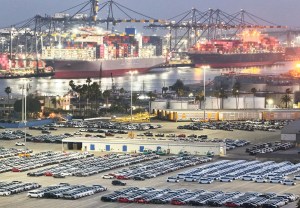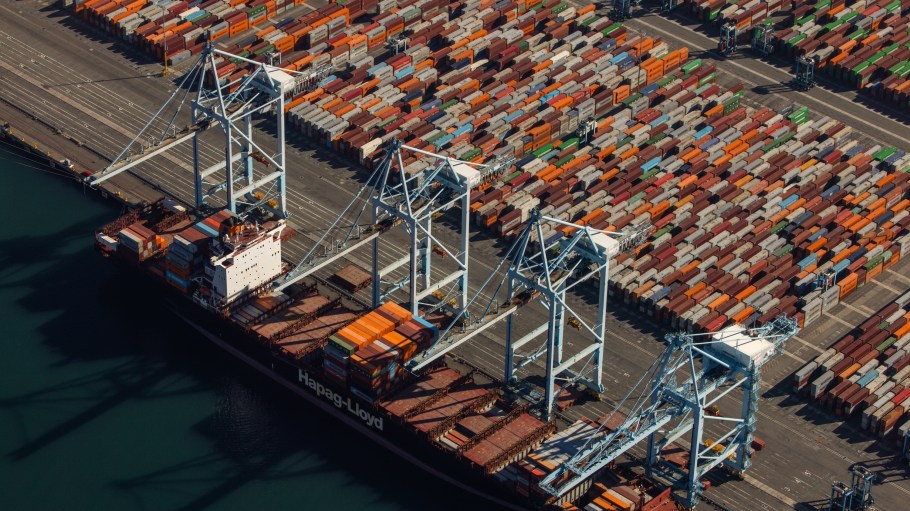
The Port of Los Angeles had a slow start to 2026, with total container throughput slumping 11.9 percent to 812,000 20-foot equivalent units (TEUs).
Loaded imports declined 12.9 percent to 421,594 20-foot equivalent units (TEUs), while loaded exported containers dropped 7.9 percent to 104,297 TEUs.
Despite projecting overall cargo throughput declines of less than 10 percent in the first quarter due to an expected post-Lunar New Year slowdown in March, the port’s executive director Gene Seroka remains cautiously optimistic about volumes beyond the slowdown.
Related Stories
“I don’t see the economy or cargo volume dropping off a cliff after that,” said Seroka in a briefing. “Even though holiday sales were softer than we would have liked, I don’t see a dire situation. I watch purchase orders that go out three months in advance to Asia factories, and right now they’re looking stable. That’s a good sign.”
The port is not seeing the cancellation of purchase orders to kick off the year, contrary to “other years that were much bumpier from an economic output standpoint,” said Seroka.
Seroka’s projections for the West Coast port come as wider U.S. inbound cargo volume is expected to remain muted for the first four months of 2026. According to the Global Port Tracker from the National Retail Federation and Hackett Associates, the first month of year-over-year growth is not expected until May. The performance weighs down first-half forecasts, with inbound TEUs expected to see a 2 percent decline.
The decline in cargo has coincided with China’s diminishing role in trade through the gateway in the wake of the U.S. trade policy shifts.
Since 2018, when the first Trump administration began slapping the sourcing superpower with tariffs, China’s share of cargo entering the Port of Los Angeles has dwindled from about 60 percent of imports to “40 percent and dropping” today, Seroka said.
Southeast Asian countries have helped fill the void, but it has required a collective to do it, the port director said. In 2025, Vietnam, Malaysia, Cambodia, Indonesia and the Philippines combined to move an incremental 200,000 container units.
“That outstripped the declines that we saw from China,” said Seroka.
The port director was blunt in his assessment of U.S.-China trade, noting that exports to China look “dismal.”
U.S. containerized exports to China were down 26 percent last year, although cargo shipped out of the Port of Los Angeles was “relatively flat.”
The biggest hit came from the soybean trade, which saw 80 percent declines out of the Port of Los Angeles last year with no improvement seen in either November or December even after the U.S. lowered its punitive fentanyl tariffs on China.
Chad Bown, the chief economist at the U.S. State Department under the Biden administration, said during the briefing that despite the easing of tariff tensions, Chinese suppliers have not been lowering prices to U.S. buyers.
“To the extent that sales continue, it’s basically being borne by somebody on the American side,” Bown said. “But oftentimes the sales aren’t continuing.”
As the decision on the International Emergency Economic Powers Act (IEEPA) tariffs lingers in the Supreme Court, Bown said businesses should be following the high court’s opinion if they rule against the duties.
“Will they send signals about when using those other statutes would be appropriate and when they would not be appropriate?” Bown said. “If they do rule against the tariffs, there’s also the possibility and likelihood that all the tariff revenue that was collected last year—and we’re talking hundreds of billions of dollars year—would need to be refunded to the American public. How is that going to work? The lawyers that I’ve talked to have basically said, ‘Buckle up.’ There could be another period of chaos.”
When asked about whether intended trade fraud enforcement efforts from Customs and Border Protection (CBP) are resulting in more containers flagged, inspected or detained at the port, Seroka did not directly answer the question. But he noted that any potential investigations by the agency had not impeded operations at the port.
“Looking at the daily stats of the port, the dwell time for cargo moving in and out by truck is below three days now, and that’s better than it was pre-Covid. The velocity of cargo moving in and out is really good,” said Seroka. “The truck wait times at both ports of Long Beach and Los Angeles are right at about an hour or less. Again, the best in five or six years.”