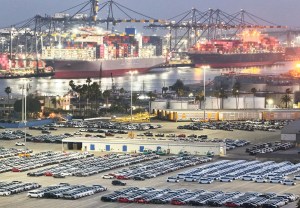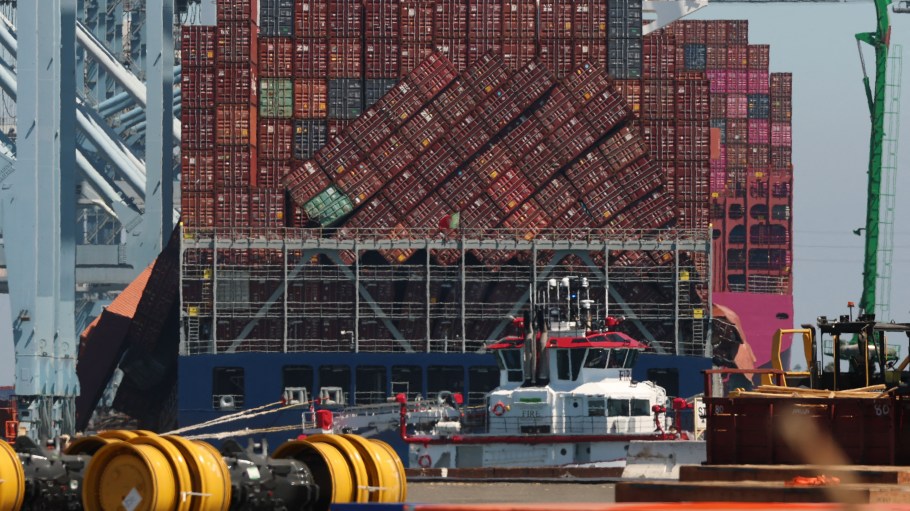
An estimated 67 containers fell off a ZIM cargo ship into the harbor at the Port of Long Beach Tuesday morning, forcing the temporary suspension of cargo operations at the gateway’s Pier G terminal.
The incident occurred just before 9 a.m., with several fallen containers damaging a clean air barge connected to the MV Mississippi vessel, which has a capacity of 5,550 20-foot equivalent units (TEUs).
No injuries were reported, and no other terminals or port operations have been impacted. As of Tuesday morning, operations at Pier G remain suspended.
Related Stories
Port officials are still trying to determine the cause of the collapse. The officials said that after the ship came into port and crews started to release the straps holding the containers down, they started to fall into the water, creating a domino effect.
Hours after the initial shipping containers fell into the ocean, more containers tumbled onto the port side.
Local reports have said shoes and clothing were seen floated in the water, with some containers appearing to have sunk into the ocean. Port officials said the Mississippi carried a full load of goods headed for retailers like Costco, Target, Walmart and small mom-and-pop stores.
Videos show that two separate, non-neighboring, stacks toppled. The stack collapses indicate that cargo that did not go overboard may have also been damaged.
According to the Port of Long Beach, a unified command was established to respond to the incident. That group includes representatives from the port, U.S. Coast Guard, Long Beach Fire Department, Long Beach Police Department, and Army Corps of Engineers, among others.
The Coast Guard established a safety zone 500 yards around the Mississippi and is issuing marine safety broadcasts every hour to alert other vessels of the navigation and safety hazards.
In a post on X, Flexport said it was in contact with ZIM and port officials to identify impacted containers and shipments. According to CEO Ryan Petersen, 20 separate Flexport clients had goods aboard 36 of the containers.
The ship is part of the Asia-to-America ZIM Ecommerce Xpress (ZEX) service line, which makes stops in Long Beach; Vietnam’s Hai Phong and Cai Mep ports; and Yantian Port in Shenzhen, China. The ship had departed Yantian on Aug. 26 and reached Long Beach on Tuesday morning.
The incident occurred a day after the World Shipping Council (WSC) highlighted the rise in safety concerns that containers pose.
In a report released Monday, the trade association said 11.39 percent of inspected cargo shipments were found to have deficiencies, up slightly from the 11 percent calculated by the International Maritime Organization (IMO) calculated before discontinuing the data series.
The 2024 report is based on information from 77,688 containers inspected, where 8,850 were found to have deficiencies.
When accounting for the WSC’s estimates that the container shipping industry transports 250 million boxes a year, this comes out to 28.5 million containers that could have some deficiency.
The number has crawled upwards in the years after 2020, according to the data from the WSC and IMO. From 2017 to 2020, 7.75 percent of containers on average were marked as deficient, compared to 10.27 percent from 2021 to 2024.
Deficiencies can include misdeclared and undeclared dangerous goods; incorrect documentation; structural deficiencies; and improper, damaged or mislabeled packing, all of which can lead to safety incidents, including ship fires.
“Cargo safety starts with correct declaration and safe packing of goods,” said Joe Kramek, president and CEO of the World Shipping Council in a statement. “With over one in ten shipments showing deficiencies, the message is clear: gaps in cargo safety remain far too common. Cargo deficiencies put crews, ships, cargo and the environment at risk.”
Container shipping companies are growing more concerned with misdeclarations regarding the weight or hazard level of the cargo inside the container amid incidents like the one at the Port of Long Beach.
Maersk recently told Indian customers that container loads with incorrect weight declarations face a $5,000 surcharge, while dangerous goods violations would cost and extra $15,000. The carrier warned that incorrect declarations can result in cargo shifting or collapsing, alongside other accidents like chemical reactions, fires or even explosions.
CMA CGM tapped similar penalties for Chinese customers last September, tacking on a $7,000 weight misdeclaration fee and a $17,000 dangerous goods misdeclaration surcharge in the event of a violation. In late 2023, CMA CGM also warned Indian customers that misdeclared weights were becoming more of a common occurrence out of the country. The company did not appear to levy a penalty in the follow up to the note.