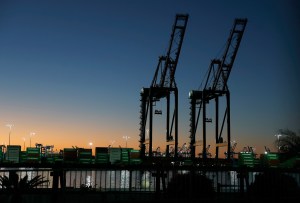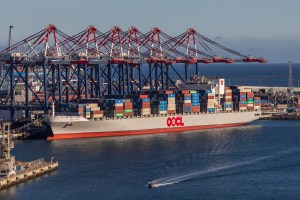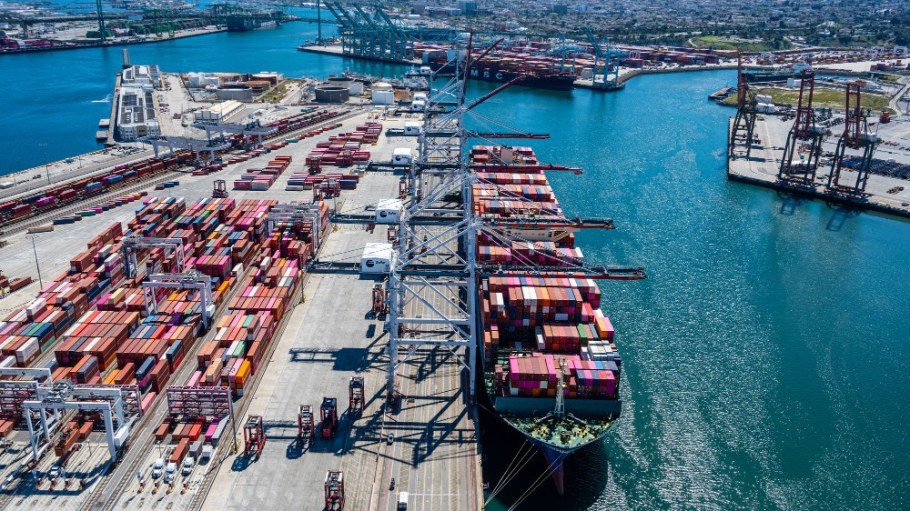
The Port of Los Angeles moved 10.2 million containers last year—its third best year on record—but a wave of fluctuations in global trade prompted executive director Gene Seroka to describe 2025 as “a roller coaster.”
The nation’s busiest port of entry celebrated that distinction for the 26th year in a row. “Every record set and every bar raised is a direct result of the dedication and commitment of the people who make this Port work,” Seroka said during his annual address at AltaSea at the Port of Los Angeles. “Cargo remains the lifeblood of the U.S. economy. American farmers, manufacturers, retailers and consumers all depend on how well we move that cargo.”
Related Stories
“2025 was a year like no other, from accelerated dips in volume to record highs,” Seroka added.
Total twenty-foot-equivalent unit (TEU) movement peaked in July, with 1,019,837 containers loaded for export and unloaded for import—an 8.54 percent increase from the same period in 2024. But results were more mixed throughout the remainder of the year, illuminating the marked impact of undulating increases and decreases in tariff rates on America’s trading partners across the globe.
In May—the month after President Donald Trump announced his sweeping tariff regime, which targeted imports from dozens of countries—the port saw its container volumes drop 4.82 percent from the year-ago period to 716,618 TEUs. The following two months saw year-over-year increases, however, as Trump deferred the tariffs and importers rushed to get shipments on the water.
Over the ensuing months beginning in August, volumes began to fall again, first marginally (0.23 percent) and then accelerating. In September, volumes at the Port of L.A. fell 7.5 percent to 883,053 TEUs. November saw a larger year-over-year drop of 11.5 percent to 782,249 TEUs and December saw a 14.1 percent drop to 791,587 TEUs.
While the end of the year saw an accelerated decline in container volume movement, overall, the total fiscal year saw a 14.07 percent increase from 2024.
Seroka stressed that the port will remain poised an ready to adapt to new challenges in 2026.
“There’s a lot of change in our world right now, the global trade map is being redrawn. Shifting trade policies are creating uncertainty and volatility, and the maritime supply chain is at the center of it all,” he said. “But here’s what hasn’t changed: Cargo remains the lifeblood of the U.S. economy, American farmers, manufacturers, retailers and consumers all depend on how we move that cargo, and that means we this port must be ready for whatever is coming.”
Infrastructure development and technology
In order to meet the demands of the future, the Port of L.A. is upping its capacity, adopting “smarter technology” and continuing to place a premium on sustainability and improving its ecological output, the executive director said.
One key tenet of the port’s “Build Bigger and Build Smarter” investment framework is infrastructure development in anticipation of cargo volume increases. The proposed Pier 500 Marine Container Terminal is an expansion that would significantly increase the Port’s overall cargo capacity. According to Seroka, a request for proposals was issued to vendors and partners in October.
“Pier 500 would be the first new container terminal to be developed at the Port in a generation,” Seroka said. “We envision it to be the greenest, cleanest terminal in the world. It will be an investment in our workforce, sustainability, resilience and innovation—keeping us ready for the opportunities of tomorrow.”
Beyond the terminal, Seroka pointed to infrastructure projects like the Maritime Support Facility, which will be a hub for chassis parking and container pick-up and drop-off located on Terminal Island, as well as an expansion of Fenix Marine Services Terminal on Pier 300 and proposed upgrades to wharf and rail at the L.A. TiL Container Terminal in the West Basin.
A notable point of contrast from the port’s neighbor in the San Pedro Bay complex, the Port of Long Beach, was the focus on expanding a growing cruise business. Seroka noted that the Port of L.A. saw a record-setting 1.6 million passengers on 241 cruise calls.
That business is positioned for future growth, he added. The Outer Harbor at the port is slated to see the construction of a new Cruise Center by Pacific Cruise Terminals, a joint venture between Carrix, Inc. and JLC Infrastructure. “Together, we’ll establish Los Angeles as the primary West Coast gateway for cruising and strengthen our position for decades to come,” Seroka said.
The port is also continuing to invest in technology like its Port Optimizer, Signal and Universal Truck Appointment System, and it plans to expand its truck appointment system to terminals at the Port of Long Beach using an $8 million California GO-Biz grant. This effort will also support data-sharing with five other California ports.
Sustainability
The Port of L.A. saw the lowest emissions report on a per-TEU basis of any port in the world last year, Seroka said.
“We’re moving more cargo than ever before, with the lowest pollution footprint on record for every container shipped,” he said. “This includes priority pollutants that directly affect our local communities, like diesel particulate matter and the critical greenhouse gasses that impact climate.”
The port’s achievements with regard to emissions reduction as well as cargo volume are “verified proof that efficiency and sustainability are not mutually exclusive, but two sides of the same success story,” he added.
With an eye toward driving those gains further, the port is funneling efforts into projects like a collaboration with the South Coast Air Quality Management District to develop zero-emissions infrastructure. Meanwhile, a $412 million EPA Clean Ports grant announced last year (along with $230 million in non-federal funding) will allow the gateway to purchase more zero-emissions equipment for its terminals.
“All this environmental work—the record-low emissions, the groundbreaking agreement with AQMD, the projects on our terminals—is an essential part of our collective DNA,” Seroka said.
The executive director also thanked first responders including the Los Angeles City Fire Department, U.S. Coast Guard, Los Angeles Police Department to a major ship fire that occurred in November, also praising International Longshore Workers Union (ILWU) Local 13, 63 and 94, Los Angeles Port Police, Yusen Terminals, Inc. and the crew of the Ocean Network Express Henry Hudson for preventing fatalities or injuries while also keeping air and water pollution below danger thresholds.