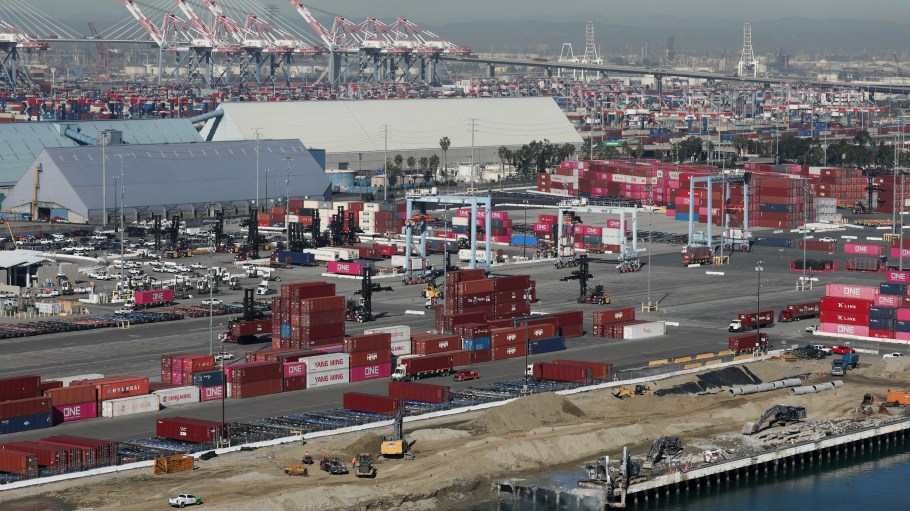
The Port of Long Beach saw cargo handled at the port drop 11 percent from year-ago totals in January, mirroring last month’s 11.9 percent fall in container numbers at its twin gateway, the Port of Los Angeles.
Dockworkers and terminal operators moved 847,765 twenty-foot equivalent units (TEUs) of cargo containers, which remains the port’s best January and second-busiest overall month in its 115-year history.
Imports were down 13.1 percent to 409,818 TEUs and exports rose 0.8 percent to 99,478 TEUs. Empty containers moving through the port declined 11.5 percent to 338,470 TEUs.
Related Stories
In the wake of last year’s record for container throughput despite the widespread tariffs placed on foreign goods entering the U.S., the Port of Long Beach expects a light downturn in 2026.
The port forecasts 9.5 million TEUs to come through its terminals this year, a decrease of 4 percent from 2025’s 9.9 million TEUs.
The all-time highs in 2025 weren’t enough to prevent some sectors from bringing in fewer imported goods cross both San Pedro Bay ports.
Components for apparel at the Long Beach and Los Angeles ports were hit hard in some respects, with knitted or crocheted fabrics seeing an 89 percent decline to 123 metric tons processed, according to Port of Long Beach CEO Noel Hacegaba.
“That isn’t because people lost their love for knitting,” Hacegaba quipped in a Wednesday presentation. “Today, higher prices have forced consumers to be more selective and to purchase more generic items.”
Synthetic fibers were also down 43 percent.
Other commodities experiencing import declines included salt, sulfur and cement (a 21 percent drop), iron and steel (a 32 percent decrease) and toys, games and sports equipment (a 15 percent downturn).
As the ports put 2025 behind them, they will have to maneuver through an uncertain tariff environment in which the Supreme Court ruled President Donald Trump’s IEEPA duties illegal.
While this forced the Commander in Chief to take those “reciprocal” duties off the table, Trump shortly after replaced them with Section 122 tariffs, which were enacted Tuesday and currently sit at 10 percent globally.
“Adding to the uncertainty, it is unclear at this point if this could trigger another cargo surge. We saw this type of front-loading before tariffs were originally enacted and again when tariffs and reciprocal tariffs were briefly paused last year. This time around, importers will have to wait to implement any front-loading activity as factories in Asia are closed for up to two weeks to celebrate the Lunar New Year which started Feb. 17.”
Like its sister port, the Port of Long Beach is seeing more diversity in the origin and destination of its cargo volumes.
While China alone accounted for 70 percent of the volumes at the Port of Long Beach in 2019, including imports and exports, that number has since dropped to 60 percent. Comparatively, the Port of Los Angeles brings in roughly 40 percent of its imported volumes from China, a decline from 60 percent in 2018 when the first Trump administration levied its first tariffs against the country.
When asked whether he thought the tariffs on China would remain lower than their IEEPA counterparts, Hacegaba cited the decline in soybean exports from the U.S. to China as an ongoing concern.
“It’s a trend that I see no reason will stop anytime soon,” said Hacegaba. “My advice to shippers and to those who are navigating these new tariffs and these shifts in trade policy is not to overreact.”
Hacegaba reiterated the Port of Long Beach’s new ambitious long-term goal revealed last month, in which the gateway plans to double its container throughput to 20 million TEUs by 2050. To double its cargo capacity, the port is investing $3.2 billion over the next 10 years to modernize its infrastructure across terminals, roadways, waterways and railroads.
With the buildout of the projected $1.8 billion dollar on-dock rail support facility at Pier B, the port aims to triple its on-dock rail capacity and reduce rail dwell from four days to 24 hours by 2032.
“This is critical to our competitiveness because a manufacturing shift from China to Southeast Asia is adding two to three days of transit time on the water,” Hacegaba said. “Pier B will help us cut three days once the ship arrives to our port and get more product to the nation’s key rail hubs faster.”