Marks & Spencer (M&S) has acquired a warehouse from fellow U.K. retailer Asos as the department store seeks to double its online fashion business.
The fully automated 437,000-square-foot logistics hub in Lichfield, U.K. is expected to become operational by 2027. The warehouse is expected to employ 600 people, according to a company press release.
M&S acquired the space for 67.5 million pounds ($91 million), which is designed to add capacity across the retailer’s distribution network and process orders more quickly to serve customers faster. The company said the warehouse will enable customers to order items online later in the day, while making more sizes and styles available.
Related Stories
“We’ve always said that we’ll deliver our transformation with highly disciplined capital investment, always mindful of spending shareholder money wisely,” said John Lyttle, managing director for fashion, home and beauty at M&S. “This acquisition does just that, delivering tangible business benefits that move our transformation forward, at a much lower cost compared to a new build option.”
According to M&S, supply chain transformation is a strategic priority for the retailer as it reshapes for growth, with shortening the time it takes for product to move from supplier to distribution center and then into stores or customers is a key focus. The company consider the move as another lever to pull to drive online growth and improve profit margin in the long term.
The warehouse acquisition complements M&S’ three-year, 120-million-pound ($160 million) investment in automation to increase capacity and reduce complexity across its supply chain that began last year.
That is part of a much wider overhaul, in which M&S is spending 600 million to 650 million pounds ($806 million to $873 million) on capital investment in the 2025-26 fiscal year of which between 200 million and 250 million ($269 million to $336 million) is being invested in technology infrastructure, store maintenance and upgrades to its logistics fleet.
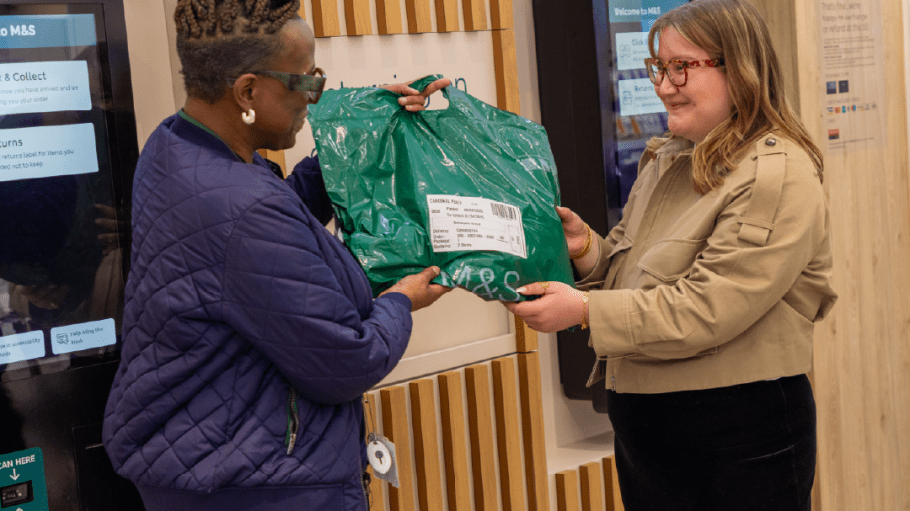
Marks & Spencer has five non-grocery national distribution centers across England, with the company investing in robotics technology designed to speed up sorting “click-and-collect” parcels. The technology has helped extend cut-off times for next-day delivery to nearly midnight.
Further investments at the 900,000-square-foot Central Donington site and another in Bradford will increase the company’s boxed storage capacity by more than 30 percent.
Last November, at its annual shareholder meeting, the retailer unveiled a goal to double online fashion sales over 2025 numbers to roughly 2.8 billion pounds ($3.8 billion) with the help of its automation push.
In its third quarter, M&S saw sales in its fashion, home and beauty segment contract 2.5 percent year over year to roughly 1.3 billion pounds ($1.7 billion). On a comparable store basis, sales declined 2.9 percent.
The unit is the second largest across all Marks & Spencer segments, covering 25.5 percent of sales at the wider business as of the company’s third quarter. The M&S grocery unit is its largest revenue driver, generating 2.7 billion pounds ($3.7 billion) in the three-month period, or 54.5 percent of total sales.
As M&S seeks to expand its supply chain square footage, former owner Asos has taken the opposite approach in recent years to strengthen its balance sheet and cut costs.
The fast-fashion retailer began to sunset the facility in late 2023, with the company saying that over the past three years, improvements in stock turn and the launch of its Asos Fulfillment Services (AFS) in the 2025 fiscal second half have resulted in lower capacity requirements.
“The disposal of our Lichfield fulfillment center represents a further step in strengthening Asos’s balance sheet and improving our capital efficiency,” said Jose Antonio Ramos, CEO of Asos in a statement. “This transaction enables us to unlock value from one of our non-core assets while reducing our ongoing cost base, consistent with the actions we have taken over the past three years to simplify the business and enhance financial resilience. Asos is a well-invested business and we have significant capacity to support future growth. We will continue to maintain a disciplined approach to capital allocation as we execute our strategy.”
In the absence of the Lichfield location, Asos says its two other U.K.-based fulfillment centers in Barnsley and Berlin provide sufficient capacity to support future growth.
Asos also closed an Atlanta-area distribution center in the U.S. in January last year, opting to serve American customers via the automated Barnsley fulfillment center. The closure was expected to cost the fashion seller roughly 190 million pounds ($256 million) in one-off expenses, before freeing up 20 million pounds ($27 million) in cash flow for the 2026 fiscal year.