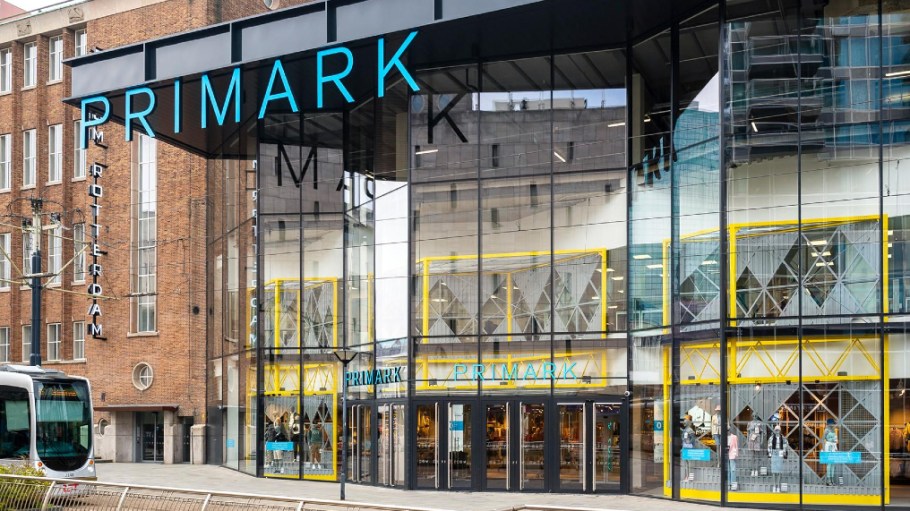
Primark had a solid first-half, with sales strong in both women’s wear and men’s wear.
The value chain saw strength in performance wear, leisure, knitwear and in its Rita Ora collection. Revenue rose 6 percent to 4.5 billion pounds ($5.6 billion) from 4.23 billion pounds ($5.09 billion) a year ago, or up 7.5 percent on a constant currency basis. Adjusted operating profit jumped 45 percent to 508 million pounds ($632.1 million) from 351 million pounds ($422.4 million) last year. New stores contributed 5.4 percent of sales growth, while like-for-like sales rose 2.1 percent, driven by higher average selling prices that were partially offset by slightly smaller basket sizes and correspondingly lower volumes. Foot traffic was about the same as year-ago levels.
Related Stories
The chain has completed its Click + Collect trial in the U.K., which reflected good basket sizes and strong additional store sales. “The trial also demonstrated that the Click + Collect service is satisfying unfulfilled demand from both new and existing customers by offering them extended choice beyond their local store offering,” Primark’s parent Associate British Foods (ABF) said its financial report. “We believe we have developed a bespoke version of e-commerce that is additive to our store-led model, enhances our overall digital engagement program and delivers incremental sales.”
Primark plans to roll out its Click + Collect service to all its stores in England, Wales and Scotland, with a curated product range across women’s wear, kids, men’s wear and a selection of home wear.
The company also is expanding its selling space through new stores. Nine new stores opened in the half, with three each in the U.S. and France, two in Spain and one in Poland. The La Vaguada in Madrid that opened in the period represented the first of four store openings in the city this year. For the second half, Primark plans to enter its 16th market with the opening of its first store in Hungary.
U.K. sales rose 4.3 percent in the half, while sales in the rest of Europe were up 7.9 percent. Sales in the U.S. jumped 38.4 percent, driven by new store openings. The three new U.S. stores were at Woodfield Mall in Chicago, Smith Haven on Long Island in New York, and in Charlotte, N.C. ABF said it opened a new distribution center in Jacksonville, Fla., to serve stores in the southern U.S., and that lease agreements are set for stores in Tennessee, Maryland, and Texas.
“We continue to target 530 stores by the end of 2026 and have visibility for continued footprint expansion beyond,” ABF said.
As for its digital strategy, traffic to Primark’s websites rose in all markets in the half, with record traffic levels over Christmas. On average, 20 percent of visitors use the site’s stock checker option, which ABF said contributed to “meaningful support to sales.”
ABF said group revenue for the half ended March 2 rose 2 percent to 9.73 billion pounds ($12.1 billion), or up 5 percent on a constant currency basis, with adjusted operating profits rising 39 percent to 951 million pounds ($1.18 billion).
“This is a very strong set of financial results, as we are now benefitting from the restoration of some normality in our markets and in our supply chains,” ABF CEO George Weston said. “Improvements to the Group’s operational performance, driven by the investments and strong execution over the last few years, are now becoming visible.”
Weston said that while geopolitical risks remain and the consumer has yet to fully emerge from cost-of-living pressures, ABF is well positioned to deliver good returns to shareholders. The company said it expects Primark to continue to perform well in the back half due to store expansion and modest like-for-like growth.
“While the consumer environment remains soft, we expect to benefit from the strength of our value proposition, our product relevance and category stretch and our increasingly effective digital engagement,” ABF said. “We expect a moderate improvement in adjusted operating margin in Primark in the second half compared to the first half, albeit with a step-up in investment to support medium-term growth.”
Primark’s adjusted operating margin was 11.3 percent for the period, versus 8.3 percent a year ago. The adjusted operating margin excludes one-time items. Primark’s expected margin for the full year was targeted at above 10 percent.