Just two months after China’s ports saw a severe slowdown in activity as U.S. importers took a wait-and-see approach to President Donald Trump’s tariffs, business is booming again.
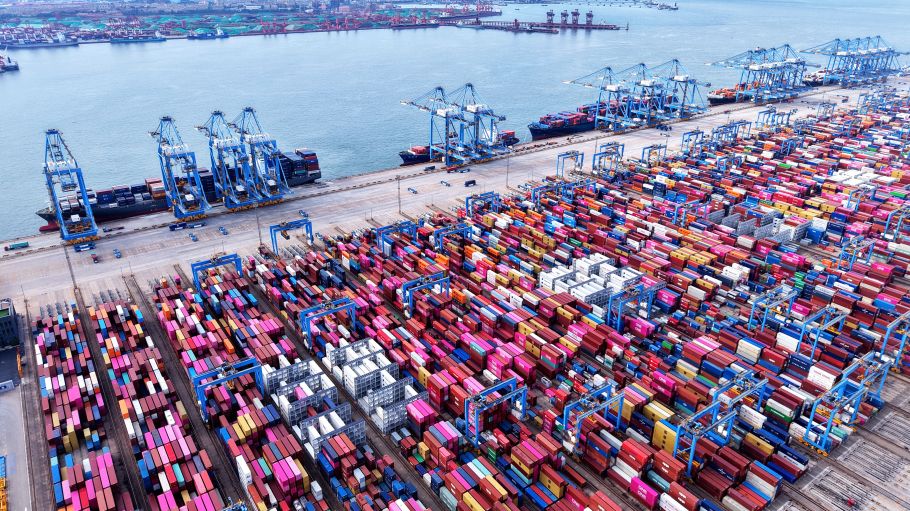
Seaports across China had their busiest week on record from June 16-22, with roughly 6.7 million 20-foot equivalent units (TEUs) shipped domestically and internationally out of ports including Shanghai, Ningbo, Shenzhen and Xiamen among many others.
That marks a 5.9 percent increase from the week prior, with total cargo tonnage increasing 5.6 percent to 263.8 million tons, according to data from China’s Ministry of Transport.
Related Stories
The strong numbers follow this month’s trade truce between China and the U.S. that brought combined tariff levels down to 55 percent on Chinese goods. Prior to the deal which is still yet to be formally approved by either Trump or Chinese President Xi Jinping, China’s exports to the U.S. had a rough two months.
In April, when the tariffs were first announced and escalated as high as 145 percent, shipments of Chinese goods to the U.S. dropped 21 percent annually to $33 billion. The next month saw a more pronounced plunge of 34.5 percent to $28.8 billion—China’s largest export decline in five years.
The U.S. is likely not the only driver of the overall jump, as Chinese exporters have also been shipping goods in droves to Southeast Asian countries like Vietnam, Thailand and Malaysia, all of whom have their own tariff negotiation deadlines to adhere to with the U.S. by July 9.
The record movement of containers moved appears to bode well for dockworkers at the West Coast ports of Los Angeles and Long Beach, which were impacted by fewer job opportunities when Chinese exports to the U.S. sank.
A CNBC report on Tuesday said that another wave of ocean freight is on its way to the San Pedro Bay ports that would mark the highest number of container ships since January, according to the Marine Exchange of Southern California. On Friday, 64 vessels are expected to arrive at the twin ports, while another 68 should flow in Saturday. Sunday’s incoming vessel total is expected to be 64.
And while blank sailings on the trans-Pacific trade lane were common through the tariff turbulence, they’re expected to decrease in the coming weeks. Port of Long Beach CEO Mario Cordero told CNBC he expects 18 blank sailings at his port in June, but that this number is slated to fall dramatically to four across July and August combined.
Although the current projections indicate a return of more stable traffic to California ports, there remains no guarantee that the excess cargo out of China will continue to stay elevated throughout the summer, even as the traditional peak shipping season approaches. Across all U.S. ports, the Global Port Tracker had forecast inbound cargo volumes to remain below last year’s numbers for the summer, but that came out ahead of June’s trade truce resumption.
“The initial demand surge post the May 12 China-U.S. de-escalation and ahead of the Aug. 12 deadline for the reduced U.S. tariffs on China may be behind us,” said Judah Levine, head of research at Freightos. “At the same time, carriers, expecting a stronger and more prolonged trans-Pacific container volume spike, have increased capacity on the lane by 13 percent compared to March and early April.”
Freight rates from China to the U.S. already appear to have hit their seasonal peak earlier this month amid the reports of container capacity outpacing new demand.
A Monday analysis from container shipping research firm Linerlytica indicated that the Shanghai Containerized Freight Index (SCFI) rolled back all gains it made in the past three weeks as trans-Pacific rates collapsed due to the excess capacity.
As of Friday, the Shanghai-to-U.S. West Coast rate plummeted 33 percent on a weekly basis to $2,772 per 40-foot container, just after a 27 percent drop the week prior.
“Freight rates to the U.S. West Coast have recorded their largest weekly losses in the last two weeks as their failure to retain any of their June 1 rate hikes have also put the peak season surcharge for contract customers at risk,” said the Linerlytica update. “The early end to the trans-Pacific peak season have not yet dragged down rates on the secondary routes that remain supported by buoyant cargo volumes, while charter rates also remain firm with very limited open tonnage.”